


Here is a publication-ready draft built on public, traceable data.
Groundwater Stress in Chennai: A Ward-Level Analysis of Extraction, Recharge, and Urban Growth
Chennai’s groundwater story is usually told as a citywide crisis. That is only partly true. The sharper reality sits below that headline. Groundwater stress in Chennai is not uniform. It is intensely local, shaped by where a ward sits in the urban fabric, how much open land it has lost, what water bodies still survive nearby, how much piped water has reached it, and whether the aquifer below it is threatened not just by depletion but by salinity and contamination. The city has 200 wards across 15 zones, and it now has a ward-level monitoring system to watch groundwater move. What it still does not have, in the public domain, is a comparable ward-level ledger of how much groundwater is being extracted. That gap matters. It forces any honest ward-level analysis to triangulate between depth-to-water data from Chennai Metro Water, district and city groundwater assessments from the Central Ground Water Board and the State, and the geography of recharge assets such as marshes, lakes, tanks, drains and open land. That is enough to see the pattern clearly. It is also enough to see where the city’s water governance is still flying half-blind.
Start with the hard numbers. In the 2025 district-wise groundwater assessment for Tamil Nadu, Chennai district recorded total annual groundwater recharge of 9,796.45 hectare-metres, annual extractable groundwater resources of 8,917.30 hectare-metres, and total annual groundwater extraction of 10,854.47 hectare-metres. That put Chennai’s stage of groundwater extraction at 121.72 percent. In plain language, the city extracted more groundwater than the aquifer could sustainably offer. The CGWB’s resource-assessment framework defines the stage of groundwater extraction as the ratio of annual groundwater extraction to annual extractable resource. Chennai is therefore not merely stressed. It is operating beyond the safe line. The major-cities compilation for 2024 told the same story from another angle, listing Chennai’s stage of extraction at 124.89 percent. The overdraw is not a one-year anomaly. It is structural.
That is why the city’s groundwater cannot be read simply through summer panic or post-monsoon relief. The aquifer does respond to rainfall. Chennai Metro Water’s digital water level recorders, installed in all 200 depot locations, showed that the city’s average groundwater level improved from 5.59 metres in the pre-monsoon period to 2.95 metres in the post-monsoon period in 2023, a rise of 2.64 metres. The same monitoring architecture, built out across all 200 divisions, was explicitly designed to make groundwater depth visible at a fine local scale. That is good news, but only up to a point. A seasonal rise after monsoon does not cancel chronic over-extraction. It simply shows that recharge is possible when rainfall is captured and when the aquifer still has room to recover. Chennai’s problem is not that recharge never happens. It is that recharge remains episodic while extraction pressure is constant.
This is where the ward lens changes the story. The public data gives ward-wise monthly groundwater depth. It does not give ward-wise extraction volumes, tanker abstraction, private borewell withdrawals, or commercial pumping by locality in a clean public table. So the most defensible way to read groundwater stress at ward level is to combine three things: first, observed depth-to-water; second, the ward’s recharge context, meaning its relation to lakes, marshes, tanks and stormwater pathways; and third, the kind of urban growth occurring there. Look at the city that way and Chennai breaks into four broad groundwater geographies. They overlap, but they are distinct enough to matter for policy.
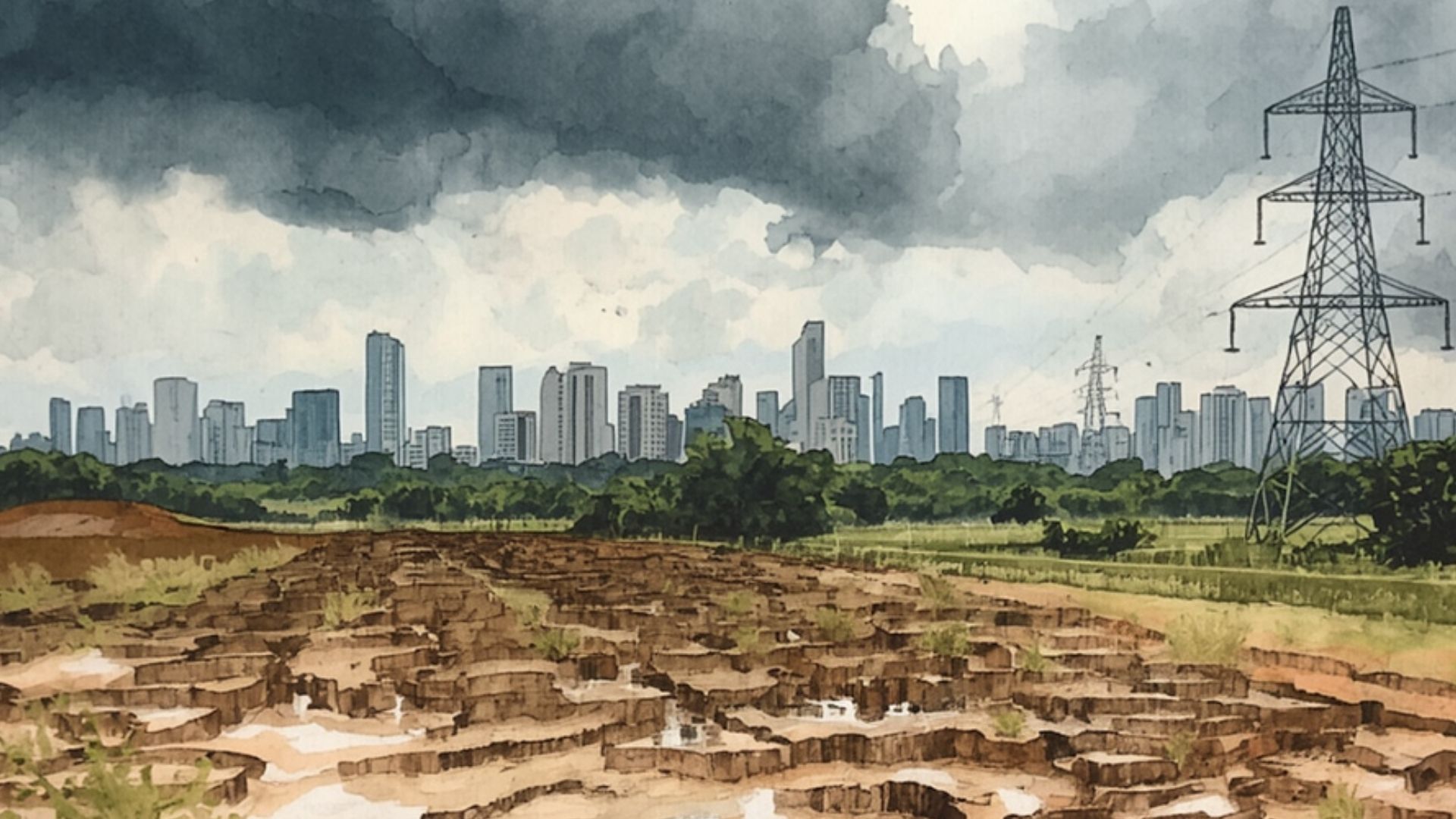
The first is the southern and southeastern growth belt, especially the wards in and around Perungudi, Sholinganallur, Pallikaranai, Velachery, Madipakkam and the wider OMR corridor. These are the wards where the groundwater conversation cannot be separated from wetland loss. Pallikaranai Marsh drains a catchment of about 250 square kilometres in South Chennai and encompasses 65 wetlands. Official climate planning documents note that the marsh, which once spread over roughly 5,000 hectares, had shrunk to around 600 hectares by 2006. More recent state material records the designated Ramsar site as 1,248 hectares, combining the existing reserve forest and adjoining wetland area. This is not background scenery. It is the city’s recharge and retention system. When urban expansion hardens land in this belt, groundwater recharge does not simply decline in the abstract. It becomes physically harder for rain to enter the ground in the places where the aquifer most needs it. That is why these wards often live with a brutal contradiction: floodwater in the monsoon, groundwater anxiety in summer.
That same southern arc carries another risk. It is coastal, low-lying, fast-growing and increasingly impervious. Recent research on the South Chennai coastal region links urban sprawl and rising imperviousness to higher seawater-intrusion vulnerability in littoral aquifers, while broader studies have concluded that urbanization and seawater intrusion are already affecting groundwater quality in South Chennai’s coastal districts. The city’s own aquifer documentation also flags seawater intrusion as a live threat. This matters because a ward can have groundwater and still not have secure groundwater. In the coastal south, stress is not only about depth. It is also about quality. Once salinity enters the system, the economic and ecological cost of reversal rises sharply.
The second groundwater geography is the dense inner city: wards in central and older built-up zones such as Teynampet, Kodambakkam, Royapuram, Thiru-Vi-Ka Nagar and the compact residential-commercial core. Here the issue is less dramatic but no less serious. These wards typically have far less open land, fewer functioning local tanks, and a much higher proportion of paved surface. They may depend more on the piped system than fringe wards do, but that does not mean groundwater has ceased to matter. It still acts as a backup source, a buffer for apartment complexes and institutions, and a hidden part of the city’s resilience in water-short periods. The push to construct 23,000 catchpits in roadside drains under Chennai’s flood-management program is revealing. The city is, in effect, admitting that large parts of the paved core no longer recharge enough on their own and now need engineered infiltration points just to return some stormwater to the aquifer. That is not a small adjustment. It is an urban water diagnosis.
The third geography lies in North Chennai and the industrial coast, especially wards in Tiruvottiyur, Manali, Tondiarpet, Royapuram’s northern edge and the Ennore belt. In these wards, groundwater stress is as much about what is in the water as how much of it is left. The Chennai aquifer-system report identifies several linked threats: seawater intrusion, groundwater mining for the city, contamination from landfill sites and contamination from industrial activity. North Chennai’s coastal aquifer has also been the subject of more recent geophysical and geochemical work aimed at delineating saline intrusion zones. So a shallow well in the north is not automatically an asset. Its value depends on whether the water is usable. This distinction is often missed in citywide debates. Groundwater availability and groundwater security are not the same thing. In some northern wards, the crisis is not only scarcity. It is compromised quality.
The fourth geography is the western and northwestern expansion belt, in wards across Ambattur, Madhavaram, Valasaravakkam, the Anna Nagar fringe and other zones where former peri-urban land has been absorbed into the city. This is where Chennai’s metropolitan growth is colliding with its recharge logic. CMDA records that the Chennai Metropolitan Area was expanded from 1,189 square kilometres to 5,904 square kilometres in 2022, and its planning documents still project the region’s population reaching 14.8 million by 2035. Growth at that scale almost always means more roads, more layouts, more apartment clusters, more warehousing and more surface sealing unless actively checked. Studies on Chennai’s water bodies and flood system show that upstream tanks still store significant water and materially reduce hazard. One recent assessment found that if those upstream water bodies were lost to urbanisation, flood damages could rise by 44 percent and the population at risk by 40.5 percent in a comparable extreme event. That is a flood statistic, yes. But it is also a groundwater statistic in disguise, because tanks, ponds and marshes are not only flood buffers. They are recharge infrastructure. Remove them and the city loses both storage above ground and infiltration below it.
Seen together, these four geographies expose the central weakness in how Chennai still talks about groundwater. The city usually asks whether the monsoon was good, whether reservoirs are full, whether desalination is running, whether tanker prices are rising. Those questions matter, but they are not enough. Groundwater stress in Chennai is really a land-use problem wearing a water mask. Wards that lose permeable ground, tanks, temple ponds, marsh edges or drainage connectivity steadily lose recharge capacity even before their borewells run dry. Wards that continue to rely on private abstraction while piped supply lags create a second layer of pressure. Coastal wards then add a third problem, salinity. The result is not one crisis. It is several, stacked on top of one another.
The city has not been passive. Rainwater harvesting remains mandatory in Chennai. CMWSSB’s current rules and citizen charter say buildings seeking new water and sewer connections must have proper rainwater-harvesting arrangements, and the requirement applies across premises, including existing ones. Metro Water and the Corporation are also investing in recharge-linked stormwater measures, while the wetland and flood programs now speak much more openly about recharge than they did a decade ago. Those steps matter. They have measurable effects, especially after strong monsoon years. But Chennai’s own numbers show that the city is still drawing groundwater beyond sustainable limits. That should end any temptation to confuse policy presence with policy success. Mandates on paper are not the same thing as recharge on the ground.
It is also true that formal water supply expansion can ease groundwater pressure in some wards. Metro Water reported record daily supply of 1,240 MLD in 2025, with additional piped coverage reaching areas that had historically depended more heavily on tankers and groundwater, including Perungudi, Sholinganallur, Manali and Madhavaram. That is a meaningful shift. A ward with more reliable piped water will often lean less on borewells, at least for domestic demand. But this transition is incomplete, and it does not automatically solve commercial or institutional extraction. Nor does it repair the recharge deficit created by years of hardscaping and wetland loss. New supply buys time. It does not rebuild aquifers.
So what does a serious ward-level groundwater strategy for Chennai actually look like? First, the city needs to publish ward-wise extraction proxies, not just ward-wise depth-to-water. That means mapping private tanker loading points, commercial borewell permissions, large-campus abstraction, and groundwater-intensive construction activity alongside the existing monitoring network. Second, recharge planning has to follow hydrogeology, not just road geometry. Catchpits are useful, but they cannot substitute for protected marshland, functioning lake chains and unsealed recharge corridors. Third, land-use approvals in fast-growing wards should be tied to local groundwater budgets, not merely citywide service assumptions. A ward sitting on the edge of Pallikaranai or over a vulnerable coastal aquifer should not be treated the same way as a ward with stronger piped-water redundancy and better recharge conditions. Fourth, quality monitoring has to sit beside quantity monitoring, especially in the north and along the coast. A rising water table is not a success if the water is saline or contaminated.
The larger point is simple. Chennai does not have a groundwater problem in the abstract. It has a ward problem. Some wards are overbuilt. Some are under-recharged. Some are salinity-prone. Some are still waiting for the piped network to become reliable enough to reduce dependence on borewells. Some sit next to the city’s last recharge landscapes and are steadily urbanising right up to their edge. If the city keeps treating all of that as one undifferentiated water shortage, it will continue to misread both the risk and the remedy. The data now exists to do better. What is missing is not warning. It is granularity in governance. Until Chennai starts budgeting groundwater ward by ward, it will keep bouncing between two familiar images: streets under water in December, and empty borewells by June.
If you want, I can turn this into a magazine-style version with a stronger opening scene and a more narrative flow, while keeping the same evidence base.

