


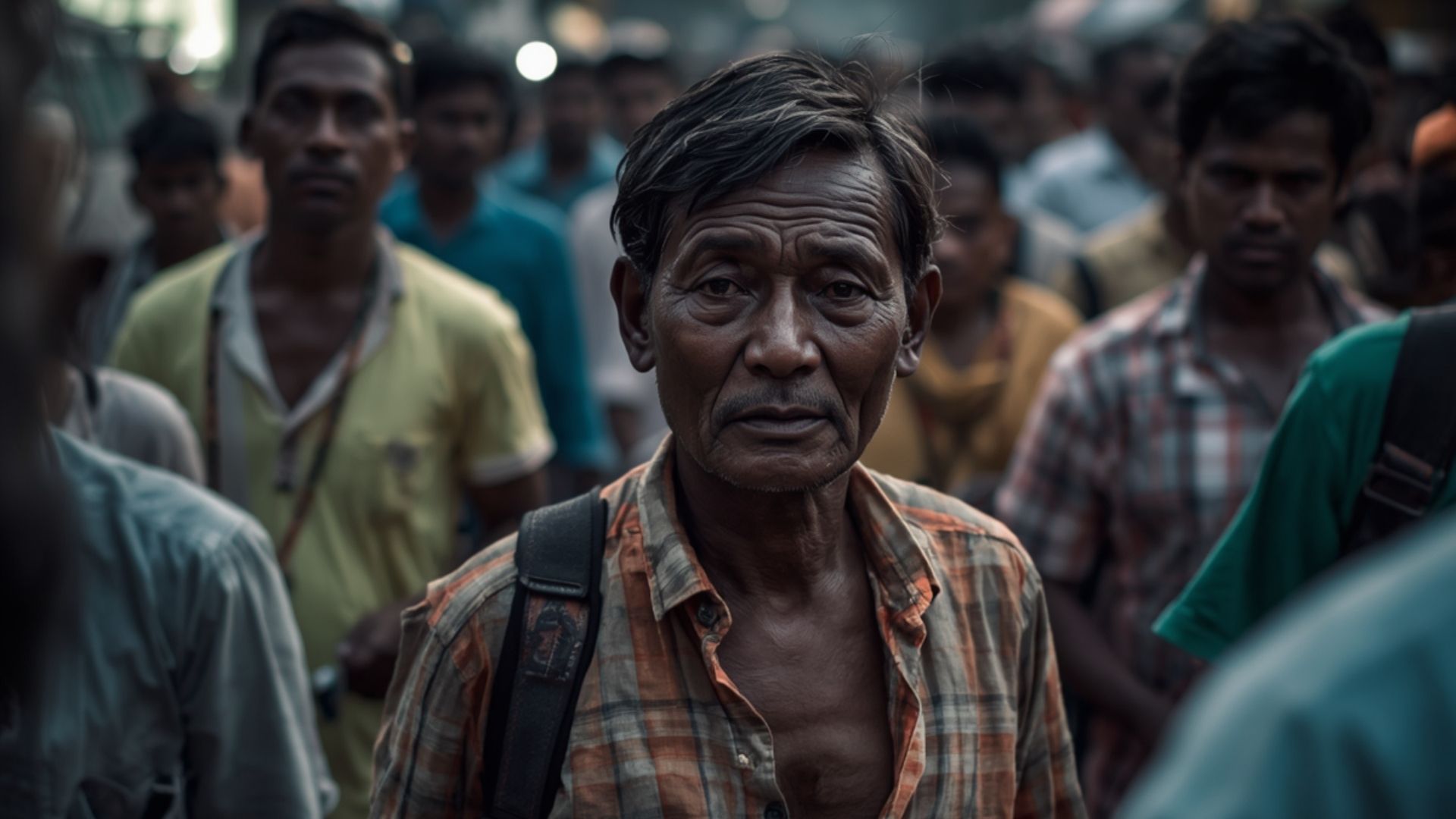
The City That Runs on Borrowed Labour: Migration, Immigration and the Making of Modern Chennai
Chennai does not run only on the people born here. It never has.
From the dockworkers of colonial Royapuram to the Odia masons raising apartment towers in Sholinganallur, the city has long been built, serviced and expanded by people who came from elsewhere. That is not new. What is new is the scale. The numbers are larger, the networks are more complex and the economic dependence is harder to ignore.
The 2011 Census recorded 4.64 million people within Greater Chennai Corporation limits and 8.65 million across the Urban Agglomeration. By 2025, estimates for the wider metropolitan region placed the population at roughly 12 million. That figure includes a floating population that rarely appears properly in official counts. The 2021 Census, delayed by the pandemic is still unavailable. In its absence, the clearest picture comes from scattered sources: sector studies, government registration systems, transport data and academic fieldwork. Taken together, they point to one conclusion. Chennai is deeply dependent on people who travel long distances to do work that many local residents no longer want, or are no longer able, to do.
The 35-Lakh Estimate: What the Numbers Actually Say
In 2020, the Tamil Nadu government launched an Inter-State Migrant (ISM) registration portal, the first such effort by any Indian state to systematically map incoming migrant labour at scale. By July 2025, the portal had recorded 12.17 lakh registered guest workers across Tamil Nadu. Odisha accounted for the highest number at 2.89 lakh, followed by Bihar at 2.51 lakh, Jharkhand at 1.95 lakh and West Bengal at 1.91 lakh. Assam and Uttar Pradesh also contributed significant numbers, with 93,175 and 91,497 workers respectively.
But the 12 lakh figure is almost certainly too low.
Broader estimates suggest that around 35 lakh inter-state migrant workers are employed across Tamil Nadu’s 38 districts, spread across construction, mining, hospitality, manufacturing, textiles and retail. Even the state government has effectively acknowledged that the portal captures only part of the picture. Officials have said that at least 80 per cent of the migrant workforce would need to be covered for the database to become meaningfully representative. In August 2025, the government floated a tender for a more comprehensive statewide survey.
That gap, between 12.17 lakh registered workers and an estimated 35 lakh actually present, is not just an administrative shortfall. It reflects how informal labour works in India. Workers move frequently. Many have no contracts. They share rooms with strangers, change worksites without notice, and often fear that registration could bring scrutiny rather than protection.
Chennai district itself has recorded 1.29 lakh registered ISM workers. That places it behind Tirupur, Kancheepuram and Coimbatore. Yet that number almost certainly misses large segments of the migrant workforce in the city. Construction labourers, domestic workers, street vendors, app-based delivery workers, hotel staff, mechanics and helpers often remain outside formal databases. Older census data gives some sense of the scale. In 2001, out of 2.93 million migrants in Chennai, 61.5 per cent came from other parts of Tamil Nadu, 33.8 per cent from the rest of India, and 3.7 per cent from outside the country. More recent proxy data based on non-suburban passenger arrivals suggests continued inflows from Karnataka, Kerala and Andhra Pradesh, even though the largest visible stream now comes from northern and eastern states.
Nationally, the picture is even starker. India has an estimated 600 million internal migrants. That makes internal migration one of the largest population movements anywhere in the world. One in three urban Indians is a migrant. Between 2001 and 2011, the migrant stock in India rose from 31.4 crore to 45.5 crore, an increase of 45 per cent in just one decade.
What They Do: Sector by Sector
Construction
Construction remains the single largest employer of inter-state migrant workers in India, and Chennai’s urban expansion has made that dependence unmistakable. In Tamil Nadu, manufacturing, construction and textiles together account for more than 80 per cent of employment among registered inter-state migrants. At the national level, reports estimate that about 15 million migrants work in construction.
In Chennai, the evidence is visible everywhere. On high-rise sites in Sholinganallur and Perumbakkam, on road projects, on metro expansion corridors, the workforce is dominated by men from Bihar, Jharkhand and Odisha. Researchers writing in the International Journal of Innovative Research in Management Finance in 2024 found that many of these workers lived on site, cooked for themselves worked through holidays and operated without written contracts. One labourer from Bihar described a life that barely extended beyond the worksite. They stayed there, cooked there, ate there, and worked late whenever possible to earn a little more. The study, based on interviews with 149 migrant workers across six locations in the Chennai region, found that the older middleman-driven recruitment model had weakened in some places, but insecurity had not.
This matters because construction is already under pressure. Across India and the wider Asia-Pacific region, the sector is facing a serious labour shortage. Costs are rising. Demand remains strong. In India, the issue is not a lack of unskilled hands. The shortage is sharper higher up the chain. Builders need experienced masons, welders, electricians, shuttering carpenters and formwork specialists. Chennai’s real estate market increasingly depends on those trades, and they are not easy to replace.
Domestic Work
Domestic work is a different story, but no less important.
Chennai’s domestic worker economy employs an estimated hundreds of thousands of women. It remains one of the least protected forms of labour in the country. In November 2025, the Government of India consolidated 29 older labour laws into four labour codes. Domestic workers were absent from all of them. A petition before the Madras High Court, filed by domestic worker unions seeking recognition of minimum wages, was not entertained. In practice, that leaves pay, timing, leave and treatment to the discretion of individual employers.
Most domestic workers in Chennai are Tamil women. Many are intra-state migrants from districts such as Villupuram, Tiruvannamalai and Cuddalore. Some commute long distances each day. Others live inside the homes where they work. Many take on multiple houses at once, stitching together an income from three or four separate households. The sector runs almost entirely on verbal agreements. There are no contracts, no real social security protections, little paid leave, and almost no legal recourse. Wages are determined through private bargaining and usually fall well below what similar hours might earn in more formal occupations.
Information Technology and Services
At the other end of the labour market, Chennai’s IT and services economy faces a very different kind of shortage.
Along the OMR corridor, especially in Sholinganallur, Perungudi and Siruseri, companies are not struggling to find workers in general. They are struggling to find workers with the right capabilities. A ManpowerGroup survey published in January 2025 found that 80 per cent of employers in India were having difficulty finding suitable skilled talent. That figure had remained stubbornly high since 2022 and sat above the global average of 74 per cent. In South India, the number was even higher at 85 per cent.
So the problem is not volume alone. India produces huge numbers of engineering graduates every year. The problem is fit. Employers repeatedly point to a gap between academic qualification and actual workplace readiness. One senior IT executive put it plainly: fresh graduates are often not job-ready, which means companies must spend heavily on communication and technical training before they become useful on the floor. The same pattern appears in newer fields. India’s AI and machine learning talent pool, estimated at 416,000, currently meets only 49 per cent of demand. By 2027, the country could face a shortfall of more than one million professionals in those areas.
Then there is attrition. Chennai’s BPO and IT services sector loses people quickly. Customer support and BPO roles often see annual attrition rates of 25 to 35 per cent, driven by repetitive tasks, night shifts, burnout, limited career growth and the constant presence of alternative jobs. Many firms are not hiring to expand. They are hiring just to replace the people who left last month.
Garments, Manufacturing and Catering
While Tirupur dominates Tamil Nadu’s garment story, Chennai and its surrounding industrial belt are also heavily reliant on migrant labour. Tirupur district alone accounts for more than 1.22 lakh ISM workers in textiles and garments, along with 72,463 workers in manufacturing. Kancheepuram district has 1.61 lakh registered workers. Across the registered ISM base in Tamil Nadu, 41,723 workers are employed in catering establishments, dhabas, hotel kitchens and canteens that feed factory workers, transport workers and construction crews across the wider urban region.
These sectors rarely attract the same public attention as IT or real estate. But they are central to the city’s daily functioning. Without them, everything slows down.
The Language Flashpoint and the Social Tension
Migration into Tamil Nadu has always carried some friction. In 2018, and again in 2022, viral videos claiming that Hindi-speaking workers were being harassed or exploited in Tamil Nadu triggered intense political argument. They also exposed a deeper anxiety. If large numbers of migrant workers left suddenly, several parts of the state’s economy, especially construction, would struggle almost immediately.
The Tamil Nadu State Planning Commission’s report, Life and Times of Migrant Workers in the Chennai Region 2024-25, addressed this directly. It noted that a large share of migrants in the Chennai region came from Bihar, Odisha and Assam, and that many were living and working in precarious conditions only marginally above the poverty line.
Language is one source of tension, but it is not always a wall. On many sites, supervisors speak Tamil to contractors and a rough working Hindi to labourers. Some contractors rely on men from Bihar or Odisha to act as intermediaries and site supervisors. That helps work move faster. It also creates fresh hierarchies inside already fragile labour chains.
There is a political dimension too. Many migrant workers in Tamil Nadu remain tied electorally to their home states. For a worker from Bihar earning a low daily wage in Chennai, travelling more than 2,000 kilometres home to vote is often impossible. Leave is hard to get. Transport is expensive. Missing work can mean lost wages and debt. As Tamil Nadu heads into the 2026 Assembly election cycle, that tension is becoming harder to ignore. Migrants are central to the economy, yet weakly represented both where they came from and where they now live.
The Welfare Delivery Problem
Tamil Nadu’s ISM portal is often described as a model. In some ways, it is. But it also reveals the scale of the administrative challenge.
As of 2024, nearly 293 million workers had registered on India’s centralised e-Shram portal. Yet it remains unclear how inter-state migrants will be specifically identified, tracked and served through that system. Reliable migration data is still patchy. Detailed migration tables from the 2011 Census are not publicly available in the form many researchers need. The 2021 Census is delayed. The NSSO does not produce regular, dedicated migration data at the frequency required for planning.
For workers on the ground, these gaps translate into everyday exclusion. A labourer living in Ambattur may still be tied on paper to a village address in Bihar. A domestic worker in Manali may be unable to access local welfare because her documentation remains linked to Odisha. This affects ration access, healthcare eligibility, housing support and, more broadly, recognition by the state.
The One Nation One Ration Card scheme has eased part of this burden. Nationally, it has recorded more than a billion transactions since launch. Even so, its effectiveness depends on awareness, portability, local implementation and the ability to locate workers who move frequently between worksites and rented rooms.
The electoral system has similar blind spots. The 2025 SIR voter roll revision removed roughly 40 per cent of registered voters from several Chennai constituencies, including Villivakkam, Anna Nagar and Velachery. Migrant tenants were especially vulnerable. Many were marked as having shifted residence because they were not at home when booth-level officers visited. Some were at work. Others had moved recently. Many simply disappeared from the rolls. It is one more way in which economic dependence coexists with civic invisibility.
The Labour Shortage is Now Structural
Chennai is short of workers. Not in one sector, and not for one temporary reason. The shortage now runs across the economy.
In construction, the problem is the shrinking supply of experienced labour, especially workers with practical trade skills. In domestic work, the issue is different. The work is poorly paid, socially undervalued and left outside meaningful labour protection. In IT, the shortage is concentrated in specialised domains such as AI, machine learning, cybersecurity and advanced analytics. The city needs all of these workers at once, and in numbers it cannot easily secure.
That is why migration is no longer a side story in Chennai’s growth. It is central to it.
Across India, migration itself is changing. Older drivers remain in place: rural distress, crop failure, debt, low farm incomes and seasonal unemployment. But new motivations have grown stronger. Families move for children’s education. Young workers leave home for mobility, exposure and the possibility of building something beyond subsistence. Some are no longer simply escaping hardship. They are chasing opportunity.
Yet the conditions waiting for them in Chennai are still shaped by informality, weak legal protection and distance from power. They build the city, clean it, feed it, code for it, deliver for it and care for its households. Still, many remain only loosely visible in planning documents and political language.
That may be the city’s biggest blind spot.
These are not merely temporary workers passing through. Many are settling. They are enrolling children in schools, entering local voter rolls, forming neighbourhood networks and creating social worlds that connect Chennai to villages in Odisha, Bihar, Jharkhand and beyond. In the most literal sense, modern Chennai has been assembled from elsewhere.
The question now is whether the city is willing to admit that plainly.
Because once that truth is faced, the policy implications become unavoidable. Housing, schooling, healthcare, transport, labour rights, welfare portability and political representation all begin to look different. So does the story Chennai tells about itself. Whoever forms the next government after the April 23 election will have to deal with that reality, whether it appears in the manifesto or not.
Sources: Tamil Nadu government ISM portal data (July 2025); Tamil Nadu State Planning Commission report, Life and Times of Migrant Workers in the Chennai Region 2024-25; India Economic Survey 2016-17; Census of India 2011; Periodic Labour Force Survey 2021-22; ManpowerGroup 2025 Talent Shortage Report; Statista Migration in India series; National Herald India (October 2025); DT Next (August 2025); IJIRMF (2024); World Bank; UN Population Division.

