Tamil Nadu has set itself a target of 33 per cent forest and tree cover, and a ten-year sapling drive to get there. The Forest Survey of India’s latest count puts the state at 24.47 per cent. Measured in land, the gap is about 11,000 square kilometres, and the official numbers show how slowly it is closing.
The numbers
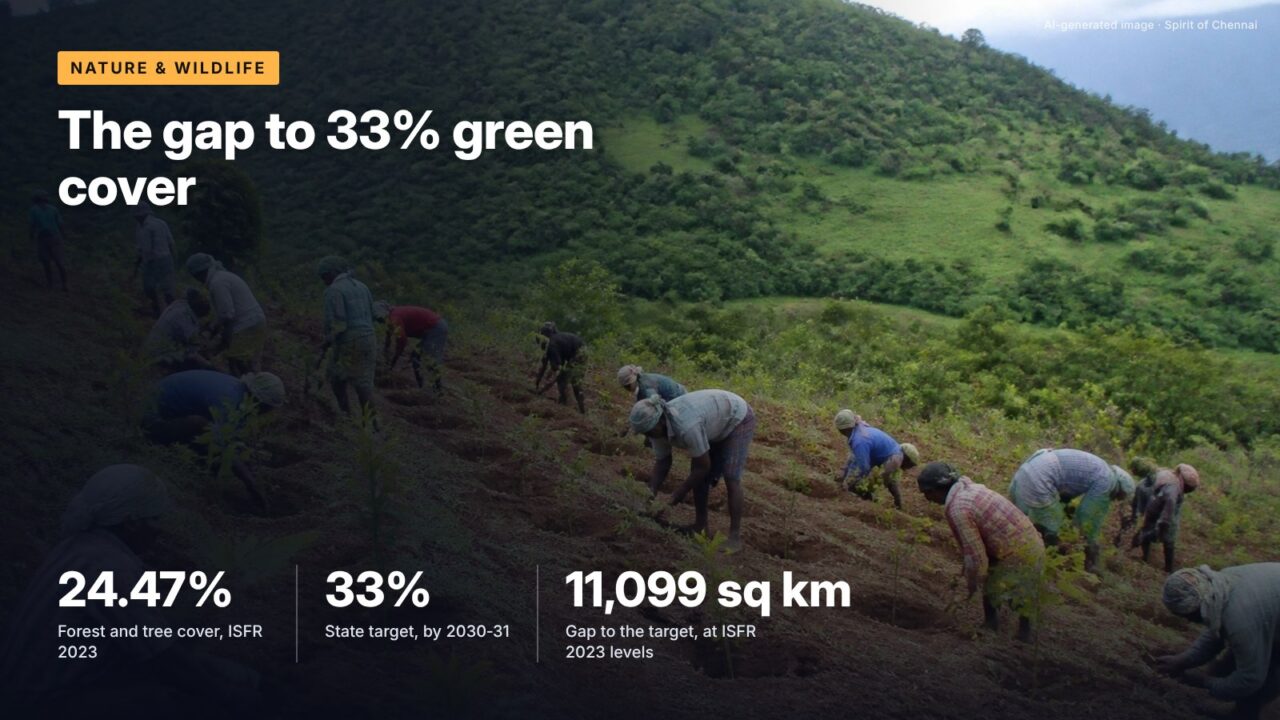
Tamil Nadu had 26,450 sq km of forest cover and 5,371 sq km of tree cover outside forests in the Forest Survey of India’s India State of Forest Report (ISFR) 2023, the forest department’s state profile records. Together that is 31,821 sq km, or 24.47 per cent of the state’s area. The target of the Green Tamil Nadu Mission is 33 per cent.
Using the state area of 1,30,060 sq km given in a 2023 environment department order, 33 per cent is 42,920 sq km. Subtracting the 31,821 sq km already counted leaves about 11,099 sq km, more than a third of all the forest and tree cover the state has today. The order dates the target to 2030-31 and ties it to the National Forest Policy.
What the mission is
The Green Tamil Nadu Mission (Pasumai Thamizhagam) is run by the forest department from Panagal Maaligai in Saidapet as a ten-year programme. Its site describes 260 nurseries in 43 forest divisions, a State Green Committee and district green committees for protecting and managing trees, and free saplings for people who want to plant on their own land.
Getting those saplings is done online. On the TNAGRISNET people’s app, a resident registers with a mobile number, files a seedling request with land details and the number wanted, and the district forest office processes it. The page states no upper limit and lists no species.
What the mission’s counters say
The mission’s own counters are hard to read. For the 2022-23 planting year the site shows a target of 2.5 crore and an achievement of 2.8 crore. A banner elsewhere says 1.18 crore seedlings have been raised, and the About section says 73 lakh seedlings were raised and handed to the agriculture department. A further block shows a target of 260 under a crore heading, which looks like the nursery count placed in the wrong box. None of these figures is a year-by-year count of saplings planted and surviving, which is the number the target depends on.
What the satellite counts show
The independent check is the ISFR, which the Forest Survey of India publishes every two years. The November 2023 order quoted the previous edition; the forest department profile quotes the latest.
| Measure | ISFR 2021 | ISFR 2023 | Change |
|---|---|---|---|
| Forest cover (sq km) | 26,419 | 26,450 | +31 |
| Tree cover (sq km) | 4,424 | 5,371 | +947 |
| Total (sq km) | 30,843 | 31,821 | +978 |
| Share of state area | 23.8% | 24.47% | +0.67 points |
Source: ISFR 2021 figures as quoted in G.O.(D) No. 215, Environment, Climate Change and Forest Department, 10 November 2023; ISFR 2023 figures from Tamil Nadu Forest Department state profile. Totals and changes are simple arithmetic
Nearly all the gain between the two reports came from tree cover outside forests, the category that captures farm trees, avenue planting and urban trees. Forest cover proper rose by only 31 sq km. That is consistent with a programme that hands saplings to farmers and institutions rather than planting inside reserve forests, though the ISFR does not attribute its changes to any scheme.
Growth in Tamil Nadu’s tree cover outside forests between ISFR 2021 and ISFR 2023, against +31 sq km for forest cover; figures from G.O. 215 and the forest department profile.
How long the gap would take
A rough calculation shows the scale. If cover kept growing at the ISFR 2021 to 2023 pace of about 978 sq km every two years, closing an 11,099 sq km gap would take about 11 more reports, or more than 22 years. That would land well after 2030-31. The arithmetic is crude. Saplings planted in 2022 will add to measured cover only as they grow, so the next one or two reports may show faster gains if survival is good. Losses to roads, housing and industry run in the other direction.
The website figure of 23.69 per cent, and the 23.7 per cent used on the sapling app, appear to reflect an earlier base. Both sit close to the ISFR 2021 figure of 23.8 per cent, which shows how much the target’s starting point matters to any claim of progress.
The industrial groves scheme
Alongside the free saplings, the state has asked industry to plant. G.O.(D) No. 215 of 10 November 2023 launched the 1000 Kurunkadugal scheme, also called the Tamil Nadu Kurunthoppu Thittam, under which industrial units create a thousand micro plantations of native trees. The Tamil Nadu Pollution Control Board was to prepare the detailed proposal. The order sets no state budget: the groves are to be paid for and maintained entirely from the industries’ own funds.
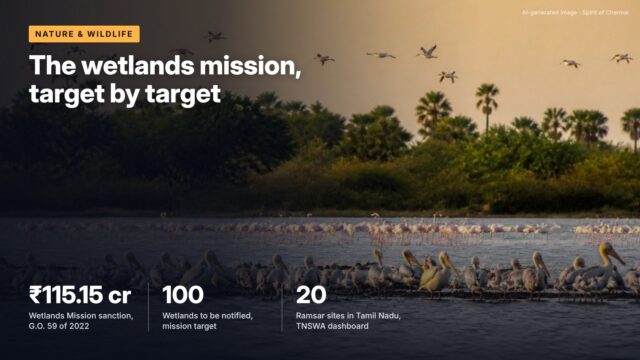
The green cover drive is one of several environmental missions the state runs through its forest and environment departments. The Tamil Nadu Wetlands Mission was sanctioned ₹115.15 crore in 2022, and the Coastal Restoration Mission was announced in 2021 as the state’s fourth climate mission. Mangrove and coastal shelterbelt planting under the coastal programme can also add to measured cover.
It’s often said planting crores of saplings raises green cover by the same measure almost at once.
The record shows Between ISFR 2021 and ISFR 2023, measured forest and tree cover rose by 978 sq km, or 0.67 percentage points of the state’s area. Saplings count only once they have grown into trees the survey can see, and survival rates are not published on the mission site.
What this means for you
- Chennai residents with private land, schools and housing societies can request free saplings through the TNAGRISNET app; the district forest office handles the request.
- Removing or pruning trees in Chennai needs permission from the green committee route, so planting now also means accepting those rules later.
- Watch the tree cover outside forests line in the next ISFR: it is where the mission’s planting would show up first.
- Industries near Chennai may be asked to take up native groves under the Kurunkadugal scheme at their own cost.
What to watch
Pending
The next India State of Forest Report, which will show whether tree cover outside forests kept rising after 2023.
2030-31
The year G.O. 215 gives for reaching 33 per cent green cover; at ISFR 2023 levels that needs about 11,099 sq km more.
Pending
A published year-by-year count of saplings planted and surviving under the mission.
Checked against official sources on 23 October 2026. Figures and rules change; confirm on the linked official pages before relying on them.
Sources
- Green Tamil Nadu Mission, Tamil Nadu Forest Department
- Tamil Nadu State Forest Profile: Status of Forest (ISFR 2023), Tamil Nadu Forest Department
- G.O.(D) No. 215, 10 November 2023, Environment, Climate Change and Forest Department (1000 Kurunkadugal scheme)
- Free tree sapling registration, Tamil Nadu Forest Department, TNAGRISNET
- G.O.(Ms) No. 59, 25 March 2022, Tamil Nadu Wetlands Mission (TNSWA copy)
- Tamil Nadu Coastal Restoration Mission, Tamil Nadu Green Climate Company