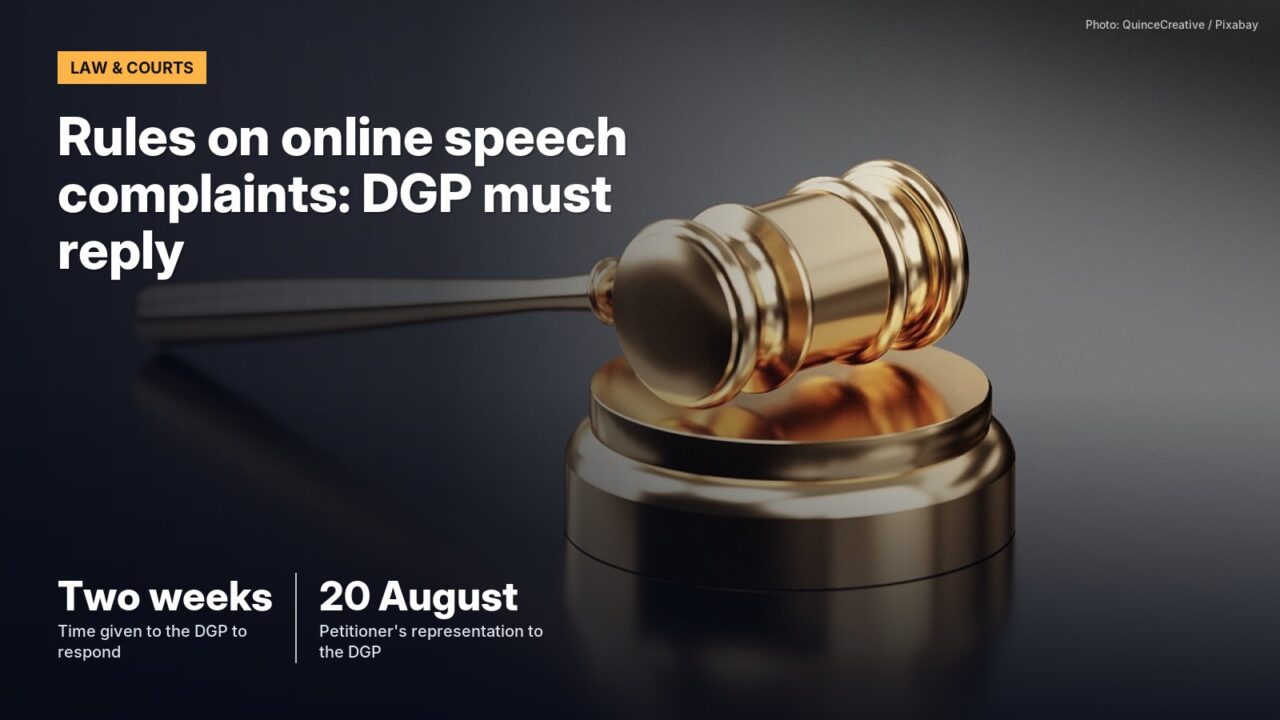
The Madras High Court has given the Director General of Police two weeks to answer a plea for written rules on how police handle complaints about social media posts.
Two weeks. That is how long Chief Justice S.A. Dharmadhikari and Justice G. Arul Murugan gave the State’s top police officer on 11 November, when a public interest petition asking for a Police Standing Order on online speech came before their Division Bench.
The petition, filed by a Chennai advocate, wants the DGP to issue a standing order or circular setting uniform safeguards for every police station, cyber crime unit and investigating officer who receives a complaint over a social media post, political criticism or satire. It does not ask the court to stop the police from registering cases. The petitioner’s own framing keeps the duty to register and investigate cognisable offences intact, and asks only for careful scrutiny of such complaints before anyone is arrested or otherwise coerced.
The State says an SOP is already being drafted
Additional Public Prosecutor Arun Anbumani told the Bench that two similar petitions are pending before a single judge of the High Court. He also told the court that the State has begun drafting a standard operating procedure. Neither the draft nor a timeline for it was placed before the court on Wednesday.
So the DGP’s reply, due in two weeks, will be the first written account of what the police propose. It will have to sit alongside the two single-judge cases, and the Bench may yet decide whether all three are heard together.
The complaint is about arrests that come before scrutiny
The petition argues that police in Tamil Nadu often register cases and make arrests over online remarks without first checking whether the person complaining is actually aggrieved, or whether the complaint is legally maintainable at all. It says arrests are sometimes used to harass people under political pressure. In legal terms, the petitioner says, this breaks Article 14 (equality before the law) and Article 21 (life and personal liberty), and chills the freedom of speech and expression guaranteed by Article 19(1)(a) of the Constitution. The petition cites recent cases against speakers from more than one side of the State’s politics.
The advocate had first written to the DGP with a representation on 20 August, asking for such guidelines, before going to court.
What a standing order would change at the station
A Police Standing Order binds officers across the State in a way an individual court order does not. If one is issued, a sub-inspector in a Chennai cyber crime cell and one in a district station would be working from the same checklist when a complaint about a post on X or a YouTube speech lands on the desk. The petition leaves the content of that checklist to the DGP. It asks for safeguards, not a list of protected or banned speech.
The hearing will resume after the DGP files his response.
For Context
The petition leans on Telangana. On 10 September 2025 the Telangana High Court quashed a case over posts critical of that State’s ruling party and laid down guidelines for police dealing with complaints about social media posts and political speech. Among them: verify that a complainant in a defamation matter has standing; hold a preliminary inquiry before registering an FIR for speech; register a case only where there is prima facie material of incitement to violence, hatred or public disorder; avoid automatic arrests; and close complaints that are frivolous or politically motivated. The Telangana government challenged the judgment. On 2 February 2026 a Bench of Justices J.B. Pardiwala and Vijay Bishnoi of the Supreme Court dismissed that challenge, leaving the guidelines in force in Telangana. Tamil Nadu has no equivalent written order for its police yet.
Checked against official sources on 13 November 2026.