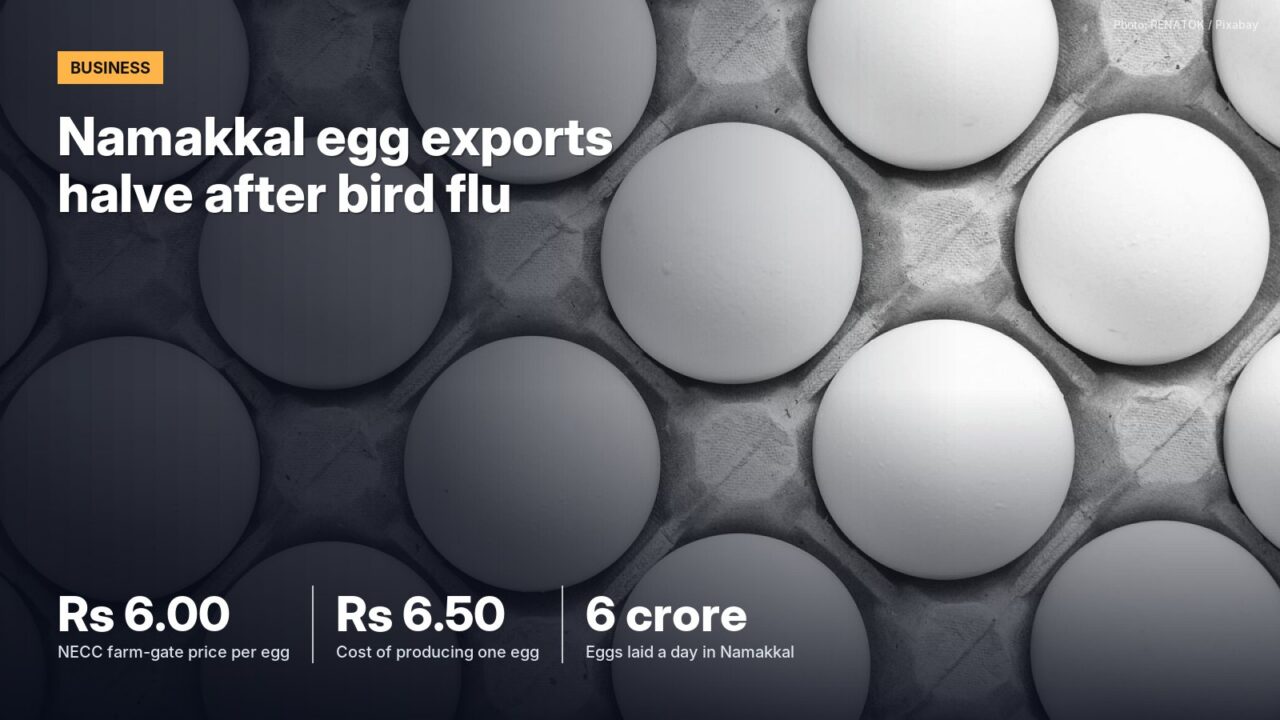
Namakkal’s egg exports have fallen by half again since bird flu was found in Cuddalore, and the farm-gate price is now below what it costs to produce an egg.
Six rupees an egg. That is the National Egg Coordination Committee’s Namakkal farm-gate price after three cuts in five days, and farmers put their cost of production at about Rs 6.50. Every egg sold at that price loses money.
The cuts came on 11, 13 and 15 November, by 20, 25 and 25 paise, taking the price down from Rs 6.70. They followed the outbreak of H5N1 avian influenza among broiler birds in Cuddalore district, and the cancellations that came with it.
Buyers in the Gulf pulled out first
Importers in the United Arab Emirates, Oman and South Africa have cancelled orders over fear of infection, Namakkal (நாமக்கல்) exporters say. Exports have fallen by about half since the Cuddalore report. They were already down. Until about six months ago the belt was shipping roughly 25 crore eggs a month; that slid to about 15 crore after the war between Iran and Israel, before this latest halving.
Vangili Subramaniam, president of the Tamil Nadu Egg Poultry Farmers Marketing Society, warned that shipping even a few crore eggs this month could prove difficult and that farmers would take heavy losses if prices fell further.
K Singaraj, chairman of the National Egg Coordination Committee, puts the slowdown down to more than bird flu. Exports, he said, had already shrunk to around 30 per cent of the usual volume because of high shipping costs and transport disruptions. At home, the Kanda Sashti fast and the start of the Sabarimala pilgrimage season keep many households off eggs at this time of year. He expects prices to recover in the coming days.
Farmers say Namakkal is free of the virus
The birds that died in Cuddalore were broilers, raised for meat. Namakkal is a layer belt: more than 1,000 farms keeping hens for eggs, laying about 6 crore eggs a day between them. Farmers there say strict hygiene has kept the district free of bird flu, and they have tightened it again, with regular disinfection, a bar on outsiders entering sheds, and disinfectant sprayed on feed lorries before they come in.
The farmers’ worry is the next fortnight: if prices keep slipping while exports stay shut, the losses on each egg add up quickly across a belt that lays crores of them a week.
The timing is odd for the trade. Egg prices usually stay firm at this time of year on seasonal demand, which is why three cuts in five days stand out.
There is no stockpile to fall back on. Farms are not holding eggs, so a cancelled export order means eggs pushed into a domestic market that is already soft.
For anyone buying eggs in Chennai, the State’s public health directorate has said in an earlier advisory that bird flu rarely passes from birds to people and that the small risk is to those who handle sick or dead birds. Its advice is to avoid undercooked eggs and poultry and to call the 104 health helpline with flu-like symptoms after contact with sick birds.
For Context
The buyers who cancelled this month are in the UAE, Oman and South Africa. Six months ago monthly exports were near 25 crore eggs. The fall to about 15 crore came first, after the conflict between Iran and Israel; the Cuddalore outbreak has halved what was left. The farm-gate price, set by the NECC for the Namakkal zone, stood at Rs 6.70 before the first cut on 11 November and at Rs 6.00 after the third on 15 November.
Checked against official sources on 18 November 2026.
Sources
- National Egg Coordination Committee (NECC), daily egg prices, Namakkal zone
- Directorate of Public Health and Preventive Medicine, Tamil Nadu: advisory on avian influenza, 5 February 2026
- Department of Animal Husbandry and Dairying, Government of India (avian influenza)