The 74th Amendment promised cities a list of 18 functions and the money to run them. In Chennai, an elected council of 200 controls some of that list outright, shares some with state boards and has no say over the rest. The audit record shows where the lines fall.
The numbers
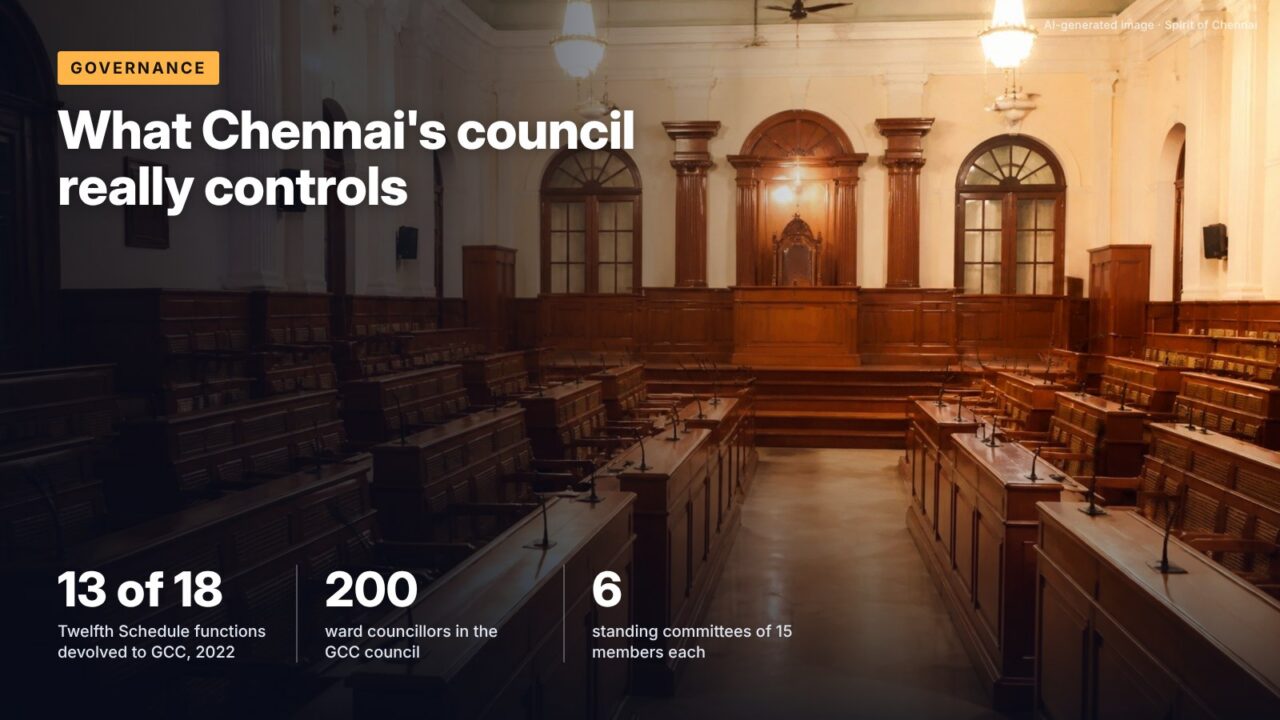
As of October 2022, the Greater Chennai Corporation had 13 of the 18 functions listed in the Constitution’s Twelfth Schedule devolved to it, according to the CAG’s Report No. 1 of 2024 on local government in Tamil Nadu. The same paragraph notes that water supply for the Chennai Metropolitan Area is run by the Chennai Metropolitan Water Supply and Sewerage Board, a statutory body outside the council’s control.
That gap between the constitutional list and the city’s actual powers is the heart of the 74th Amendment debate. The CAG’s statewide performance audit of the Amendment, tabled in the Assembly on 24 March 2022, found that on paper all functions except fire services had been transferred to corporations and municipalities, yet parastatals still ran key services, planning bodies had not been formed and transfers fell short of what was recommended.
What the 74th Amendment requires
The 1992 Amendment added Part IXA to the Constitution. It requires elected municipalities with five-year terms, reservation of seats, ward committees in larger cities, a State Finance Commission every five years to review municipal finances, and district and metropolitan planning committees. Its Twelfth Schedule lists 18 functions a state may devolve, from urban planning and roads to water supply, public health, slum improvement and fire services. Crucially, the states decide how much to hand over, which is why the result differs so much between cities.
Who runs what in Chennai
| Function | Who runs it in Chennai | Basis |
|---|---|---|
| Roads and storm water drains | GCC | CAG flood audit, Report No. 4 of 2017 |
| Water supply and sewerage | CMWSSB, a statutory board | CAG Report No. 1 of 2024, para 1.3 |
| Urban and land-use planning | CMDA prepares the master plan | CAG Report No. 4 of 2017 |
| Fire services | State Fire and Rescue Services; GCC released ₹2.68 crore to it for 2011-15 | CAG 74th Amendment audit; Report No. 1 of 2024, para 1.11.3 |
| Conservancy and public health | GCC (₹259.67 crore conservancy salaries, 2024-25) | GCC Budget 2026-27 |
| Elementary schools and breakfast scheme | GCC, with a ₹20 crore state grant budgeted | GCC Budget 2026-27 |
Source: CAG of India reports (2017, 2022, 2024); Greater Chennai Corporation Budget 2026-27 at a glance
Police, traffic, the metro rail and suburban buses sit with state or central agencies and are not on the Twelfth Schedule list at all, though they shape daily life in every ward.
How the council itself is organised
According to the corporation’s council page, the council consists of the Mayor and 200 ward councillors, across 15 zones grouped into three regions. It works through six standing committees of 15 members each: taxation and finance; works; health and family welfare; town planning; education (parks and playfields); and accounts and audit. Each of the 15 zones has a ward committee made up of its councillors, which elects a chairman. The council meets every month, and its legal basis is still the Chennai City Municipal Corporation Act of 1919, as amended.
In its 2024 report the CAG recorded GCC’s statement that its appointment, standing and other committees were in place and met monthly. That had not always been true: the 74th Amendment audit found that the previous council’s term expired on 24 October 2016 and no urban local body elections were held for years afterwards, pending a ward delimitation case in the Supreme Court, so ward committees could not be formed.
Development charges and open space reservation money collected by CMDA and DTCP that had not been passed to urban local bodies, per the CAG’s 74th Amendment audit.
The money test
Functions mean little without funds. The 2026-27 GCC budget shows own revenue of about ₹3,666 crore against revenue spending of ₹6,146 crore, so the council depends on state decisions for roughly 40 per cent of its running costs. Its formula share of state taxes is fixed by G.O.(Ms) No. 60 of 2023: 16 per cent of the urban pool, with 18 per cent of that routed directly to Metro Water. The council does not set that formula; the State Finance Commission recommends it and the government decides.
The CAG’s statewide audit found the pattern across Tamil Nadu: fiscal transfers formed about 40 per cent of urban body revenue, a share of assigned revenue went to the state-run TURIF fund rather than directly to local bodies, and ₹1,323.60 crore of performance grants for 2017-18 to 2019-20 had not been received. Staff were short too: staff in position fell from 0.69 to 3.78 per 1,000 people (on 2011 population) to 0.55 to 3.35 per 1,000 (on 2019 population), and in three of the four corporations tested only 69 of 244 sanctioned revenue-section posts were filled, which directly limits how much tax a council can collect.
It’s often said the Mayor and council run Chennai.
The record shows They run a large part of it, but not water, planning, fire, police or transit. The CAG found 13 of 18 constitutional functions devolved to GCC in 2022, and its earlier audit found district and metropolitan development plans had not been prepared, the main tool the Amendment gives cities to shape regional planning.
The missing metropolitan planning committee
Article 243ZE asks for a metropolitan planning committee in every metropolitan area, with at least two-thirds of its members elected from among municipal and panchayat representatives, to draft a development plan for the region. The CAG reported in 2022 that district and metropolitan development plans had not been prepared. In practice, regional planning for Chennai remains with the CMDA, a state authority, which is why decisions on land use, flood plains and new towns are taken outside the council chamber.
What this means for you
- For roads, drains, garbage, street lights and property tax, your councillor and zonal office are the right first call.
- For water and sewer lines, approach Metro Water; for building approvals in large projects and land use, CMDA.
- Ward committees exist at zone level; their meetings are where ward-level priorities can be raised.
- Money decides power: the State Finance Commission’s formula affects your ward’s works more than most council resolutions.
What to watch
Pending
The Seventh State Finance Commission’s report, which will set the devolution formula for the next five years (see tnsfc.tn.gov.in).
Pending
Any move to constitute a metropolitan planning committee for the Chennai region, which the CAG found missing.
Checked against official sources on 23 October 2026. Figures and rules change; confirm on the linked official pages before relying on them.
Sources
- Report No. 1 of 2024, Compliance Audit (Local Government) for the year ended March 2022, Government of Tamil Nadu, CAG of India
- Press brief: Performance Audit on Implementation of the 74th Constitutional Amendment Act, CAG of India (Tamil Nadu), 2022
- About the Council, Greater Chennai Corporation
- Budget 2026-27 at a glance, Greater Chennai Corporation, 2026
- G.O.(Ms) No. 60, Finance (SFC-MC), 28 February 2023: Sixth State Finance Commission recommendations, Government of Tamil Nadu
- Report No. 4 of 2017, Performance Audit of Flood Management and Response in Chennai: Chapter 5, Drainage System, CAG of India
- Seventh State Finance Commission, Tamil Nadu (official website)