Tamil Nadu still has a law that bans liquor in principle, the Prohibition Act of 1937. After the Kallakurichi spurious liquor deaths in June 2024, the state rewrote its penalties. What the amendment changed, what it left untouched, and how the law is enforced.
The numbers
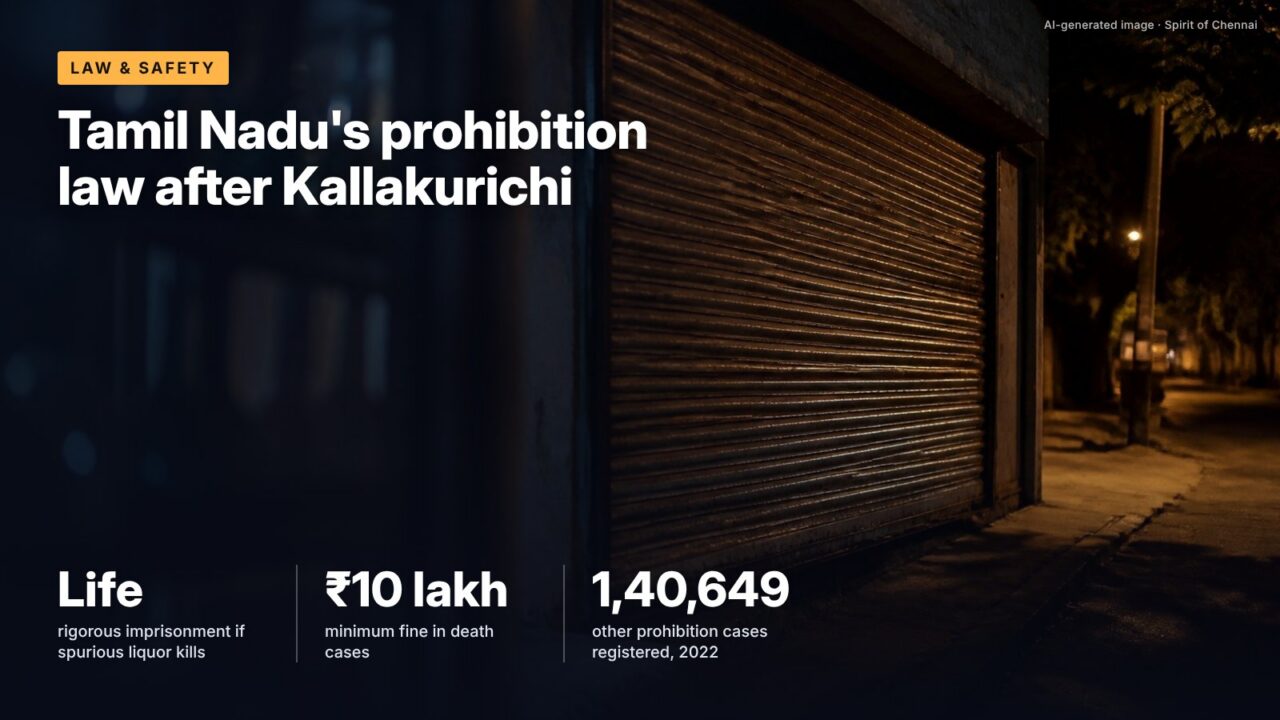
Under the Tamil Nadu Prohibition (Amendment) Bill, 2024, anyone whose illicit liquor causes a death faces rigorous imprisonment for life and a fine of at least ₹10 lakh. The Bill, L.A. Bill No. 29 of 2024, was introduced in the Assembly on 29 June 2024 by Minister S. Muthusamy, days after the National Human Rights Commission took suo motu cognizance of reports that more than 47 people had died after drinking spurious liquor in Kallakurichi district.
The amendment raised penalties across sections 4, 5, 6, 7 and 11 of the Tamil Nadu Prohibition Act, 1937, allowed sealing of unlicensed drinking places and confiscation of any movable property used in an offence, and added good-behaviour bonds and wider externment for habitual offenders. The consolidated text hosted by PRS lists amending Acts through Act 35 of 2024.
How a prohibition law coexists with liquor sales
The 1937 Act is built as a general ban with exceptions. Section 4 prohibits importing, transporting, manufacturing, bottling, selling, buying and consuming liquor, which the Act defines broadly to include toddy, arrack, spirits, wine, beer and any liquid containing alcohol. Legal sale and consumption happen through licences and permits issued under the Act: section 20, for example, allows permits for personal consumption and licences for institutions to supply permit holders, and section 21-A levies sales tax on foreign liquor sold to permit holders. Every legal bottle is an exemption from the ban; every other bottle is an offence.
That structure explains the revenue line in the budget. State excise is budgeted at ₹14,164 crore in 2026-27, up from an actual ₹11,055 crore in 2024-25, about 6 per cent of the state’s own tax revenue, according to PRS Legislative Research. Sales tax charged on liquor is booked under a different head, so total liquor revenue is larger than the excise figure.
What the 2024 amendment changed
| Section | Before 2024 | Under the 2024 Bill |
|---|---|---|
| 4(1-A)(i): illicit liquor causing death | Not reproduced in the Bill | Rigorous imprisonment for life; fine not less than ₹10 lakh |
| 4(1-A)(ii): other cases under the clause | Not reproduced | Rigorous imprisonment 5 to 10 years; fine ₹5 to 10 lakh |
| 4(1)(A): clauses (aaa), (b), (f), (h), (i) | Mostly up to 2 years and/or fine up to ₹5,000 (consolidated Act) | Rigorous imprisonment 3 to 7 years; fine ₹2 to 3 lakh |
| 5 | Up to 3 years; fine up to ₹10,000 | Rigorous imprisonment 3 to 7 years; fine ₹2 to 3 lakh |
| 6 | Up to 6 months; fine up to ₹1,000 | Rigorous imprisonment 2 to 5 years; fine ₹1 to 2 lakh |
| 11 | Up to 6 months; fine up to ₹500 | 1 to 3 years; fine ₹50,000 to ₹1 lakh |
| 24-D: compounding | ₹1,000 to ₹10,000 | ₹10,000 to ₹25,000 |
Source: Tamil Nadu Legislative Assembly, L.A. Bill No. 29 of 2024; Tamil Nadu Prohibition Act, 1937 consolidated text (PRS)
The Bill also widens the definition of “place” in section 3(12) to cover houses, sheds, shops, tents, booths, vehicles, carts and vessels, so a car or a boat used as a bar now counts. Public intoxication remains a separate offence under section 4-A, with minimum terms rising from six months and ₹750 for a first offence to a year and ₹1,500 for a third.
New section 5-A lets a prohibition officer or an officer not below the rank of tahsildar seal any unlicensed place where liquor is consumed, for up to three months, with notice within 48 hours, a decision on representations within seven days and an appeal to the Collector within 30 days. Section 52-AA lets an executive magistrate bind a person convicted under sections 4, 5 or 7 who habitually breaches the peace to a good-behaviour bond for up to three years.
The compounding range for many prohibition offences in the substituted section 24-D, even though the Bill’s statement of objects says these offences should be made non-compoundable.
A contradiction worth checking
The Bill’s statement of objects and reasons says offences should be made non-compoundable, meaning they could not be settled by paying a sum. Yet the substituted section 24-D, as printed in the Bill, still allows offences under sections 4(1)(A) to (C), 4(1-A), 5, 6, 7 and 52-E to be compounded, at a higher range of ₹10,000 to ₹25,000. Whether the enacted text kept this wording should be confirmed against the gazetted Act; the Bill on its own does not resolve it.
How the law is enforced
The Prohibition Enforcement Wing of the state police registered 105 cases involving spurious liquor in 2022 and seized 37,217 litres of rectified spirit and 4,682 bottles of spurious liquor, according to the Police Policy Note 2023-24. It registered a further 1,40,649 cases under other heads and arrested 1,39,697 people, 11,828 of them women. It seized 2,957 vehicles, 2,646 of them motorcycles, and auctioned 4,493 vehicles for ₹9.7 crore. The prohibition helpline, 10581, received 3,275 complaints that year.
It’s often said Tamil Nadu repealed prohibition when it started selling liquor.
The record shows The 1937 Act is still in force and was amended again in 2024. Legal sales operate as licensed exemptions from a law that otherwise bans liquor, which is why possession or sale outside those licences remains a criminal offence.
The new penalties apply to offences after the amendment took effect, not to cases already under trial. Most enforcement numbers in the policy note pre-date the amendment, so the first full-year figures under the new law will come in later notes.
What this means for you
- Buying or carrying liquor outside licensed channels is an offence under the 1937 Act, and the 2024 penalties are far higher than before.
- Vehicles and other movable property used for illicit liquor can now be confiscated under section 14, and unlicensed drinking places can be sealed under section 5-A.
- Report illicit liquor to the prohibition helpline 10581; the wing logged 3,275 complaints in 2022.
- If an unlicensed place you own is sealed, the law gives you seven days for a decision on your representation and 30 days to appeal to the Collector.
What to watch
Pending
Prosecutions and convictions under the new section 4(1-A) life-term provision, which will show whether the higher penalties are being applied.
Pending
Prohibition Enforcement Wing figures for 2024 and 2025 in the next Police policy note, the first to cover the amended law.
Checked against official sources on 23 October 2026. Figures and rules change; confirm on the linked official pages before relying on them.
Sources
- L.A. Bill No. 29 of 2024, Tamil Nadu Prohibition (Amendment) Bill, Tamil Nadu Legislative Assembly (copy hosted by PRS)
- Tamil Nadu Prohibition Act, 1937 (Act X of 1937), consolidated text with amendment list (PRS)
- NHRC takes suo motu cognizance of reported deaths after consuming spurious liquor in Kallakurichi district, National Human Rights Commission, 25 June 2024
- Policy Note 2023-24, Police (Demand No. 22), Home, Prohibition and Excise Department, Government of Tamil Nadu
- Tamil Nadu Budget Analysis 2026-27, PRS Legislative Research, 2026