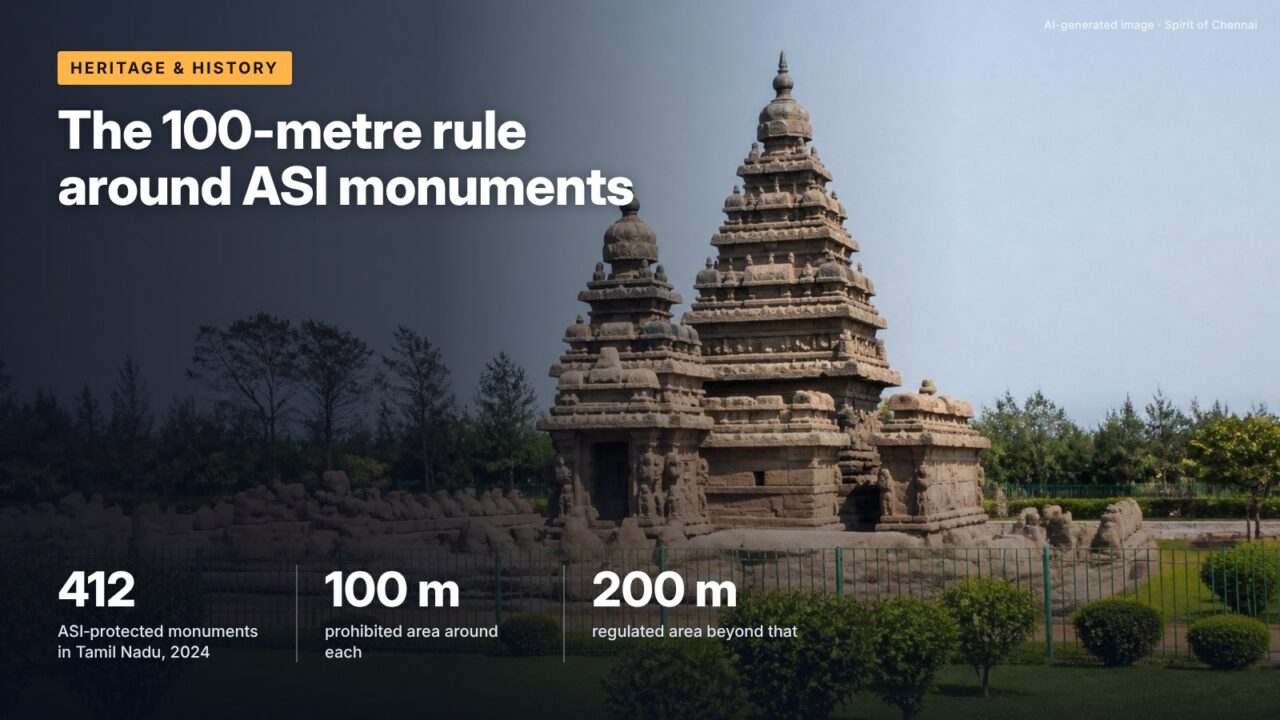
Tamil Nadu has more centrally protected monuments than most states, and every one of them carries an invisible fence: 100 metres where new building is barred and 200 metres more where any change needs Delhi’s advice. The 2010 law behind it is strict on paper and slow in practice.
The numbers
The Union Culture Ministry told the Lok Sabha on 2 December 2024 that Tamil Nadu has 412 monuments and sites protected under the Ancient Monuments and Archaeological Sites and Remains (AMASR) Act, out of 3,697 nationally. The state’s own archaeology policy note for 2024-25 counts 411 ASI monuments, made up of 251 historical monuments and 160 archaeological sites, alongside 108 that the state protects itself. The two counts differ by one, which is typical of lists that are updated through separate notifications.
For anyone who owns land near one of them, the numbers that matter are 100 and 200. Within 100 metres of the protected limit, new construction is not allowed. In the next 200 metres, any construction, reconstruction, repair or renovation needs prior permission.
What the law says
The zones were written into the Act by the AMASR (Amendment and Validation) Act, 2010, which received the President’s assent on 29 March 2010. Section 20A defines the prohibited area as at least 100 metres in all directions from the monument’s limit, and Section 20B defines the regulated area as a further 200 metres. The Centre may extend either distance. Only archaeological officers may build in the prohibited area; the narrow exception for essential public works may not be used for any permission granted on or after the assent date.
The amendment also validated permissions granted in such areas between 16 June 1992, when the zones were first notified, and 2010, unless they had been given after construction or without the recommendation of an expert committee set up in 2006. Penalties are imprisonment of up to two years, a fine of up to ₹1 lakh, or both, for building without or against a permission. Officials who connive in such work face up to three years.
How a permission is decided
The ASI Chennai Circle’s guidance tells owners to submit Form I in five sets, with documents, before starting any work. For most of Tamil Nadu the application goes to the NOC cell of the Competent Authority for Tamil Nadu at Fort St George, Chennai 600 009. Applications for Tirunelveli, Kanniyakumari and the Nilgiris go instead to the ASI Thrissur Circle in Kerala.
| Step | Who acts | Time limit in Section 20D |
|---|---|---|
| Application received | Competent Authority | Forward to NMA within 15 days |
| Impact assessment and advice | National Monuments Authority (NMA) | Within 2 months of receipt |
| Grant or refusal | Competent Authority | Within 1 month of NMA advice |
| Refusal with hearing | Competent Authority | Within 3 months of application |
| Publication | Centre or Director-General | On the website |
Source: AMASR (Amendment and Validation) Act, 2010, Section 20D
The National Monuments Authority is a central body with a whole-time chairperson appointed by the President, up to five whole-time and five part-time members, and the ASI Director-General as an ex officio member. Section 20I gives it the job of grading monuments, overseeing competent authorities and assessing large development projects in regulated areas.
It’s often said nothing at all can be done to a house within 100 metres of a protected monument.
The record shows The Act bars new construction there, but repair and renovation of existing buildings are allowed with prior permission. The NMA’s draft heritage bye-laws limit this to buildings that existed before 16 June 1992 or were later approved by the ASI.
Heritage bye-laws, the missing piece
Section 20E requires heritage bye-laws for each protected monument, prepared with INTACH or other expert bodies, covering elevations, facades, drainage, roads and services. Until they exist, permissions can be given only in exceptional cases with the NMA’s approval. A Superintending Archaeologist’s note attached to the 2010 Act copy put it plainly: no construction in regulated areas until the bye-laws are prepared.
The bye-laws themselves are detailed. A 2024 NMA draft for a Delhi monument shows the template: an 18-metre height cap in the regulated area including water tanks and solar panels, no basements, flat roofs only, earthy facade colours, no aluminium composite cladding, and a heritage impact assessment for large public projects. Drafts are published for 30 days of public objections before they go to Parliament.
What the auditor found
The Comptroller and Auditor General’s 2013 performance audit of monuments and antiquities checked 1,655 of the 3,678 protected monuments across 24 ASI circles and found 92 of them untraceable, about 6 per cent of the sample and well above what the ASI had reported to Parliament. It recommended time-bound completion and approval of heritage bye-laws, among 61 recommendations.
The same year, the ministry told the Lok Sabha on 6 August 2013 that construction had been permitted in restricted areas in 14 cases between 23 November and 31 December 2011, 939 cases in 2012 and 688 cases in the first seven months of 2013, and that no relaxation of the norms was under consideration.
Share of monuments checked by the CAG in 2013 that could not be traced, according to its performance audit.
The money for Tamil Nadu’s monuments
The ASI looks after Tamil Nadu through two circles, Chennai and Trichy. The Chennai circle also covers Puducherry’s seven protected monuments.
| ASI circle (₹ crore) | 2021-22 | 2022-23 | 2023-24 |
|---|---|---|---|
| Chennai (with Puducherry) | 8.00 | 11.45 | 12.95 |
| Trichy | 4.00 | 8.50 | 9.55 |
| Total | 12.00 | 19.95 | 22.50 |
| All India | 269.57 | 391.93 | 443.53 |
Source: Ministry of Culture, Lok Sabha Starred Question No. 85, 2 December 2024, Annexure II (expenditure)
Spending in the two circles nearly doubled in two years. Divided across 412 monuments, the 2023-24 figure works out to roughly ₹5.5 lakh per monument (₹22.50 crore divided by 412, including Puducherry’s share), a rough measure of what is available for each site in a year.
What this means for you
- Before buying or rebuilding near a temple, fort or excavated site, check whether it is ASI-protected and measure the distance from its notified boundary.
- Apply for permission before any work in the 300-metre belt; the law penalises the owner and the builder, not just the person who signs the plan.
- Repairs in the prohibited area are possible for older buildings, but need permission and are scrutinised for external changes.
- Keep copies of every application and acknowledgment; the Act sets deadlines that run from the date of receipt.
What to watch
Pending
Heritage bye-laws for individual Tamil Nadu monuments: once the NMA publishes a draft, residents have 30 days to object before it is finalised.
Pending
The ASI’s next state-wise statement of allocations to Parliament will show whether the rise in Tamil Nadu spending since 2021-22 continues.
Checked against official sources on 23 October 2026. Figures and rules change; confirm on the linked official pages before relying on them.
Sources
- Information on construction activity regulations near protected monuments, ASI Chennai Circle
- Ancient Monuments and Archaeological Sites and Remains (Amendment and Validation) Act, 2010, copy hosted by Government of Puducherry
- Lok Sabha Starred Question No. 85, Monuments protected under AMASR Act, Ministry of Culture, 2 December 2024
- Lok Sabha Unstarred Question No. 254, Construction activities near protected monuments, Ministry of Culture, 6 August 2013
- Report No. 18 of 2013, Performance Audit of Preservation and Conservation of Monuments and Antiquities, Executive Summary, CAG of India
- Draft Heritage Bye-Laws and public notice, National Monuments Authority, 2024
- Policy Note 2024-25, Department of Archaeology, Government of Tamil Nadu