Keeladi made Tamil Nadu’s archaeology department famous, but the department’s real workload is quieter: eight excavations a season, a backlog of thousands of temple inscriptions and a growing chain of site museums. Its policy notes show how that work is approved, staffed and paid for.
The numbers
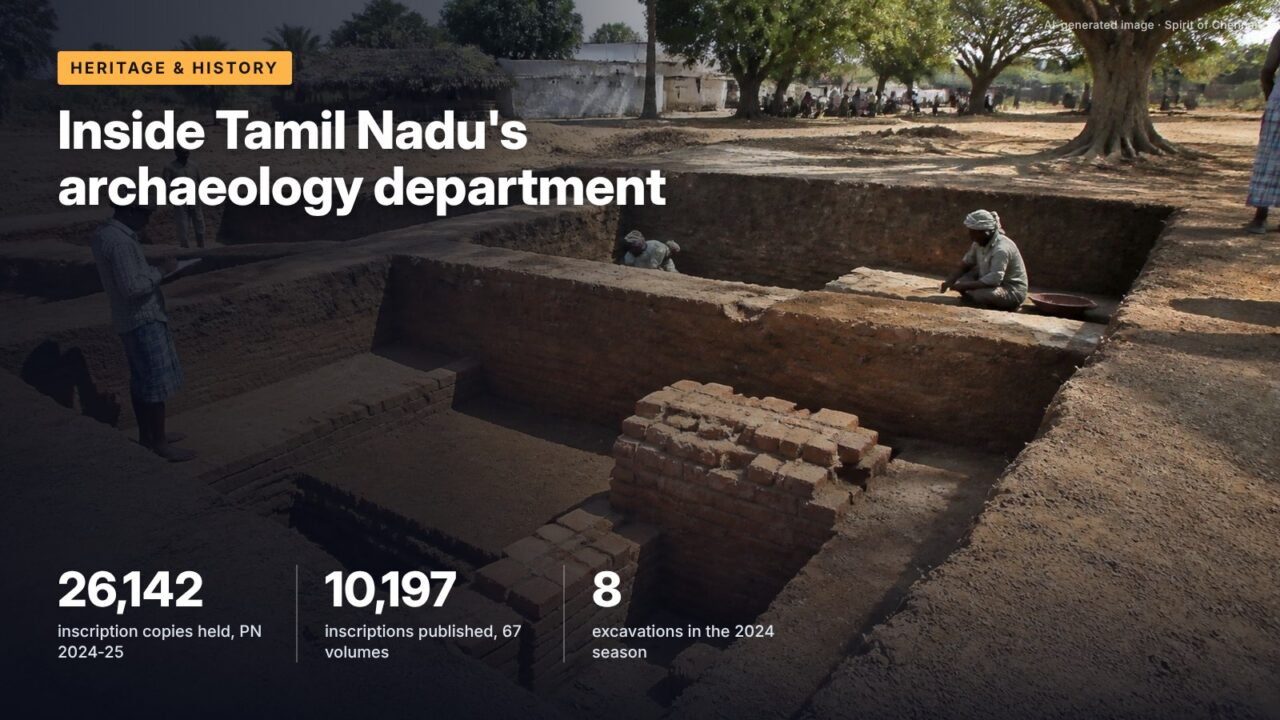
The department, set up in 1961 and headed by a Commissioner of Archaeology, holds about 26,142 estampages (ink-on-paper copies of inscriptions) from 38 districts, according to its policy note for 2024-25. Of these, 15,945 have been deciphered and 10,197 published across 67 volumes. In other words, about 61 per cent have been read and 39 per cent are in print (10,197 divided by 26,142), more than half a century after the epigraphy wing was created in 1966.
That is faster than it used to be. The 2019-20 policy note recorded 24,771 estampages from 29 of 32 districts, 14,200 deciphered and 7,320 published in 50 volumes, and only 50 inscriptions copied in 2018-19. In five years the department published nearly 2,900 more inscriptions and 17 more volumes.
How a dig gets approved
The state does not decide alone where to dig. The 2024-25 note says the Archaeological Survey of India, as the central body, regulates archaeological activity, and that the state’s eight excavation proposals for the 2024 season were sent to the Standing Committee of the Central Advisory Board of Archaeology (CABA). Permission came for all eight, and work began on 18 June 2024.
The season list shows the pattern: return visits to sites that have produced results, plus a few new ones. In 2024 that meant Keeladi and its cluster, including Kondagai (10th season), Vembakkottai (3rd), Kilnamandi (2nd) and Porpanaikkottai (2nd), with new digs at Tirumalapuram in Tenkasi, Chennanoor in Krishnagiri, Kongalnagaram in Tiruppur and Marungur in Cuddalore.
It’s often said Tamil Nadu can dig wherever and whenever it likes.
The record shows Every state excavation proposal goes to the CABA Standing Committee for permission, as the 2024-25 policy note records for all eight sites of that season.
What the digs are finding
The 2023 season, the note reports, yielded 804 antiquities from 14 quadrants at Keeladi, with more than 200 graffiti-marked potsherds in preliminary analysis, and 685 antiquities at Gangaikondacholapuram in its third season. Thulukkarpatti in Tirunelveli district produced 12 potsherds inscribed in Tamili (the department’s term for Tamil-Brahmi) and nearly 4,800 bearing graffiti. Surface finds at Marungur were dated by letter forms to the second or third century BCE.
Inscribed pottery is not new to Tamil Nadu archaeology. A 2010 Lok Sabha answer listed Sangam-age Tamil-Brahmi inscriptions on potsherds from Kodumanal, Mangudi, Uraiyur, Mangalam and Arikamedu in Puducherry, dated to between the third century BCE and the third century CE. What has changed is scientific dating. The 2024-25 note reports accelerator mass spectrometry (AMS) dates of 580 BCE for Keeladi’s inscribed sherds, 1155 BCE for paddy from Sivagalai, analysed at Beta Analytic in Miami, and 1615 and 2172 BCE from Mayiladumparai in Krishnagiri.
The inscription backlog
Temple walls carry most of Tamil Nadu’s historical record: grants, land sales, tax remissions and lists of temple staff. Copying is only the first step. Each estampage must be read, translated, annotated and printed, which is slow specialist work.
In 2019-20 the department began a five-year special initiative with ₹2 crore, engaging 15 experts with a target of about 3,000 inscriptions a year. By the 2024-25 note, 6,200 had been deciphered and 2,877 published in 15 volumes of a new “Tamil Nadu Inscriptions” series. The scale of the national task is larger still: the Culture Ministry told the Lok Sabha in August 2006 that ASI epigraphy branches had copied 73,901 inscriptions across India.
| Indicator | PN 2019-20 | PN 2024-25 |
|---|---|---|
| Estampages held | 24,771 (29 districts) | 26,142 (38 districts) |
| Deciphered | 14,200 | 15,945 |
| Published | 7,320 in 50 volumes | 10,197 in 67 volumes |
| State-protected monuments | 91 | 108 |
| Identified for protection | 55 | 60 |
| Site museums | 14 | 15 |
| Sites excavated since inception | 40 | 40 (annexure lists 53) |
Source: Department of Archaeology, Government of Tamil Nadu, Policy Notes 2019-20 and 2024-25
Share of the state’s 26,142 copied inscriptions that are published, from the 2024-25 policy note.
The money
The policy note does not print a single departmental total in the sections available, but it lists the main allocations. The 2024-25 excavation programme carried ₹5 crore, epigraphy ₹2 crore and recurring maintenance of protected monuments ₹2 crore. Conservation of three forts and palaces had ₹16.93 crore, the Thanjavur Maratha Durbar Hall murals ₹6.95 crore, and an offshore survey at Korkai ₹1.50 crore.
The scale has changed sharply. The 2019-20 note recorded that the state’s only Keeladi season up to then, in 2017-18, cost ₹55 lakh, and that conservation of protected monuments had a special fund of ₹1 crore, with ₹24 crore of Asian Development Bank money for 12 monuments. The 2024-25 excavation budget alone is nine times the cost of that first state season at Keeladi.
| Museum project | Cost | Status in PN 2024-25 |
|---|---|---|
| Keeladi Museum | ₹18.42 crore | Opened 5 March 2023 |
| Keeladi open-air site museum | ₹17.10 crore (estimate) | Planned on 4.48 acres |
| Porunai Museum, Tirunelveli | ₹33.02 crore | About 50% built |
| Upgrade of site museums | ₹10 crore | Announced 2022-23 |
Source: Department of Archaeology, Government of Tamil Nadu, Policy Note 2024-25
Training the next readers
Reading inscriptions takes years of training, and the department runs its own pipeline. The Institute of Epigraphy, a training centre since 1974, was overhauled in 2020-21 and renamed the Tamil Nadu Institute of Archaeology and Museology. It runs a two-year PG Diploma in Epigraphy that admits 10 students a year from 2021-22. The 2019-20 note recorded that the student stipend had been doubled from ₹2,000 to ₹4,000 a month from August 2018.
What this means for you
- Most of the state’s inscription volumes are public documents; the published series is the place to start for the history of a particular temple or village.
- If a site near you is being dug, the season usually starts in mid-year after CABA permission; finds are reported in the next policy note.
- The PG Diploma in Epigraphy is one of the few formal routes into reading Tamil inscriptions, with 10 seats a year.
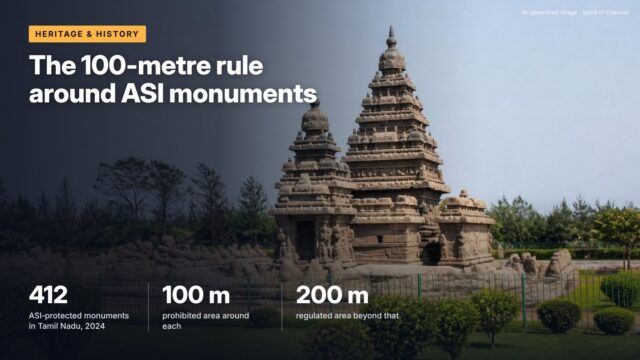
- State-protected monuments (108) are separate from the ASI’s list, which the Centre put at 412 for Tamil Nadu in a December 2024 Lok Sabha answer; the protecting body decides who gives permission for work nearby.
What to watch
Pending
Completion of the ₹33.02 crore Porunai Museum in Tirunelveli, about half built at the time of the 2024-25 note.
Pending
The next season’s excavation list, which must again clear the CABA Standing Committee before work begins.
Pending
Progress of the special epigraphy initiative begun in 2019-20, which had published 2,877 inscriptions in 15 volumes by the 2024-25 note.
Checked against official sources on 23 October 2026. Figures and rules change; confirm on the linked official pages before relying on them.
Sources
- Policy Note 2024-25, Department of Archaeology (Demand No. 29), Government of Tamil Nadu
- Policy Note 2019-20, Department of Archaeology, Government of Tamil Nadu
- Lok Sabha Starred Question No. 416, Discovery of inscripts, Ministry of Tourism and Culture, 24 August 2006
- Lok Sabha Unstarred Question No. 2180, Use of Tamil language in ancient times, Ministry of Culture, 10 March 2010
- Lok Sabha Starred Question No. 85, Monuments protected under AMASR Act, Ministry of Culture, 2 December 2024