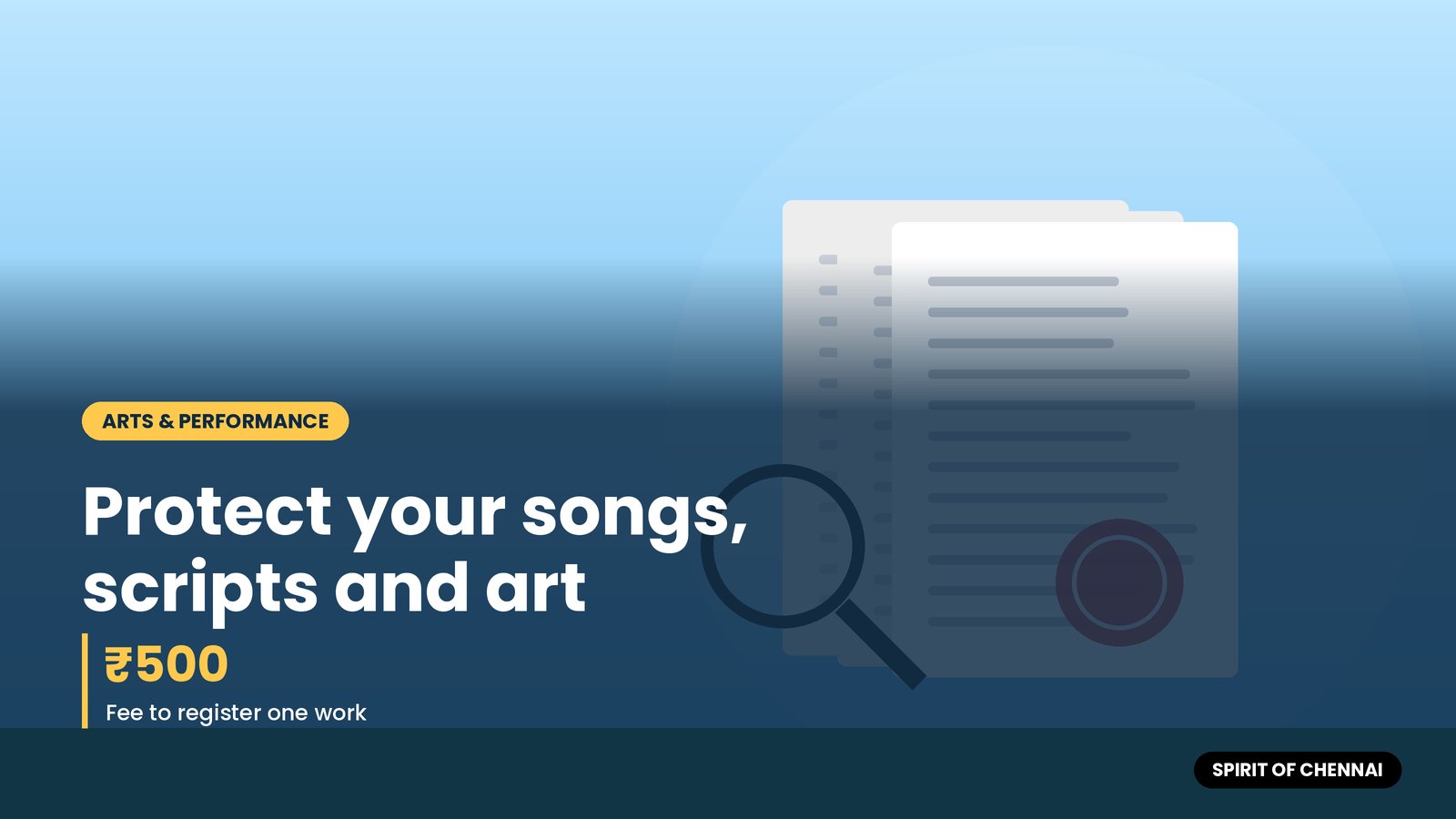
Registering the copyright in a song, a script, a painting or a choreographed piece’s music costs Rs 500 per work at the Copyright Office, and a sound recording costs Rs 2,000, according to the office’s official fee schedule. Registration is optional: copyright arises automatically when you create an original work. But a registration certificate counts as prima facie evidence in court, which is why composers, lyricists, playwrights and illustrators in Chennai’s film and music industry often file.
There is no copyright office in Chennai. The office is in Dwarka, New Delhi, and filing is done online, so an artist in Mylapore or Kodambakkam can complete the process from home. Here is what to file, what it costs and what to watch out for.
What copyright covers
The Copyright Office’s basics page lists original literary, dramatic, musical and artistic works, cinematograph films and sound recordings. Computer programs count as literary works. Copyright does not protect ideas, titles, names, slogans or short phrases, its FAQs add.
For a working artist that means:
- A song’s lyrics are a literary work and its tune a musical work; they can be registered separately.
- A recorded track is a sound recording, a separate right usually owned by whoever made the recording.
- A stage script is a dramatic work; a painting, sketch or photograph is an artistic work.
- A website is not protected as a whole, though its text, images and code can be registered individually.
How long protection lasts
For literary, dramatic, musical and artistic works, copyright runs for 60 years counted from the year after the author’s death, effectively life plus 60 years. For films, sound recordings, photographs, and anonymous or posthumous works, the 60 years run from publication.
Fees
| Registration of | Fee per work |
|---|---|
| Literary, dramatic, musical or artistic work | Rs 500 |
| Literary or artistic work used on goods or services | Rs 2,000 |
| Sound recording | Rs 2,000 |
| Cinematograph film | Rs 5,000 |
| Change in particulars (literary, dramatic, musical, artistic) | Rs 200 |
The higher Rs 2,000 rate applies to artwork used, or capable of use, on goods, such as a logo or a label design.
Filing online, step by step
The Copyright Office’s guide sets out the process:
- Create a user account on the e-filing portal and log in.
- Fill in Form XIV, the application for registration, and save it.
- Fill in the statement of particulars and upload the work with supporting documents.
- For literary, dramatic, musical, artistic and software works, complete the statement of further particulars.
- Pay online. A diary number is generated; note it to track the application.
Upload formats are fixed: PDF or JPG for artistic works, MP3 for sound recordings, and PDF under 10 MB for literary, dramatic and musical works. Film applicants must send two copies on CD or pen drive to the office. One application covers one work.
Documents and no-objection letters
The office’s checklist is where most applications stumble:
- If you are not the author, attach a no-objection certificate from the author.
- If someone else published the work, attach an NOC from the publisher.
- If a person’s photograph appears in the work, give their name, address and nationality, with an NOC where applicable.
- For artwork used on goods, attach a search certificate from the Trade Marks Registry (Form TM-60) and two identical copies matching it.
- If a lawyer files for you, include a power of attorney.
A firm cannot be listed as the author; the actual creator must be named. Anyone who is the author, rights owner, assignee or legal heir can file.
After you file
You must notify people with an interest in the work. If no objection is received within 30 days and the Registrar is satisfied, the entry is made in the Register of Copyrights. If someone objects, there is an inquiry and you get a hearing before any rejection. Registration is complete only when you receive a signed copy of the entries. The portal shows deficiency letters, objections and hearing notices against your diary number.
The Copyright Office is at Bouddhik Sampada Bhawan, Plot 32, Sector 14, Dwarka, New Delhi 110078, phone 011 2803 2496, according to its location page. For disputes over film music or contracts, speak to a lawyer who handles copyright work; this guide is not legal advice.
Quick answers
Is copyright registration compulsory?
No. Copyright is automatic. Registration gives you a certificate that serves as prima facie evidence of ownership in court.
How much does it cost to register a song?
Rs 500 each for the lyrics and the music as separate works, and Rs 2,000 for a sound recording.
Is there a copyright office in Chennai?
No. Applications are filed online, and the office is in Dwarka, New Delhi.
Can I copyright a film title?
No. Titles, names and short phrases are not protected by copyright.
Information checked against official sources on 18 October 2026. Fees, dates and rules can change; confirm on the linked official pages before acting.
Sources
- Forms and official fees, Copyright Office (Intellectual Property India)
- Filing process step by step, Copyright Office (Intellectual Property India)
- Basics of copyright (Intellectual Property India)
- Copyright FAQs (Intellectual Property India)
- Copyright application check list (Intellectual Property India)
- Establishment of Copyright Office and location (Intellectual Property India)