Kalakshetra is run under a 1993 Act of Parliament that gives the Union government the chair, the director and the purse. How its board is built, what it costs and what the Ministry now demands.
The numbers
Kalakshetra in Thiruvanmiyur is a Chennai landmark, but legally it is a creature of Parliament. The Kalakshetra Foundation Act, 1993 (Act 6 of 1994, deemed in force from 29 September 1993) declared the institution founded by Rukmini Devi Arundale an institution of national importance, moved its property to the Union government and then to a new statutory Foundation, and gave New Delhi the power to appoint its chairperson and director.
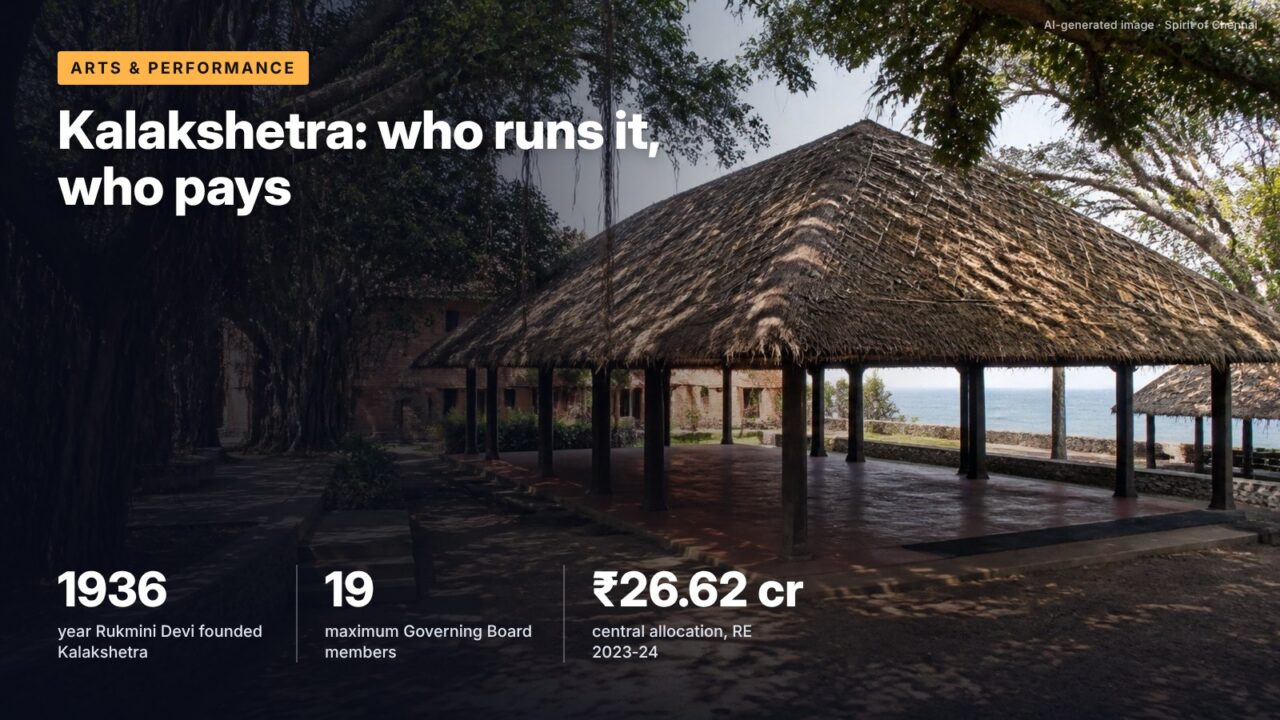
Its money now comes almost entirely through the Union Ministry of Culture. The Ministry told the Lok Sabha on 10 February 2025 that Kalakshetra’s allocation rose from ₹17.67 crore at the 2021-22 budget stage to a revised ₹26.62 crore for 2023-24, an increase of about half in two years. How the Act divides power, and what the Ministry now asks in return for the grant, explains how the institution is run.
From a trust to a statutory body
Kalakshetra began in 1936. By the 1980s its assets were held by a Board of Trustees under a scheme framed by the Madras High Court, which the Act names (petition No. 716 of 1985). Sections 4 to 6 of the Act transferred those assets to the Central Government, freed them of earlier trusts and court orders on their use, and allowed the Centre to vest them in the Foundation by notification. Section 26 bars the Foundation from selling or disposing of that property without the Centre’s prior approval. The Foundation’s website describes the campus as almost 100 acres by the sea.
Section 9 sets out the objects in the founder’s language, including the ideals of “education without fear” and “art without vulgarity”, and training and research in music, dance-drama, the fine arts and Bharatanatyam.
Who sits on the Governing Board
Section 14 makes the Governing Board the Foundation’s “supreme authority”. Section 11 fixes who sits on it.
| Seat | Who appoints | Number |
|---|---|---|
| Chairperson, “a person of high eminence in public life” | Central Government | 1 |
| Persons who served Kalakshetra, artistes, patrons | Central Government | Up to 12 |
| State nominees | Tamil Nadu Government | 2 |
| Ministry of Culture officers (Deputy Secretary or above) | Ex officio | 2 |
| State Education department officer (Joint Secretary or above) | Ex officio | 1 |
| Director | Ex officio | 1 |
| Maximum board | 19 |
Source: Kalakshetra Foundation Act, 1993, section 11 (Tamil Nadu Archives copy); Kalakshetra Foundation, Governing Board page
Members serve five-year terms and can be renominated (section 12). The board must meet at least twice a year in Chennai, decides by majority, and the chairperson has a casting vote (section 13). An Academic Committee of the director, unit heads, three Centre nominees and one state nominee oversees standards and examinations (section 15). A Finance Committee, led by the Ministry’s financial adviser or nominee with a state Finance officer, scrutinises budgets and accounts (section 17). The director, appointed by the Centre, is the principal executive officer (section 19); the board page lists Suresh Kumar Chikkala in that role.
It’s often said Kalakshetra is a Tamil Nadu government institution.
The record shows It is a central statutory body. Tamil Nadu nominates two board members and sends one ex officio officer to a board of up to 19, plus one member each on the Academic and Finance Committees. The Centre appoints the chairperson, the director and up to 12 other members.
Where the money comes from
| Year | Budget estimate | Revised estimate | Reason given for extra |
|---|---|---|---|
| 2021-22 | ₹17.67 cr | ₹18.72 cr | Committed liabilities |
| 2022-23 | ₹19.27 cr | ₹19.77 cr (₹21.27 cr after adjustment) | A third-party project, estimated ₹2.50 cr |
| 2023-24 | ₹24.52 cr | ₹26.62 cr | Creating an earned-leave fund with LIC |
Source: Ministry of Culture, Lok Sabha Unstarred Question No. 1126, 10 February 2025, Annexures I and II
Section 21 allows the Centre to pay grants each year after Parliament appropriates the money, and section 22 creates the Foundation’s own fund for those grants and its receipts. The Ministry’s memorandum of understanding with Kalakshetra for 2023-24 splits the ₹24.52 crore outlay into ₹10 crore general grant, ₹10 crore for salaries, ₹4.50 crore for creating capital assets and ₹2 lakh under another head.
Minimum share of its total budget that the Ministry wants Kalakshetra to raise from its own revenue, under the 2023-24 MoU.
That target is demanding. On a budget the size of 2023-24’s, 30 per cent is roughly ₹7.4 crore a year from fees, tickets, venue hire, crafts and similar sources. The MoU asks the Governing Board to review user charges at least once a year. The website lists hiring venues, the Craft Centre and the repertory, which are the obvious earning arms alongside the Rukmini Devi College of Fine Arts and the two schools on campus.
Accountability: audits, reports and directions
Section 24 puts the accounts under audit by the Comptroller and Auditor General, with the certified accounts and audit report laid before both Houses of Parliament. Section 25 requires an annual report, also laid in Parliament. The record shows these deadlines slip: the 2023-24 annual report and audited accounts were laid in the Lok Sabha together with a statement explaining the delay. The 2023-24 MoU itself set dates for submitting the previous year’s report and accounts, for clearing pending audit paragraphs, and for verifying appointments made over the previous five to ten years by December 2023. It also asked for a performance audit by a reputed institution every two years and periodic peer review, with future grants linked to the outcome.
The Act also keeps reserve powers in New Delhi. Under section 27 the Centre can issue directions in the public interest, with reasons recorded, and those directions override any contrary regulation. Under section 28 it can dissolve the Foundation for a stated period after giving it a chance to respond, during which its committees vacate office and appointees run it. Regulations the Foundation makes take effect only after central approval and gazette publication (section 32).
What the structure means in practice
The design gives Kalakshetra artistic autonomy on paper but leaves budget, top appointments and ultimate control with the Ministry. The grant rise since 2021-22 has come with a tighter performance contract: revenue targets, calendars agreed with the Ministry, social media goals and verification of past hiring. The Foundation’s site now lists a Works Committee and an Internal Complaints Committee alongside the statutory bodies. For students and parents, the practical point is that grievances that are not resolved inside the institution go to the Ministry of Culture, which holds the reins under the Act.
What this means for you
- Admission, fees and courses are set by the Foundation, but policy disputes ultimately rest with the Union Ministry of Culture.
- Annual reports and CAG-audited accounts are laid in Parliament; they are the best public record of its finances.
- Venue hire and ticketed programmes are part of its own-revenue drive, so expect user charges to be reviewed yearly.
- Complaints of harassment go to the Internal Complaints Committee listed on the Foundation’s website.
What to watch
Pending
The 2024-25 annual report and audited accounts, due to be laid in Parliament.
Pending
The Ministry’s next MoU with Kalakshetra, which will reset grants and performance targets.
Checked against official sources on 23 October 2026. Figures and rules change; confirm on the linked official pages before relying on them.
Sources
- The Kalakshetra Foundation Act, 1993 (Act 6 of 1994)
- Lok Sabha Unstarred Question 1126, Allocation of Grants to Autonomous Bodies, 10 Feb 2025 (Ministry of Culture)
- MoU between Ministry of Culture and Kalakshetra Foundation, 2023-24 (Ministry of Culture)
- Papers laid on the Table: Kalakshetra Foundation Annual Report 2023-24 (Lok Sabha)
- Governing Board (Kalakshetra Foundation)
- Kalakshetra Foundation official website