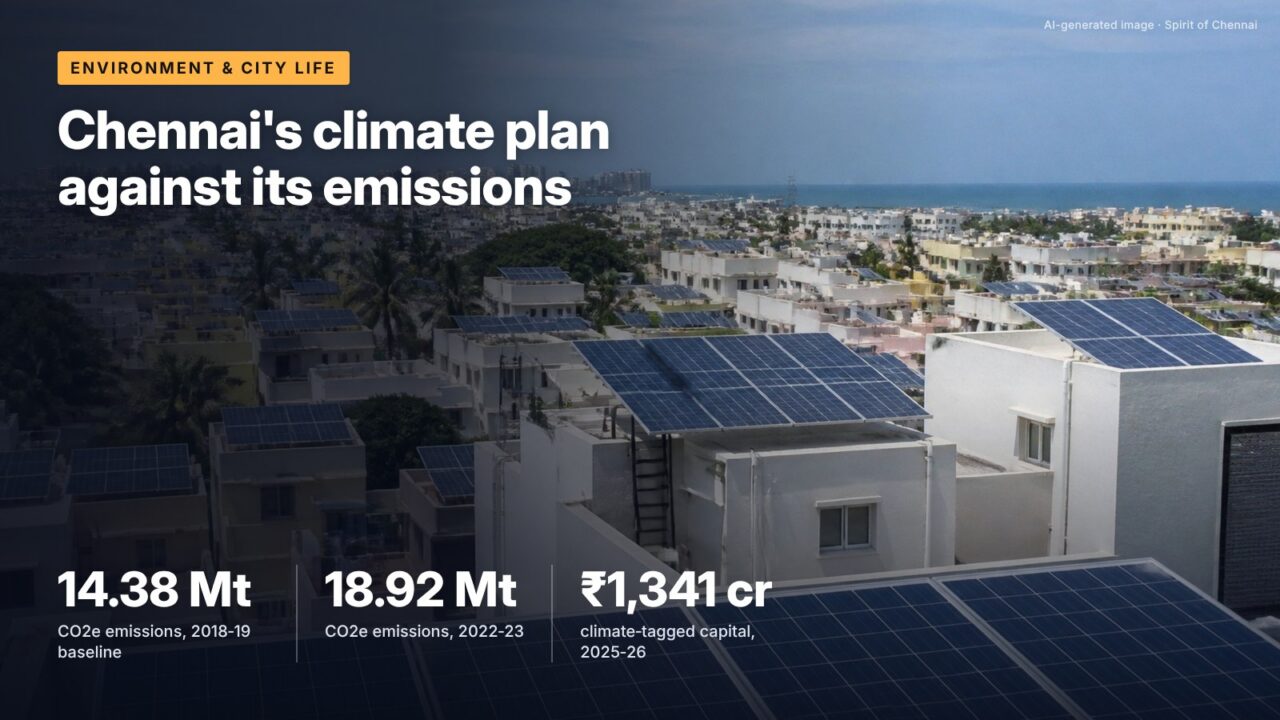
Chennai’s Climate Action Plan promises net zero emissions by 2050. The Corporation’s first climate budget shows how the money is actually tagged, and its updated inventory shows emissions rising, not falling, since the 2018-19 baseline.
The numbers
The Chennai Climate Action Plan, prepared by the Greater Chennai Corporation and the state’s environment and climate change department with the C40 Cities network and launched in June 2023, measured the city’s greenhouse gas emissions at 14.38 million tonnes of carbon dioxide equivalent (CO2e) in 2018-19, about 1.9 tonnes per person. Its target is a 40% cut by 2040 and net zero by 2050.
Two years on, the Corporation’s Climate Budget Report 2025-26 gives a newer figure: 18.92 million tonnes in 2022-23, or 2.4 tonnes per person. That is about 32% above the baseline (18.92 divided by 14.38), though part of the change may reflect improved data rather than only real growth. Either way, the curve has not yet turned.
Where the emissions come from
| Sector | Share of emissions | What it includes |
|---|---|---|
| Stationary energy | 71% | Electricity and fuel in homes, offices and industry |
| Transport | 16% | Road vehicles, mainly fuel |
| Waste | 13% | Methane from dumpsites and sewage |
Source: Chennai Climate Action Plan (2018-19 inventory) and GCC Climate Budget Report 2025-26 (2022-23 inventory); both give the same shares
Seven-tenths of the city’s emissions come from electricity and fuel used in buildings and industry, most of it from the grid. That is why the plan’s largest mitigation lever is outside the Corporation’s control: it assumes 93% of grid electricity will be renewable by 2050. The Corporation itself has converted all of its roughly 3.01 lakh streetlights and park lights to LED, claiming 45% energy savings, and has solar panels on 722 buildings, according to its electrical department.
Waste’s 13% share is large for a city of Chennai’s size, and it is directly linked to the dumpsites. The Corporation collects about 6,150 tonnes a day and its own solid waste page lists most of that going to Kodungaiyur and Perungudi. Rotting waste in open dumps produces methane, a far stronger warming gas than carbon dioxide.
Reading the inventories
| Inventory year | Total (million t CO2e) | Per person (t) |
|---|---|---|
| 2015-16 | 13.54 | not stated |
| 2018-19 (baseline) | 14.38 | 1.9 |
| 2022-23 | 18.92 | 2.4 |
Source: Chennai Climate Action Plan (2015-16 and 2018-19); GCC Climate Budget Report 2025-26 (2022-23)
Between the first two inventories emissions rose about 6% in three years (14.38 against 13.54). The jump to 2022-23 is much steeper. The Climate Budget does not explain it, and inventories are often revised as data improves, so the 32% figure should be read as indicative. What it does show is that the plan’s starting assumption of a near-flat line to 2030 is already under strain.
The targets and the scenarios
The plan models three paths. Under business as usual, emissions almost quadruple by 2050. An “ambitious” scenario with measures judged feasible still sees emissions rise 24.8% by 2030 and 13.2% by 2040 before falling 44% below 2018 by 2050, leaving about 12.5 million tonnes. Only an “extended” scenario, which relies on strategies the plan calls not yet feasible, reaches a 92% cut by 2050, with the remainder to be offset.
Cut below 2018 emissions that the Climate Action Plan‘s extended scenario needs by 2050 for net zero; its ambitious scenario reaches 44%.
The documents differ on the 2030 goal. The plan’s target section speaks of a 1% reduction by 2030, while the Climate Budget describes a 1% increase. Either way, the plan does not expect large cuts this decade; the heavy lifting is planned for the 2030s and 2040s.
It’s often said Chennai’s climate plan is mainly about cutting emissions.
The record shows The first climate budget put 62.8% of tagged money into adaptation, mostly flood and water works, and 37.07% into mitigation. In practice the city is spending first on coping with floods and heat.
What the money is tagged to
The 2025-26 Climate Budget is the Corporation’s first attempt to label which capital spending serves the plan. It found ₹1,341.2 crore, or 42.04% of the ₹3,190.61 crore capital budget, to be climate-relevant. The full multi-year cost of those activities was put at ₹7,200.53 crore.
| Plan sector | ₹ crore, 2025-26 | Share |
|---|---|---|
| Urban flooding and water scarcity | 834.75 | 62.24% |
| Waste management | 350.81 | 26.15% |
| Sustainable mobility | 133.56 | 9.96% |
| Building energy | 22.08 | 1.65% |
| Grid and renewable energy; vulnerable populations and health | 0 | 0% |
Source: Greater Chennai Corporation, Climate Budget Report 2025-26
The split mirrors the risks the plan identifies. It projects average temperature rising 1.9°C by 2050, 32% of the Corporation area inundated in a 1-in-10-year flood, and relative sea level up to 134 cm higher by the 2100s, with about 215 slum settlements at risk. About 8.2 lakh people, 18.6% of the population, live in slum conditions. The plan wants urban nature to cover 35% of the city; vegetation covered 74.3 sq km in 2021, with 8.75 sq m of green space per person.
Who has to deliver
The plan proposes a Department of Climate Change Initiatives inside the Corporation, working with the Tamil Nadu Green Climate Company. Many of its biggest targets, such as a fully electric MTC bus fleet, 80% of inner-city trips by public transport, walking and cycling, and a mostly renewable grid, depend on state agencies and the electricity utility rather than the Corporation’s own budget. Water is an energy question too: Metro Water already runs 100 MLD desalination plants at Minjur and Nemmeli and is building a 400 MLD plant at Perur, according to its 2023-24 performance report, and desalination is among the most power-hungry ways to supply a city.
What this means for you
- Household electricity is the largest single source of the city’s emissions; efficient appliances and rooftop solar make a measurable difference.
- Segregating wet waste at home cuts dumpsite methane, the waste sector’s main contribution.
- Expect more spending on drains and water than on emission cuts in the near term; that is how the first climate budget is tilted.
- Heat and flooding projections in the plan are useful when choosing where to buy or rent, especially near low-lying areas.
What to watch
Pending
The next Climate Budget, expected alongside the Corporation’s annual budget, will show whether tagged spending reaches the grid, health and vulnerable-population sectors that got nothing in 2025-26.
Pending
A fresh emissions inventory after 2022-23, which will show whether the rise since 2018-19 has slowed.
Checked against official sources on 23 October 2026. Figures and rules change; confirm on the linked official pages before relying on them.
Sources
- Chennai Climate Action Plan, GCC and TN Department of Environment, Climate Change and Forests, 2023 (via TN Green Climate Company)
- Climate Budget Report 2025-26, Greater Chennai Corporation with C40 Cities, 2025
- Electrical Department, Greater Chennai Corporation, 2026
- Solid Waste Management Department, Greater Chennai Corporation, 2026
- Annual Performance Report 2023-24, CMWSSB