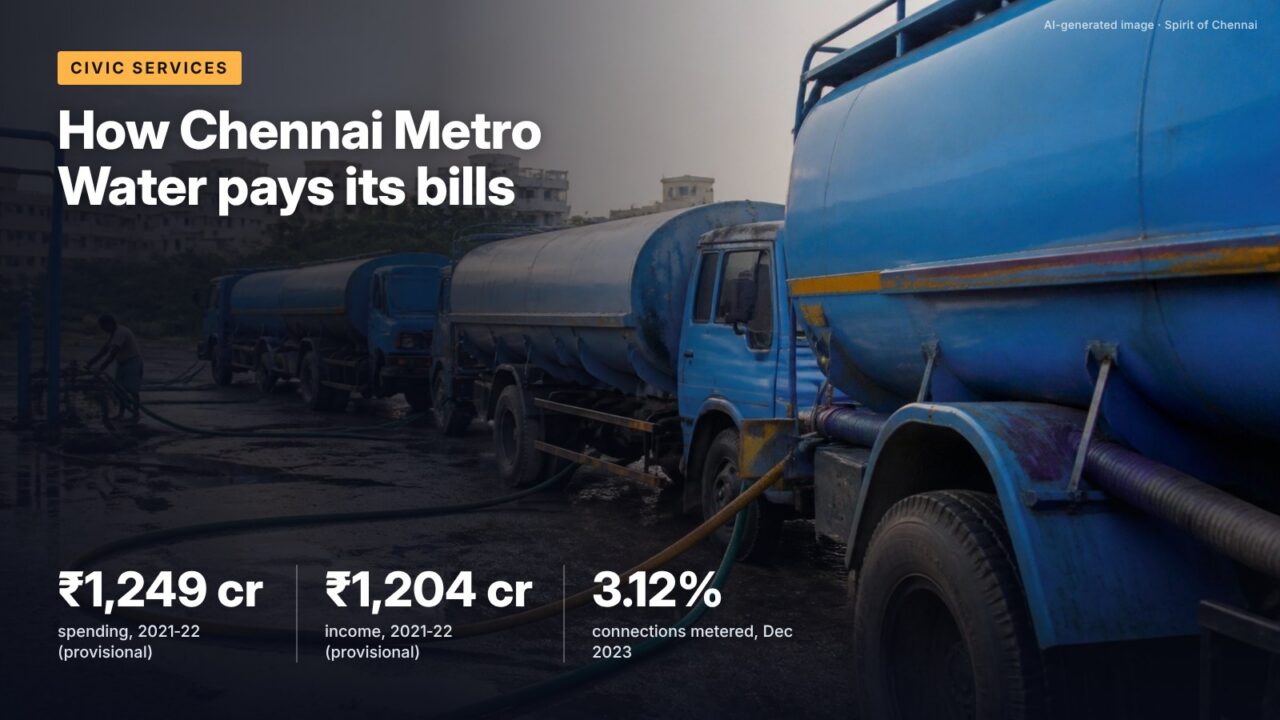
Chennai Metro Water spends more than it earns, bills most homes a flat ₹105 a month because barely 3% of connections are metered, and leans on state grants for a fifth of its income. Here is how the money works.
The numbers
Chennai Metropolitan Water Supply and Sewerage Board ran a revenue deficit of ₹44.81 crore in 2021-22 on provisional accounts, its Annual Performance Report 2023-24 shows. It earned ₹1,203.94 crore and spent ₹1,248.75 crore. The year before, the gap was ₹126.03 crore. Operations and maintenance alone took ₹694.12 crore, more than half of all spending.
The revenue side is shaped by one fact. Of 7,70,292 connections in December 2023, only 24,095 were metered, or 3.12%. Most households pay a flat charge regardless of how much water they use, so the Board’s income depends far more on how many connections it has and on property values than on water sold.
Where the money comes from
| Income head, 2021-22 | ₹ crore | Share |
|---|---|---|
| Sale of water and sewerage charges | 591.16 | 49% |
| Water and sewerage tax | 240.05 | 20% |
| Grants and subsidies | 236.49 | 20% |
| Other income | 127.00 | 11% |
| Total income | 1,203.94 |
Source: CMWSSB, Annual Performance Report 2023-24, income and expenditure (provisional), shares computed
The water and sewerage tax works like a second property tax. Metro Water levies 1.5% water tax and 5.5% sewerage tax a year on the annual value that the Greater Chennai Corporation fixes for property tax, according to its current tariff. That 7% a year works out to 3.5% each half-year. When the Corporation’s 2022 revision raised street rates, this tax base rose with it.
The charges are the second leg. Unmetered homes pay ₹105 a month per dwelling unit, billed half-yearly. Metered homes pay by the slab: ₹7 per kilolitre for the first 10 kilolitres, then ₹19, ₹30 and ₹48 per kilolitre above 25 kilolitres, with the same ₹105 minimum. Under a revision effective from the first half of 2023-24, domestic and partly commercial tariffs rise 5% a year and commercial, institutional and industrial tariffs 10%, the performance report says.
Range of per-kilolitre rates in the Metro Water tariff, from the first domestic slab to industrial use above 500 kilolitres a month.
Where it goes
| Expenditure head, 2021-22 | ₹ crore |
|---|---|
| Operations and maintenance | 694.12 |
| Employee cost | 249.47 |
| Depreciation | 127.97 |
| Finance charges | 79.89 |
| Total expenditure | 1,248.75 |
Source: CMWSSB, Annual Performance Report 2023-24 (provisional accounts)
Operations and maintenance cover power for treatment plants and pumping stations, chemicals and desalination. The Board runs 1,510 MLD of water treatment capacity, including desalination plants of 100 MLD at Minjur and 100 MLD at Nemmeli, and a 400 MLD plant at Perur under construction and scheduled for February 2027. Desalination is energy-intensive, so each new plant adds to the running bill before it adds to revenue.
The system the money runs
The Board’s 1,510 MLD of treatment capacity is spread across nine plants: Chembarambakkam (530 MLD), Red Hills (300), Kilpauk (270), Veeranam (180), Minjur (100), Nemmeli (100), Surapet (14), Kolathur (10) and Porur (6). Water then travels through 5,247 km of distribution pipes, 16 major distribution stations and 103 smaller head works, the performance report says. On the sewage side, the Board deploys 537 mechanised machines for sewer maintenance.
Even with all that, the report puts city demand at 1,400 MLD against about 1,040 MLD supplied, a gap of 360 MLD. A 150 MLD expansion at Nemmeli was under trial commissioning when the report was prepared. Every new litre the Board supplies, particularly from desalination, costs more to produce than the older lake-fed supply, and the flat domestic charge does not rise with use.
Who pays more
The tariff is built to have businesses carry more of the load. A non-water-intensive commercial user pays ₹99 per kilolitre up to 500 kilolitres a month; a private hospital pays ₹139; industry using more than 500 kilolitres pays ₹194 on its entire consumption. Government hospitals pay ₹59. Bulk supply to other municipalities is ₹35.27 per kilolitre. Treated sewage from the tertiary plants is sold at ₹28.35 per kilolitre, cheaper than fresh water for most industries.
The domestic first slab of ₹7 per kilolitre is far below what the treatment cost implies. The two recycling plants alone cost ₹440 crore (Koyambedu) and ₹330 crore (Kodungaiyur) to build under AMRUT, the Union housing ministry told the Lok Sabha in August 2025.
It’s often said Metro Water’s charges pay for the city’s water.
The record shows Charges brought in about half of the Board’s 2021-22 income. Another fifth came from grants and subsidies, and the Board still spent ₹44.81 crore more than it earned.
The long view on billing
Billing problems are old. A CAG review in the audit report for 2004-05 found annual demands of ₹179 crore to ₹192 crore during 1999-2004 from 5.17 lakh tax assessees and 3.94 lakh charge consumers. It quantified ₹6.27 crore of short collection in two sample areas, mostly from properties assessed at lower values or classed as domestic when the Corporation treated them as commercial. Because the water tax rides on the Corporation’s annual value, any error in the property assessment carries straight into the water bill.
Two decades on, income has grown roughly sixfold in nominal terms, from under ₹200 crore of annual demand to ₹1,204 crore, but the structure has barely changed: a flat domestic charge, a property-linked tax and grants to close the gap.
The same audit looked at late-payment surcharges, which are now 1% a month for all categories. It found ₹16.88 crore of surcharge income in 2002-03, and in 18,804 cases where surcharge was collected manually, only ₹1.52 crore was recovered against ₹3.91 crore the billing software had calculated. Collection discipline, not only tariff levels, decides what the Board actually earns.
What this means for you
- Your water and sewerage tax is 7% a year of the annual value on your property tax bill; if that value is wrong, both bills are wrong.
- Unmetered homes pay ₹105 a month whatever they use, so a meter helps only households that use little water.
- Pay within 30 days of the half-year to get Metro Water’s 5% incentive, capped at ₹1,500 an assessment under Board resolution 102/2024.
- Late payment attracts surcharge of 1% a month for all categories since July 2023.
- Expect tariffs to rise 5% a year for homes under the 2023 revision unless the Board changes it.
What to watch
February 2027
Scheduled completion of the 400 MLD Perur desalination plant, which will add to both supply and running costs.
Pending
Audited accounts after 2021-22 have not appeared in the performance report reviewed; later figures will show whether the deficit has closed.
Checked against official sources on 23 October 2026. Figures and rules change; confirm on the linked official pages before relying on them.
Sources
- Annual Performance Report 2023-24, Chennai Metropolitan Water Supply and Sewerage Board
- Water and sewerage tariff, CMWSSB, effective April 2025
- Computerised Billing and Collection in CMWSSB, CAG Audit Report (Civil) for 2004-05
- Lok Sabha Unstarred Question 3133, Status of Sewage Treatment Plants in Tamil Nadu, 7 August 2025
- Revenue Department: property tax and annual value, Greater Chennai Corporation, 2026