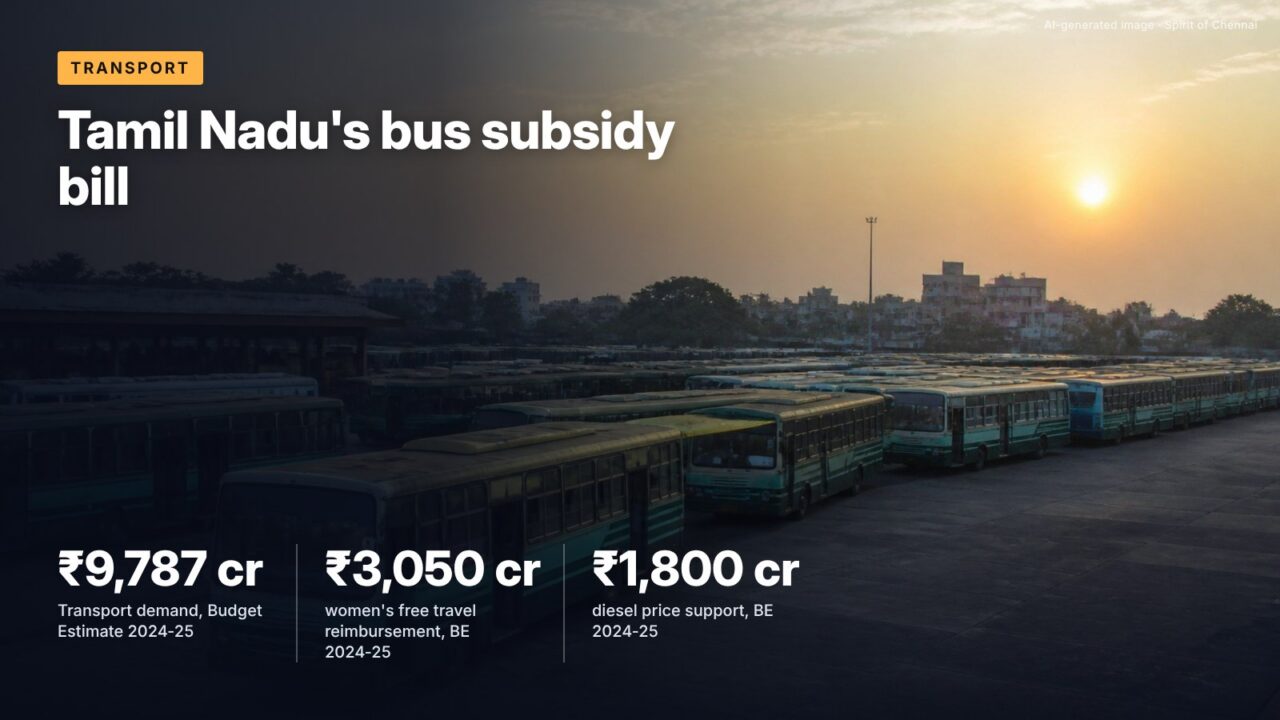
Tamil Nadu’s state-owned bus corporations run on fares, but increasingly on money from the state budget. The Transport Department’s demand for grants shows where that money goes, and how fast the bill has grown since free travel for women began.
The numbers
Three items now make up about two-thirds of what Tamil Nadu budgets for its Transport Department. In the 2024-25 Budget Estimate for Demand No. 48, the state set aside ₹3,050 crore to reimburse bus corporations for free travel by women, ₹1,521 crore for student fare concessions and ₹1,800 crore to cover diesel price increases, according to the Finance Department’s demand book. Together that is ₹6,371 crore, or 65 per cent of the department’s net demand of ₹9,786.89 crore.
These are not grants in the loose sense. The state transport undertakings (STUs), including Chennai’s Metropolitan Transport Corporation, are government companies that must keep accounts. When the government orders them to carry women, students or senior citizens free or at a discount, it compensates them from the budget. The demand book is where that compensation is recorded, head by head.
The four years in one table
| Budget head | Accounts 2022-23 | BE 2023-24 | RE 2023-24 | BE 2024-25 |
|---|---|---|---|---|
| Free bus travel for women | ₹2,728.79 cr | ₹2,800.00 cr | ₹3,000.00 cr | ₹3,050.00 cr |
| Student bus concession | ₹1,367.00 cr | ₹1,500.00 cr | ₹1,500.00 cr | ₹1,521.00 cr |
| Diesel price-difference reimbursement | ₹1,868.61 cr | ₹2,000.00 cr | ₹1,800.00 cr | ₹1,800.00 cr |
| Senior citizens’ free pass | ₹19.34 cr | ₹22.00 cr | ₹22.00 cr | ₹22.00 cr |
| Share capital to STUs (general) | ₹500.00 cr | ₹500.00 cr | ₹579.50 cr | ₹500.00 cr |
| Share capital to STUs (KfW-linked) | ₹108.53 cr | ₹400.00 cr | ₹22.77 cr | ₹665.00 cr |
| Demand total (net) | ₹8,436.12 cr | ₹8,051.59 cr | ₹7,695.27 cr | ₹9,786.89 cr |
Source: Finance Department, Government of Tamil Nadu, Demand No. 48 (Transport), Budget Estimate 2024-25; figures converted from thousands of rupees
BE is the Budget Estimate presented before the year, RE the Revised Estimate during it, and Accounts the audited actual. The gap between them is often the story.
Free travel: from estimate to actual
The free travel scheme for women on ordinary town buses was in its second year when the state budgeted ₹1,520 crore for it in the 2022-23 Budget Estimate. The audited accounts for that year show ₹2,728.79 crore actually paid, 80 per cent more than estimated. Budgets since have caught up: ₹3,000 crore in the 2023-24 revised estimate and ₹3,050 crore for 2024-25.
Student concessions followed the same path, from ₹928 crore in the 2022-23 estimate to ₹1,367 crore in actuals and ₹1,521 crore budgeted for 2024-25. The diesel line rose from ₹1,300 crore estimated in 2022-23 to ₹1,868.61 crore actually paid, then settled at ₹1,800 crore as fuel prices steadied. Diesel support is the item most exposed to decisions outside the state, since fuel prices are set by oil companies and Union taxes.
How far actual spending on women’s free travel in 2022-23 (₹2,728.79 crore) overshot the year’s ₹1,520 crore estimate, per the 2022-23 and 2024-25 demand books.
It’s often said free bus travel for women costs the bus corporations nothing because the buses run anyway.
The record shows The state pays the corporations for every scheme it mandates. The audited figure for women’s free travel alone was ₹2,728.79 crore in 2022-23, recorded under Demand No. 48 in the state budget.
Money for new buses moves slowly
Operating support is paid out roughly as budgeted. Capital support is not. In 2023-24 the state budgeted ₹400 crore of KfW-linked share capital for STUs; the revised estimate was ₹22.77 crore. Externally aided loans for road transport were budgeted at ₹700 crore and revised to ₹70.85 crore. For 2024-25 the estimates were raised again, to ₹665 crore and ₹1,235 crore. KfW is the German development bank that part-funds new buses. A shortfall at revised-estimate stage usually means procurement did not happen in that year, so the money was not drawn.
A separate line shows the shift to new models of buying service. The Chennai City Partnership’s bus performance contract head rose from ₹1 crore in the 2023-24 estimate to ₹22.50 crore revised and ₹368.25 crore for 2024-25. That money pays for service delivered rather than for buses owned.
From grants to contracts
That shift is written into a World Bank and AIIB programme. Results Area 3 of the Chennai City Partnership covers MTC’s cost recovery, non-fare revenue and “a transparent viability gap funding mechanism”. In plain terms, instead of covering losses after the fact, the state agrees in advance what it will pay MTC to run specified services. A Public Transport Service Contract between the state and MTC was issued by G.O. in October 2023, and half of MTC’s existing buses had come under the viability gap mechanism against a target of 30 per cent, the AIIB’s November 2025 report says.
The stakes for Chennai are high because buses still carry a large share of travel. The World Bank’s 2021 appraisal put the bus share of trips at 22 per cent in 2018, with walking at 25 per cent and personal motor vehicles at 30 per cent, and noted that sector spending did not match current or target mode shares.
The auditor’s wider view
The bus corporations sit within a larger set of state enterprises that the Comptroller and Auditor General reports on each year. CAG’s Report No. 5 of 2021 covered 72 state public sector undertakings as of 31 March 2020: 31 made losses totalling ₹18,629.83 crore, and 26 companies had accumulated losses of ₹1,41,157.46 crore. The report page does not break those figures out by sector, so it cannot be used to say how much of the total belongs to transport. It does show why the budget treats STUs as a standing commitment rather than a one-off.
What this means for you
- Fare concessions you use (women’s free travel, student passes, senior citizen passes) are paid for from the state budget under Demand No. 48, not absorbed by MTC.
- Watch the gap between budget estimate and revised estimate for bus purchase money; it signals whether new buses will actually arrive that year.
- The move to contracts and viability gap funding means MTC’s payments increasingly depend on kilometres run and service standards met.
- Diesel support rises and falls with fuel prices, which can squeeze funds for other heads in a bad year.
What to watch
Each budget session
The Transport Department’s demand book on the Finance Department website, with the new year’s estimates and the previous year’s actuals.
Pending
Audited accounts for 2023-24 and 2024-25, which will show whether free-travel spending stayed near ₹3,000 crore.
Pending
Progress of the bus performance contracts and e-bus deployment under the Chennai City Partnership.
Checked against official sources on 23 October 2026. Figures and rules change; confirm on the linked official pages before relying on them.
Sources
- Demand No. 48, Transport Department, Budget Estimate 2024-25, Finance Department, Government of Tamil Nadu
- Demand No. 48, Transport Department, Budget Estimate 2022-23, Finance Department, Government of Tamil Nadu
- Project Implementation Monitoring Report No. 7, Chennai City Partnership, AIIB, November 2025
- Chennai City Partnership programme, Tamil Nadu Infrastructure Development Board
- Program Appraisal Document PAD4225, Chennai City Partnership, World Bank, September 2021 (copy)
- Report No. 5 of 2021, General Purpose Financial Report (PSUs), Government of Tamil Nadu, CAG