

Red Hills lake is the busiest junction in Chennai’s water system. According to Chennai Metro Water, it feeds three separate treatment plants, at Puzhal beside the lake, at Surapet and at Kilpauk, and those three can treat 584 million litres a day (MLD) between them. No other lake in the network feeds more than one plant.
This graphic follows the pipes, not daily supply totals. It links each lake to the plant that cleans its water, using plant capacities from the Board’s Annual Performance Report for 2023-24. Every link shown is one the Board itself describes.
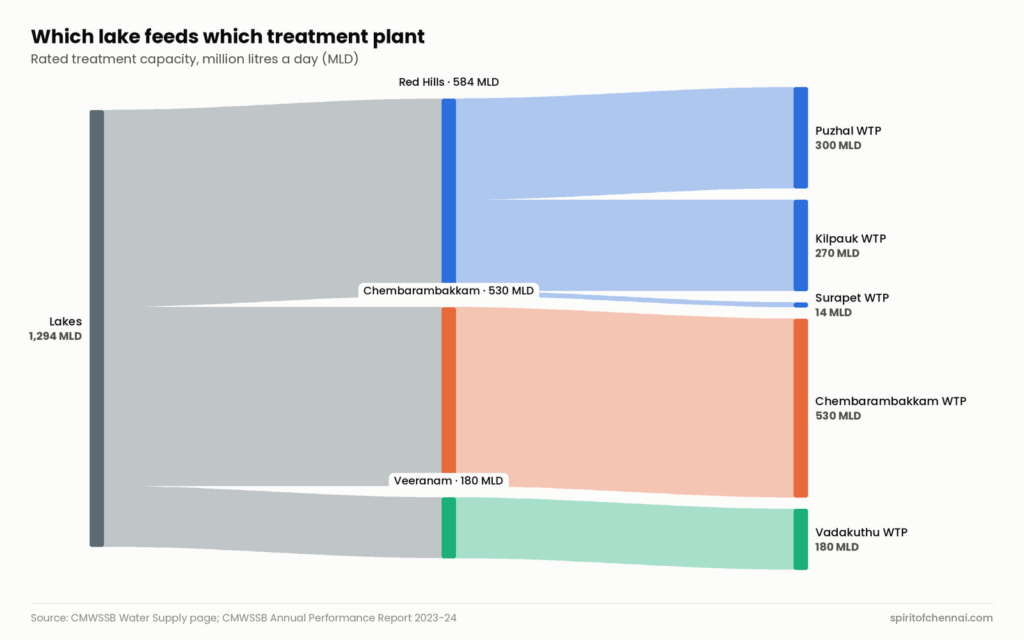
- Read left to right: all lakes together (1,294 MLD of plant capacity), each lake, then its plant. Band width is the plant’s rated capacity in MLD, not the water flowing on a given day.
- Red Hills splits three ways; Chembarambakkam and Veeranam each feed one plant.
- Not drawn: the two seawater desalination plants (Minjur and Nemmeli, 100 MLD each) and the small Porur and Kolathur plants, whose source the report does not name.
One lake, three plants
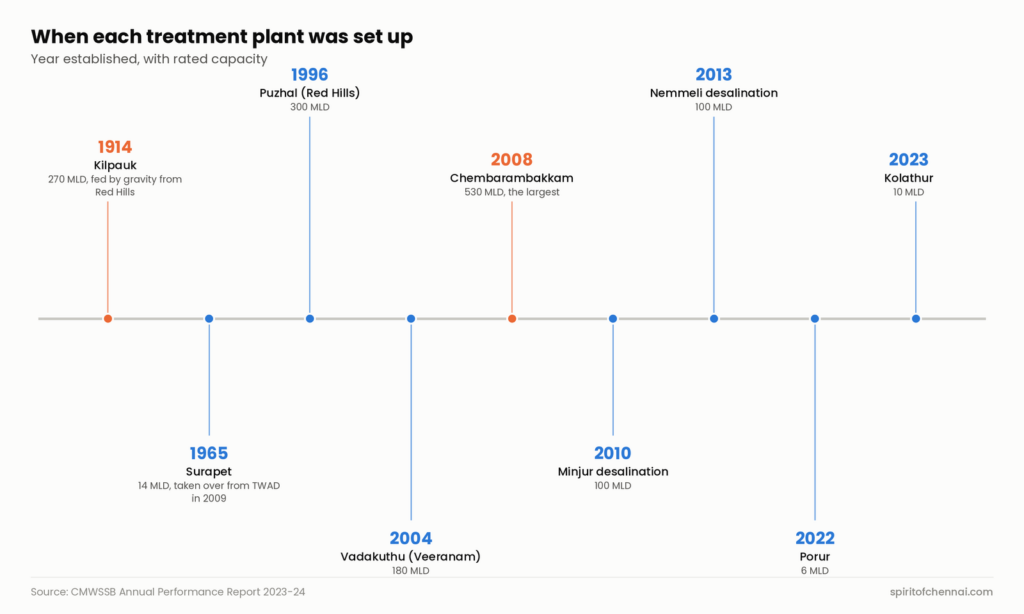
Kilpauk is the oldest piece of the network, set up in 1914, and it still works the way it was designed: water runs from Red Hills to the plant by gravity through conduits, the report says. Kilpauk is rated at 270 MLD and on average supplies about 220 MLD to north and central Chennai. The 300 MLD plant at Puzhal, dating from 1996, sits next to the lake, and the 14 MLD Surapet plant was taken over from the TWAD Board in 2009.
Poondi and Cholavaram sit upstream of this junction. Metro Water describes them as one system with Red Hills, so their stored water reaches the city through the same plants rather than through plants of their own.
The long pipes: Chembarambakkam and Veeranam
Chembarambakkam lake feeds the plant of the same name, the biggest in the system at 530 MLD. Veeranam is the outlier: the lake lies about 230 km south of Chennai and was added to the network in October 2004. Its water is treated at the Vadakuthu plant (180 MLD) and then piped to the Porur distribution station before it enters city mains, according to Metro Water.
The two plants are linked in practice. In May 2024, Metro Water’s managing director told Citizen Matters that the new 150 MLD Nemmeli desalination plant is interlinked with the Veeranam and Chembarambakkam pipelines, which let it cover a 90 MLD gap when Veeranam ran dry.
Treatment capacity fed by Red Hills lake alone: Puzhal 300, Kilpauk 270 and Surapet 14, from the CMWSSB 2023-24 report.
Storage is not the same as treatment
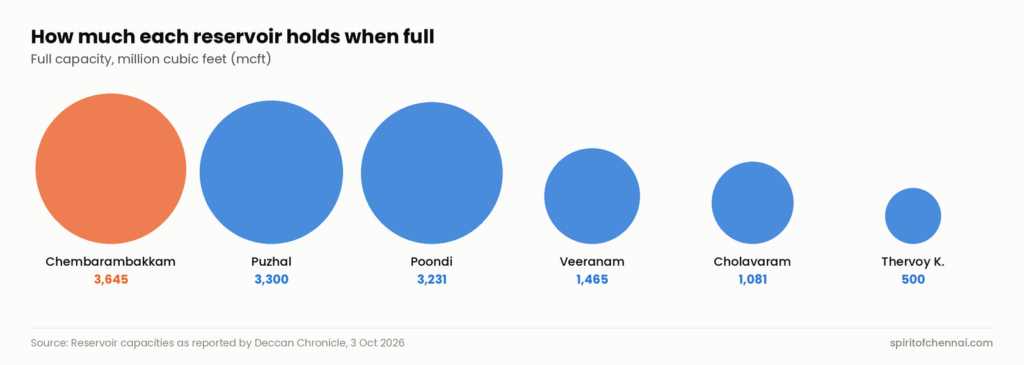
The lakes that hold the most water are not always the ones with the biggest plants. Poondi can store 3,231 million cubic feet (mcft), almost as much as Red Hills, yet the report links no treatment plant to it directly. Kannankottai Thervoy Kandigai, the newest reservoir, takes Krishna water through an 8.6 km canal from the Kandaleru to Poondi canal and was described at its 2020 opening as able to supply 66 MLD, The News Minute reported.
The numbers behind the graphic
| Source | Treatment plant | Capacity (MLD) | Set up |
|---|---|---|---|
| Red Hills lake | Puzhal (Red Hills) | 300 | 1996 |
| Red Hills lake | Kilpauk | 270 | 1914 |
| Red Hills lake | Surapet | 14 | 1965 |
| Chembarambakkam lake | Chembarambakkam | 530 | 2008 |
| Veeranam lake | Vadakuthu (Veeranam) | 180 | 2004 |
| Sea | Minjur desalination | 100 | 2010 |
| Sea | Nemmeli desalination | 100 | 2013 |
| Not stated | Porur | 6 | 2022 |
| Not stated | Kolathur | 10 | 2023 |
| Reservoir | Full capacity (mcft) | Storage, 3 Oct 2026 (mcft) |
|---|---|---|
| Chembarambakkam | 3,645 | 1,305 |
| Puzhal (Red Hills) | 3,300 | 1,856 |
| Poondi | 3,231 | 946 |
| Veeranam | 1,465 | 475 |
| Cholavaram | 1,081 | 134 |
| Kannankottai Thervoy Kandigai | 500 | 260 |
Source: source-to-plant links from CMWSSB, Water Supply; plant capacities and years from the CMWSSB Annual Performance Report 2023-24; reservoir capacities and storage as reported by Deccan Chronicle, 3 October 2026.
About the data
Plant capacities are design ratings from the 2023-24 report, which totals 1,510 MLD. They are not daily output; a plant can run well below its rating when its lake is low. The report lists Nemmeli at 100 MLD in its table but 110 MLD in its text, and it describes a further 150 MLD Nemmeli plant as being under trial at the time; that plant was supplying about 130 to 135 MLD by May 2024, Citizen Matters reported. Groundwater, quarry water and treated wastewater are not drawn.
Reservoir capacities are the figures newspapers carry from the Water Resources Department. They vary slightly by source: DT Next in December 2023 also gave 1,081 mcft for Cholavaram and 500 mcft for Thervoy Kandigai, while the CAG’s 2017 flood audit lists Cholavaram at 1.005 thousand million cubic feet. Metro Water’s own lake-level page could not be opened for this article.
Quick answers
Which is the largest water treatment plant in Chennai?
Chembarambakkam, rated at 530 MLD in the CMWSSB 2023-24 report. It treats water from Chembarambakkam lake.
Where is Veeranam water treated?
At the Vadakuthu plant, rated at 180 MLD, before it is piped to the Porur distribution station.
How old is the Kilpauk plant?
It was set up in 1914 and is fed by gravity from Red Hills lake.
Information checked against official sources on 21 October 2026. Figures can be revised; confirm on the linked official pages before relying on them.
Sources
- Water Supply (Chennai Metropolitan Water Supply and Sewerage Board)
- Annual Performance Report 2023-24 (CMWSSB)
- Chennai looks to NE monsoon as lakes drying up fast (Deccan Chronicle, 3 Oct 2026)
- Cyclonic Michaung: Storage level in TN reservoirs up by 50% (DT Next, Dec 2023)
- Five things to know about Thervoy Kandigai reservoir (The News Minute, Nov 2020)
- Desalination plants will bridge Chennai’s water gap: CMWSSB MD (Citizen Matters, May 2024)
- Performance Audit of Flood Management and Response in Chennai, Chapter 1 (CAG of India, Report 4 of 2017)


