


Six of the twelve Chennai landmarks on this timeline were finished in the 40 years between 1873 and 1913. Central station, Victoria Public Hall, the High Court, Connemara Library, Egmore station and Ripon Building all date from that one burst of building, which is why so much of the city’s postcard skyline looks like it was designed by the same generation.
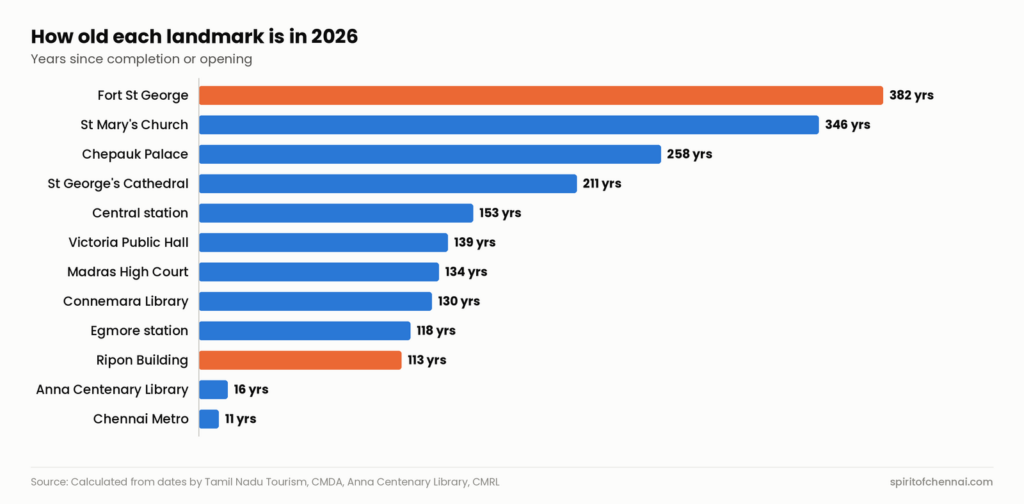
The oldest point is far earlier. Tamil Nadu Tourism says Fort St George was completed on 23 April 1644, St George’s Day, which makes it 382 years old in 2026. We placed every landmark only where an official or institutional page gave a date, and left out well-known buildings we could not confirm that way.
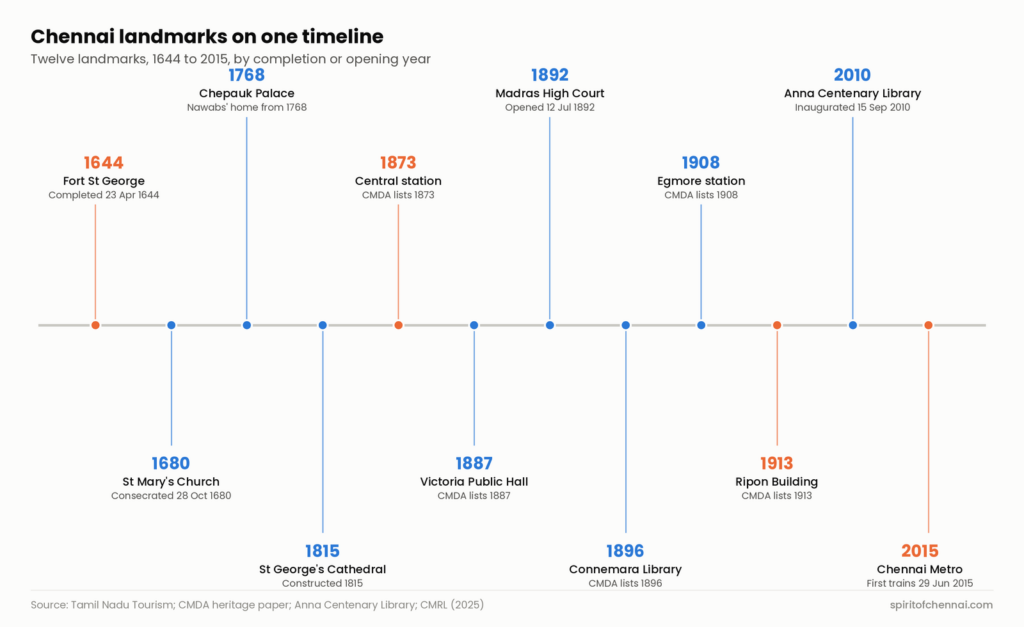
- Each dot is one landmark, in date order from left to right. Dots are evenly spaced so labels stay readable, so the gaps between dots are not to scale.
- Orange dots mark four turning points: the fort, the first big railway terminus, Ripon Building and the metro.
- The year shown is the completion, consecration or opening year given by the source named in the table below.
A fort town for two centuries
The first four dots span 171 years. The fort came first, then St Mary’s Church inside it, which Tamil Nadu Tourism says was consecrated on 28 October 1680. The same department’s heritage blog dates Chepauk Palace as the official home of the Nawabs of Arcot from 1768 to 1855, and St George’s Cathedral to 1815.
Four of these buildings were already more than two centuries old when the first metro train ran.
The 1873 to 1913 building boom
The CMDA’s heritage paper on Chennai’s historical buildings lists Central Railway Station as 1873, Victoria Public Hall as 1887, the High Court as 1892, Connemara Library as 1896, Egmore Railway Station as 1908 and Ripon Building as 1913. For the High Court, Bar & Bench reported the 125th anniversary of the building and gave its inauguration as 12 July 1892.
These were the buildings of a growing colonial capital: two railway termini, a court, a public hall, a library and a civic headquarters. Ripon Building still houses the Greater Chennai Corporation.
The day Fort St George was completed, according to Tamil Nadu Tourism. It was St George’s Day, which gave the fort its name.
The long gap, and why it is partly ours
After 1913 the timeline jumps to the Anna Centenary Library, inaugurated on 15 September 2010 and opened to the public on 20 September, and then to the metro. Chennai Metro Rail says its first section, Alandur to Koyambedu, was commissioned on 29 June 2015.
That 97-year gap does not mean Chennai stopped building. Twentieth-century landmarks such as the LIC Building and Valluvar Kottam belong on any such list, but we could not open an official page that gave their dates, so they are not shown.
The numbers behind the graphic
| Landmark | Year | Age in 2026 | What the date marks | Source |
|---|---|---|---|---|
| Fort St George | 1644 | 382 | Completed 23 Apr 1644 | Tamil Nadu Tourism |
| St Mary’s Church | 1680 | 346 | Consecrated 28 Oct 1680 | Tamil Nadu Tourism |
| Chepauk Palace | 1768 | 258 | Nawabs’ home from 1768 | Tamil Nadu Tourism |
| St George’s Cathedral | 1815 | 211 | Constructed 1815 | Tamil Nadu Tourism |
| Central station | 1873 | 153 | CMDA lists 1873 | CMDA |
| Victoria Public Hall | 1887 | 139 | CMDA lists 1887 | CMDA |
| Madras High Court | 1892 | 134 | Opened 12 Jul 1892 | CMDA; Bar & Bench |
| Connemara Library | 1896 | 130 | CMDA lists 1896 | CMDA |
| Egmore station | 1908 | 118 | CMDA lists 1908 | CMDA |
| Ripon Building | 1913 | 113 | CMDA lists 1913 | CMDA |
| Anna Centenary Library | 2010 | 16 | Inaugurated 15 Sep 2010 | Anna Centenary Library |
| Chennai Metro | 2015 | 11 | First trains 29 Jun 2015 | CMRL |
Source: Tamil Nadu Tourism (Fort St George page; “History built up” blog), CMDA, History of Historical Monuments in and around Chennai (seminar paper), Anna Centenary Library website, CMRL company profile (2025), Bar & Bench (2017). Age = 2026 minus the year shown.
About the data
Dates come from Tamil Nadu Tourism, the CMDA heritage paper, Chennai Metro Rail and the Anna Centenary Library’s own website, with one news report used to confirm the High Court’s exact day. Sources do not all measure the same thing: some give a completion year, one a consecration, others an opening or inauguration. Chepauk Palace is placed at 1768, the first year Tamil Nadu Tourism gives for the Nawabs living there, not a construction date.
Some dates were dropped. The CMDA paper lists Senate House as 1864, while Tamil Nadu Tourism says it was built between 1874 and 1879, so we left it off rather than pick one. The LIC Building and Valluvar Kottam were left out because we could not confirm their dates on an official page.
Quick answers
What is the oldest landmark in Chennai on this list?
Fort St George, completed on 23 April 1644 according to Tamil Nadu Tourism. St Mary’s Church inside the fort followed in 1680.
When was Ripon Building built?
The CMDA’s heritage paper lists Ripon Building as 1913, the last of the six landmarks here from the 1873 to 1913 period.
When did Chennai Metro start?
CMRL says the first section, Alandur to Koyambedu, was commissioned on 29 June 2015.
Information checked against official sources on 21 October 2026. Figures can be revised; confirm on the linked official pages before relying on them.
Sources
- Fort St George (Tamil Nadu Tourism)
- History built up (Tamil Nadu Tourism)
- History of Historical Monuments in and around Chennai (CMDA)
- Fort St George (Incredible India, Ministry of Tourism)
- Anna Centenary Library official website
- CMRL profile (Chennai Metro Rail Limited)
- Madras High Court celebrates 125 years of its premises (Bar & Bench)


