If you think someone is having a heart attack, call 108 straight away and tell the call taker you suspect a heart attack. Tamil Nadu’s free 108 emergency ambulance service has run since 15 September 2008, and the state reported a fleet of 1,353 ambulances in a July 2024 press release. Do not wait to see whether the pain settles, and do not drive the patient around looking for a hospital.
Speed matters because the most common serious heart attack, called STEMI by doctors, happens when an artery feeding the heart is completely blocked. Every minute it stays blocked, more heart muscle dies. That is why doctors talk of a “golden hour”: the earlier the artery is opened, by a clot-dissolving injection or by angioplasty, the better the chances. Tamil Nadu has built a network to make that happen even outside the big Chennai hospitals.
Warning signs to act on
The World Health Organization lists the common signs of a heart attack:
- pain or discomfort in the centre of the chest
- pain or discomfort in the arms, left shoulder, elbows, jaw or back
- breathlessness
- nausea or vomiting
- feeling light-headed or faint
- a cold sweat and turning pale
Women are more likely than men to have breathlessness, nausea, vomiting and back or jaw pain, which are easy to brush off as gastric trouble. Older people and people with diabetes may also have milder chest pain. WHO’s advice is simple: anyone with these symptoms should get medical care immediately.
What to do in the first minutes
- Call 108. Give the exact address with a landmark, and say the patient has chest pain. In a gated complex, send someone to the gate to guide the crew.
- Stop all exertion. Help the person sit or half-lie in a comfortable position and loosen tight clothing.
- Collect papers. Old ECGs, prescriptions and a list of medicines save time at the hospital. Bring the CMCHIS or other insurance card if you have one.
- If the person collapses and is not breathing normally, start chest compressions if you know how, and tell the 108 call taker, who can guide you.
- Do not give medicines on your own unless a doctor or the 108 call taker tells you to.
If you are close to a government hospital and can get there faster than an ambulance can reach you, go directly to the emergency department. Rajiv Gandhi Government General Hospital’s Institute of Cardiology runs a 24-hour chest pain clinic and a cath lab that works round the clock. It screened more than 4,700 people for heart attacks in a year and treated over 700 STEMI patients, The South First reported in July 2025.
How the STEMI network works
The state model grew out of an ICMR-funded project with STEMI India. Its workshop report describes the design: city “hub” hospitals with cath labs for angioplasty, linked to smaller “spoke” hospitals that give clot-dissolving drugs first and then send patients on to the hub within 3 to 24 hours. ECGs recorded in ambulances or spoke hospitals can be sent to an on-call cardiologist. The project reported fewer deaths once spoke hospitals switched from clot-busting alone to this two-step approach.
The state now runs it under the Tamil Nadu Accident and Emergency Care Initiative. The TANII page describes each cath lab hub networked with 8 to 10 spoke hospitals, mostly district headquarters and taluk hospitals with ECG and thrombolysis facilities, which together form an MI cluster.
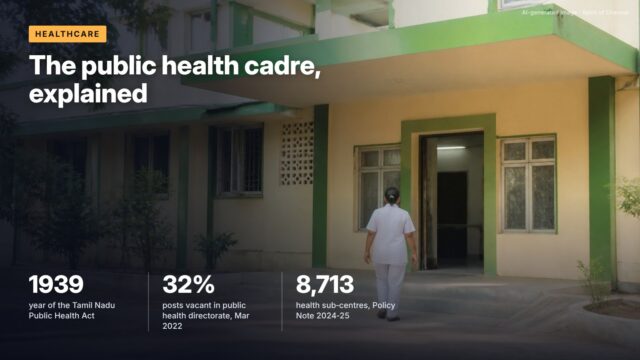
A first step was added in June 2023. Health sub-centres and primary health centres stock emergency loading-dose packs of three tablets (aspirin, clopidogrel and atorvastatin) for suspected heart attacks. The scheme covers 8,713 sub-centres and 2,286 PHCs, and the state said 8,500 patients received the dose and were referred to a hub in its first year. The tablets are given by health staff after assessment, not taken on guesswork at home.
Reducing the risk
Most heart attacks build up over years of high blood pressure, high blood sugar, smoking and raised cholesterol. Government health facilities screen adults over 30 for blood pressure and diabetes free of charge. If you have a family history of early heart disease, ask your doctor about a check-up. This article is general information, not medical advice; consult a doctor about your own risk.
Quick answers
What number do I call for a heart attack in Chennai?
Call 108, the free state emergency ambulance service. The national emergency number 112 also works.
What is the golden hour?
Doctors use it for the period soon after symptoms begin, when opening the blocked artery saves the most heart muscle. Getting to a hospital quickly matters more than anything else.
Which government hospital in Chennai treats heart attacks round the clock?
RGGGH’s Institute of Cardiology has a 24-hour chest pain clinic and cath lab. Other government medical college hospitals also have emergency departments.
Should I take aspirin at home?
Only if a doctor or the 108 call taker advises it. Some people should not take it.
Information checked against official sources on 18 October 2026. Fees, dates and rules can change; confirm on the linked official pages before acting.
Sources
- Cardiovascular diseases (CVDs) fact sheet (World Health Organization)
- Press release on health department achievements, July 2024 (Government of Tamil Nadu)
- Strengthening the cardiac-care network in Tamil Nadu (TANII, Government of Tamil Nadu)
- Report of dissemination workshop on STEMI Tamil Nadu project (ICMR)
- TN Health Minister evaluates ‘Loading dose’ scheme implementation (The Week / PTI)
- Chennai’s RGGGH cardiology marks 50 years (The South First)