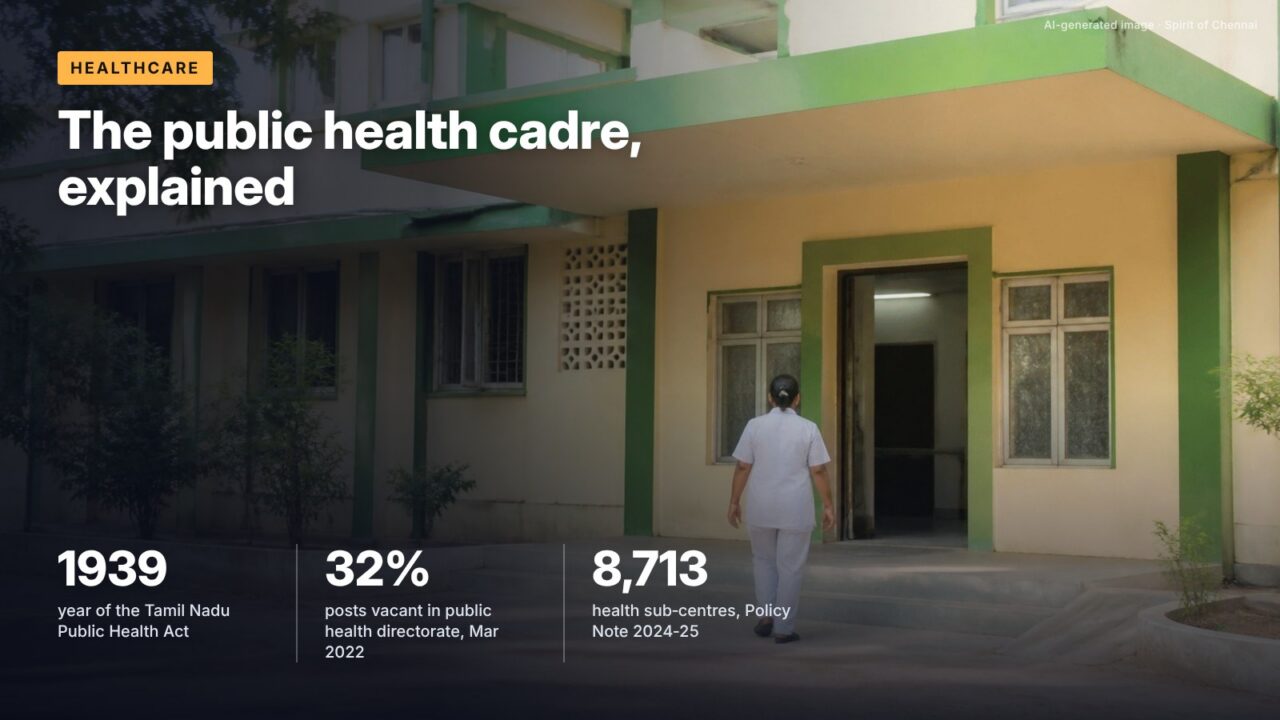
Tamil Nadu runs its preventive health work through a directorate that is legally and administratively separate from its hospitals. That split is the state’s best-known health idea, and the auditor’s staffing count shows the strain it is under.
The numbers
In most Indian states the same doctors who run hospital wards are also responsible for mosquito control, water testing and outbreak response, and the hospitals usually win the competition for time and money. Tamil Nadu chose differently. Primary care and preventive work sit with the Directorate of Public Health and Preventive Medicine (DPH); secondary hospitals with the Directorate of Medical and Rural Health Services; and teaching hospitals with the Directorate of Medical Education. The CAG’s 2024 performance audit describes the same three-way structure (para 1.4).
A 2025 World Bank discussion paper recommends that other states separate their public health and medical services directorates, with separate budgets, following what it calls the simple model of Tamil Nadu, and notes that the state gets very good health outcomes while spending no more than the national average. The model, however, is only as strong as the people in it.
A law that gives public health its own chain of command
The legal backbone is the Tamil Nadu Public Health Act, 1939, Act III of 1939, which received assent on 28 February 1939. It sets up a State Public Health Board, with the health minister as president and the Director of Public Health as secretary, and gives the Director powers to advise and direct local bodies. Section 9 lets the government require a local authority to employ a Health Officer and to recover that officer’s salary from the local body. In other words, municipalities pay for public health staff whose professional line runs to the Director.
| Chapter | What it covers | Sections |
|---|---|---|
| II | Public Health Board, Director of Public Health, Health Officers | 4 to 16 |
| III and IV | Water supply and drainage | 17 to 36 |
| VI | Abatement of nuisances | 41 to 51 |
| VII | Infectious and notified diseases | 52 to 81 |
| VIII | Maternity and child welfare | 82 |
| IX | Mosquito breeding and vector control | 83 to 88 |
| XIV | Finance, including earmarking revenue for public health | 126 to 127 |
Source: Tamil Nadu Public Health Act, 1939, as reproduced in FAOLEX (OCR text; check section numbers against the official gazette)
Few states have a comparable statute that ties drainage, water, food licensing, notifiable diseases and mosquito control to one public health authority. The Act is why a dengue drive in a Tamil Nadu town is a legal duty of a named officer, not a favour asked of a busy hospital.
The cadre the Centre now wants every state to copy
The Union health ministry’s 2022 guidance on a Public Health Management Cadre asks states to separate clinical and public health functions, with distinct cadres for specialists, public health and health management. It suggests that public health cadre doctors hold an MBBS plus an MD in community medicine or a postgraduate public health qualification, that new entrants acquire one within three to five years, and that block medical officers come from this cadre. States were asked to create the cadre by March 2022. The booklet lists Tamil Nadu among the few states that already had such a structure, and Tamil Nadu’s Director of Public Health sat on the expert committee that drafted it.
The booklet also proposes a separate health management cadre, entered at block level, with about 70% of its members holding a postgraduate public health degree and 30% drawn from management fields such as supply chain, finance and hospital administration. It cites an estimate that 77 to 80 health workers per 10,000 people are needed to reach 80% coverage of essential services. Tamil Nadu’s separate directorate already provides the structure; the vacancy figures below show how far the workforce is from those staffing levels.
Vacant posts out of 45,071 sanctioned in the Directorate of Public Health in March 2022 (CAG Report No. 5 of 2024, Table 2.1).
The staffing gap the auditor counted
| Directorate | Sanctioned | Working | Vacant | Vacancy |
|---|---|---|---|---|
| Medical Education | 30,767 | 25,112 | 5,655 | 18% |
| Medical and Rural Health Services | 19,243 | 12,932 | 6,311 | 33% |
| Public Health and Preventive Medicine | 45,071 | 30,850 | 14,221 | 32% |
| All Health Department units | 1,03,564 | 74,537 | 29,027 | 28% |
Source: CAG, Report No. 5 of 2024 (Tamil Nadu), Table 2.1, position as of March 2022
The public health directorate is the largest employer of the three and carries the largest number of vacancies. Within primary care, CAG found 6% of doctor posts, 18% of nurse posts and 27% of paramedical posts vacant in 2022; doctor vacancies had been 25% in 2019, so recruitment of doctors improved while other staff lagged. Against national IPHS staffing norms, sampled PHCs were 45% short and sampled block PHCs 53% short. Across the department, 3,621 of 10,759 sanctioned paramedical posts (34%) were empty.
Recruitment against the gap
Recruitment has been steady but not enough. The Medical Services Recruitment Board appointed 20,301 people in 2016-22, yet in March 2022 the department still lacked 2,095 doctors, 4,305 nurses and 6,391 paramedical staff. The audit, which covered 2016-17 to 2021-22 and sampled 47 facilities in six districts, counted 1,807 rural and 460 urban PHCs in the state.
It’s often said Tamil Nadu’s health results come from spending far more than other states.
The record shows The World Bank paper says the state spends no more than the national average, and CAG found the government spent around 5% of its budget on health against the 8% suggested by the National Health Policy (Executive Summary).
What the cadre delivers on the ground
The 2024-25 policy note lists 8,713 health sub-centres, the village-level outposts staffed by health nurses. It reports 1.72 crore beneficiaries of Makkalai Thedi Maruthuvam, the doorstep screening and drug delivery programme for hypertension and diabetes, and says 95% of the target population had been screened. The directorate also runs 35 of the state’s 50 labour mobile health clinics. All of this rests on field staff, which is why the paramedical vacancy rate matters more than the doctor figure.
What this means for you
- For an outbreak, foul water or a mosquito problem in your street, the legal duty lies with the local Health Officer under the 1939 Act, not with the nearest hospital.
- Your urban PHC is part of the public health directorate; it is the place for screening, immunisation and follow-up of chronic disease drugs.
- Staff shortages are worst among paramedical and nursing posts, so expect waits at labs and sub-centres rather than a missing doctor.
What to watch
Pending
The state’s replies on CAG’s human resources recommendations before the Public Accounts Committee.
Pending
Whether the 2026-27 Health Department policy note reports updated sanctioned and working strength for the public health directorate.
Checked against official sources on 23 October 2026. Figures and rules change; confirm on the linked official pages before relying on them.
Sources
- Performance Audit on Public Health Infrastructure and Management of Health Services, Tamil Nadu, Report No. 5 of 2024 (CAG)
- The Tamil Nadu Public Health Act, 1939 (Act III of 1939), text via FAOLEX (FAO)
- Booklet for Public Health Management Cadre: Guidance for Implementation, 2022 (Ministry of Health and Family Welfare / NHSRC)
- Improving Public Health Services: India’s Best Investment, HNP Discussion Paper, 2025 (World Bank)
- Health and Family Welfare Department Policy Note 2024-25 (Government of Tamil Nadu)