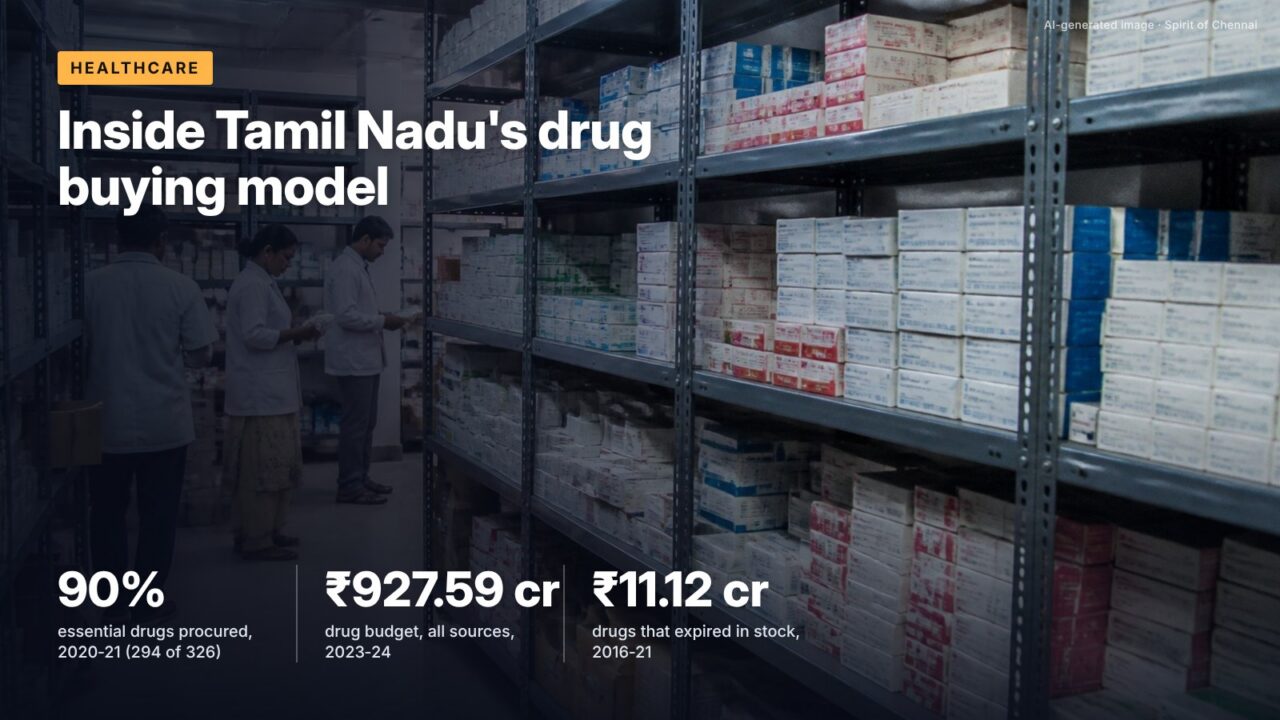
Tamil Nadu’s drug corporation is held up across India as the model for buying medicines cheaply and keeping shelves stocked. The state auditor’s 2024 report shows how the model works, and where it leaks.
The numbers
Almost every tablet, injection and dressing handed out free at a Tamil Nadu government hospital or primary health centre passes through one buyer: the Tamil Nadu Medical Services Corporation (TNMSC). The Health Department’s 2024-25 policy note describes its job as streamlining the procurement, supply and maintenance of drugs and medical equipment for government health institutions. Its company registration number carries the year 1994.
The model is centralised buying through open tenders and one-year rate contracts, storage in district warehouses, and supply to hospitals against their indents. A 2025 World Bank discussion paper on public health services cites TNMSC as a model for keeping supplies flowing. The CAG’s Report No. 5 of 2024, a performance audit of public health infrastructure tabled on 10 December 2024, tested that reputation against the records for 2016 to 2021.
How a medicine reaches a ward
The chain starts with an Essential Drugs List (EDL), the set of medicines the state commits to stock. TNMSC tenders for these, and successful bidders sign rate contracts, usually for a year, that fix the price. Suppliers then deliver to TNMSC warehouses; the audit counted supply points in 32 places. Hospitals draw stock from their warehouse against an indent, and every batch is supposed to be sampled and tested by empanelled laboratories before it is issued. The whole process runs on an online Drug Distribution Management System (DDMS).
Hospitals are not entirely tied to the warehouse. In its reply to the auditor, the government said 10% of the drug budget is kept at institution level for local purchase, so a hospital can buy what the central system fails to supply.
The money
The 2024-25 policy note puts the 2023-24 drug budget at ₹927.59 crore from all sources, of which ₹571.37 crore came from the state budget. The balance of about ₹356 crore (₹927.59 crore less ₹571.37 crore) came from other sources, chiefly centrally supported programmes. Spread over the state’s government facilities, this is the sum that has to cover everything from paracetamol to cancer drugs.
| Year | Drugs on the EDL | Drugs procured | Share procured |
|---|---|---|---|
| 2016-17 | 305 | 281 | 92% |
| 2017-18 | 314 | 307 | 98% |
| 2018-19 | 314 | 296 | 94% |
| 2019-20 | 315 | 305 | 97% |
| 2020-21 | 326 | 294 | 90% |
Source: CAG, Report No. 5 of 2024 (Tamil Nadu), Chapter IV, Table 4.3
The gap matters more than the percentage suggests. CAG noted that rifampicin, a core tuberculosis drug, was bought in only one of the five years, and benzyl penicillin in only one. The government replied that some listed drugs cannot be bought because manufacturers do not bid or the drugs are obsolete or banned.
What the auditor found in tenders and supply
At the hospital end, sampled facilities reported indented medicines that were never supplied during 2016-21: 95 at the Thanjavur medical college hospital, 61 at the Erode district headquarters hospital and 93 at Perambalur. In the tender records, 26 of 72 sampled tenders lacked mandatory documents in DDMS, and 274 price bids were opened despite incomplete papers.
The audit found 1,447 drugs from 185 suppliers delivered more than 30 days after manufacture, which eats into shelf life. Drugs worth ₹11.12 crore expired in stock, and suppliers replaced them in only 13 instances. Of suppliers who defaulted more than twice, 123 were not blacklisted. CAG also counted 2,144 purchase orders that were never cancelled and 845 cancelled late, some 885 days after issue; emergency buying to cover the gaps cost an extra ₹1.47 crore.
Cases in which drugs held in warehouses for more than six months were not re-tested, with no alert in the software (CAG, Chapter IV).
Quality control, the weakest link
Testing is what separates cheap from unsafe. The auditor found sample lifting delayed beyond two days in 3,332 of 87,495 cases, and laboratory reports for the most critical category delayed in 20,895 of 1,24,596 cases. Nineteen drug failures recurred more than twice, yet 14 of the suppliers involved were not blacklisted. Forty-six empanelled laboratories showed variations in 1,292 instances; two were blacklisted.
Most serious, drugs were issued in 520 instances after a “stop issue” order had been placed on them, covering 15.92 lakh units of 17 drugs worth ₹16.02 lakh. Dexamethasone sodium phosphate injection, a steroid, accounted for 330 of those cases.
It’s often said the TNMSC system means Tamil Nadu’s government hospitals never run short of medicines.
The record shows CAG found hundreds of indented medicines not supplied to three sampled hospitals in 2016-21, and a warehouse short-supplying a medical college, which forced local purchase (Chapter IV, para 4.4.2).
Equipment, the other half of the job
TNMSC also buys and maintains equipment, and here the audit was blunter. Four X-ray machines at Perambalur had not been installed for years; six of nine sampled PHCs in Erode and Tiruvannamalai had uninstalled X-ray units worth an estimated ₹56.25 lakh; 19 X-ray units ran without a valid licence from the Atomic Energy Regulatory Board; and 11 ECG and eight ultrasound machines lay idle for want of repair, so patients were referred elsewhere.
The auditor’s recommendations were specific: retrieve drugs that fail tests and blacklist their suppliers; make TNMSC responsible for maintaining all medical equipment, with yearly physical verification; and buy X-ray, ECG and ultrasound machines only where rooms and technicians are ready.
Why the model still matters
None of this overturns the case for central buying. Across five years TNMSC bought between 90% and 98% of the medicines on its list, at prices set by open tender, and the World Bank paper still points other states to it. What the audit exposes is weak enforcement: suppliers who fail tests or miss deliveries keep their contracts, software lacks alerts, and warehouse stock goes untested. Those are fixable inside the existing design, which is why the auditor’s recommendations are about blacklisting, testing and maintenance rather than about dismantling the corporation.
What this means for you
- If a government hospital pharmacy says a prescribed drug is out of stock, ask whether it can be bought locally; a share of the drug budget is held for that.
- Report a missing essential drug to the hospital’s Resident Medical Officer. Shortages logged by hospitals are what drive indents.
- The audit covers 2016-21. Treat it as a map of the system’s weak points, not a description of today’s stock.
What to watch
Pending
The government’s action-taken notes on Report No. 5 of 2024 to the Assembly’s Public Accounts Committee, which would show which recommendations were accepted.
Pending
The 2026-27 Health Department policy note, the first under the new government, for the next drug budget figure.
Checked against official sources on 23 October 2026. Figures and rules change; confirm on the linked official pages before relying on them.
Sources
- Performance Audit on Public Health Infrastructure and Management of Health Services, Tamil Nadu, Report No. 5 of 2024, Chapter IV (CAG)
- Report No. 05 of 2024 details page, tabled 10 December 2024 (CAG)
- Health and Family Welfare Department Policy Note 2024-25 (Government of Tamil Nadu)
- Tamil Nadu Medical Services Corporation website (TNMSC)
- Improving Public Health Services: India’s Best Investment, HNP Discussion Paper, 2025 (World Bank)