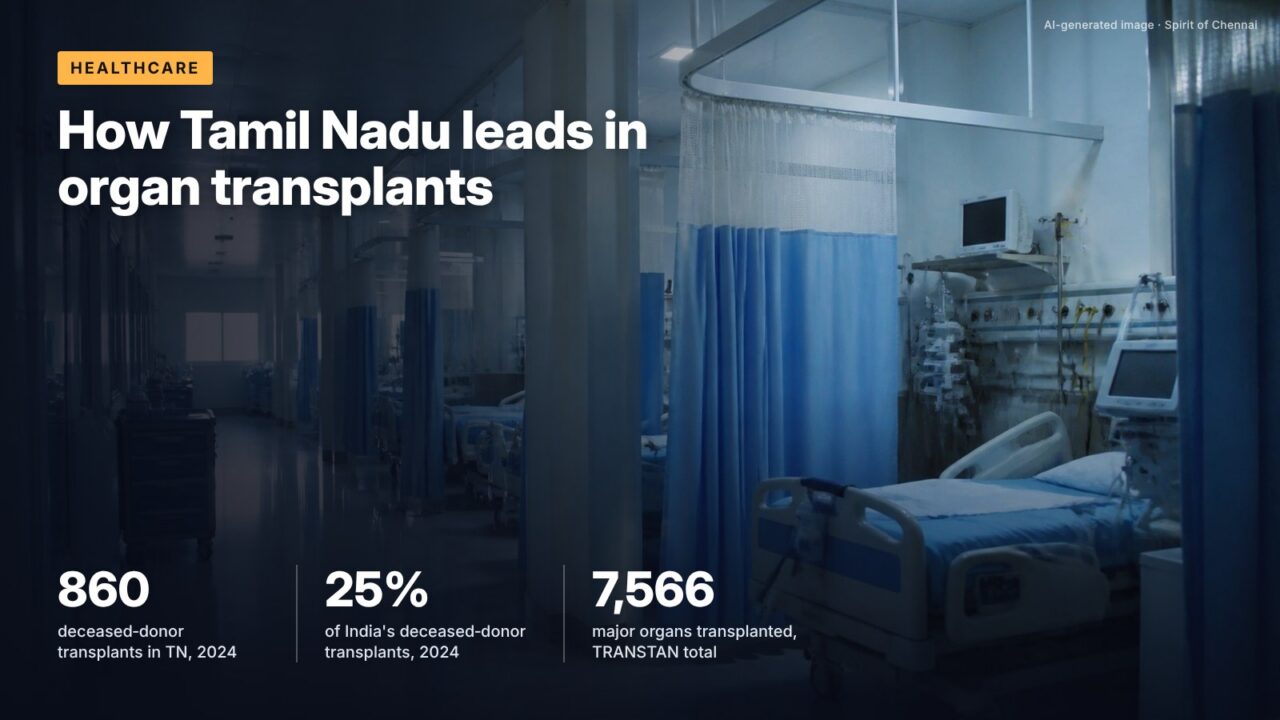
Tamil Nadu performs a quarter of India’s transplants from deceased donors. The system that makes that possible is a state authority, a shared waiting list and an insurance scheme that pays for the operation.
The numbers
In 2024, hospitals in Tamil Nadu carried out 860 organ transplants from deceased donors, more than any other state, according to national data from NOTTO, the National Organ and Tissue Transplant Organisation. Telangana came second with 587. Nationally there were 3,403 deceased-donor transplants that year, so Tamil Nadu accounted for about one in four (860 divided by 3,403).
That lead was built over a decade and a half, starting from a near standstill. The state’s 2010 press release on the programme records 6 deceased donors in 2008 and 59 in 2009, at a time when it put India’s donation rate at 0.05 per million people. What changed was not the law, which is national, but how Tamil Nadu organised hospitals around it.
How the system is organised
Organ donation in India is governed by the Transplantation of Human Organs Act, 1994, which recognises brain-stem death and sets the rules on who may donate and how hospitals are registered. Implementation falls to the states. Tamil Nadu began its cadaver transplant programme in September 2008, the 2010 release says, with revised government orders to streamline procedures and a cadaver maintenance unit at Stanley Medical College Hospital in Chennai.
The state body is now the Transplant Authority of Tamil Nadu (TRANSTAN), headed by a member secretary under the Health Department. Its core job is to run a single state waiting list and allocate each donated organ to a registered recipient by set rules, so that no hospital can quietly keep organs for its own patients. NOTTO sits above the state bodies as the national network and registry; its home page showed 4,88,784 donor pledges in the national registry when checked.
Deceased donors per million people in Tamil Nadu in early 2010, which the state said was 17.2 times the national rate at the time (press release No. 78).
What has been transplanted
| Organ or tissue | Total recorded |
|---|---|
| Kidney | 3,727 |
| Liver | 1,887 |
| Lung | 944 |
| Heart | 933 |
| Pancreas | 44 |
| Small bowel | 21 |
| Hand | 7 |
| Major organs, total | 7,566 |
| Cornea | 3,097 |
| Heart valve | 1,047 |
| Bone | 388 |
| Skin | 284 |
Source: TRANSTAN home page, cumulative counters as displayed in October 2026; the page does not state the start date of the count
Two features stand out. Hearts and lungs, which must be transplanted within hours, make up almost a quarter of the major organs, which says something about how quickly Chennai’s hospitals can retrieve and move organs. Tissue donation is a large, quieter part of the programme: more than 3,000 corneas and over 1,000 heart valves are on the same counter. The early record shows how the programme started: the state’s January 2010 release, issued a little over a year after it began, listed 136 kidneys, 52 livers, 15 hearts and 2 lungs among the organs donated. And kidneys, the organ most in demand, are only about half the total, because each donor gives at most two.
Tamil Nadu against the national trend
| Year | India deceased donors | India deceased-donor transplants | India living-donor transplants |
|---|---|---|---|
| 2013 | 340 | 837 | 4,153 |
| 2016 | 930 | 2,265 | 6,756 |
| 2019 | 715 | 2,060 | 10,604 |
| 2020 | 351 | 984 | 6,457 |
| 2022 | 941 | 2,694 | 13,338 |
| 2023 | 1,099 | 2,935 | 15,435 |
| 2024 | 1,128 | 3,403 | 15,505 |
Source: NOTTO, organ donation and transplantation data 2013 to 2024 (selected years)
Nationally, deceased donors have risen more than threefold since 2013, but living donors still dominate. The Union health ministry told the Lok Sabha in August 2024 that the deceased donor rate rose from about 0.16 per million in 2012 to 0.79 in 2023, still under one donor per million a year. It blamed poor identification and certification of brain-stem death, low awareness and a lack of trained staff and infrastructure, and said it had written to states in December 2023 asking every transplant hospital to identify potential donors in intensive care and approach families who had pledged.
It’s often said most transplants in Tamil Nadu use organs from deceased donors.
The record shows In 2024 Tamil Nadu performed 1,987 living-donor transplants against 860 deceased-donor transplants, second only to Delhi NCR for living donation (NOTTO).
Who pays for the operation
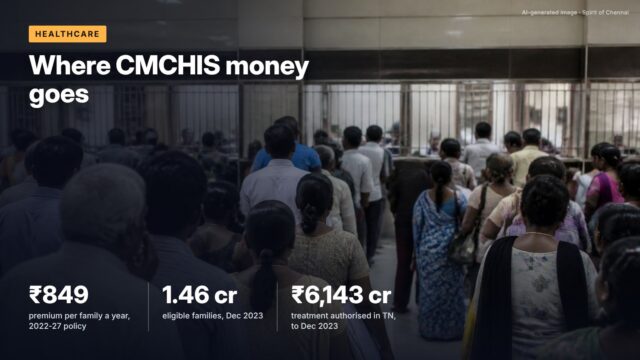
A transplant is among the most expensive procedures in medicine, and the follow-up drugs last a lifetime. Tamil Nadu covers transplants under its state insurance scheme, CMCHIS. G.O.(Ms) No.16 of 2022 kept eight high-end procedures under the scheme and moved their cost, and their follow-up, onto the insurer up to the cover limit. TRANSTAN says on its website that the state funds up to ₹22 lakh for a transplant and that 588 end-stage organ failure patients have benefited. That link between allocation and payment matters: a place on the state list is of little use to a family who cannot afford the operation.
Living donation remains the larger share nationally too. In 2024 India recorded 15,505 living-donor transplants against 3,403 from deceased donors, and living-donor kidney transplants alone (11,558) outnumbered all deceased-donor transplants more than three times over. Every deceased donor can help several patients, which is why states treat raising the deceased donor rate as the main lever on waiting lists.
Where the system is thin
The scale of the gap between supply and need is clear even without a published list. National pledges in NOTTO’s registry run to several lakh, yet India had only 1,128 deceased donors in 2024, because a pledge counts for nothing unless a death is certified in an equipped intensive care unit and the family agrees at that moment.
The official record has gaps. TRANSTAN’s public page gives cumulative totals but no year-wise donor count, no waiting-list numbers by organ and no breakdown between government and private hospitals; several of its counters appeared as placeholders when checked. NOTTO’s national file gives Tamil Nadu only for 2024. Without a published waiting list and allocation log, outsiders cannot check how long patients wait or how organs are shared between public and private hospitals.
What this means for you
- To receive an organ in Tamil Nadu, a patient must be registered on the state list through a TRANSTAN-registered transplant hospital; ask the hospital for your registration details.
- If you are on CMCHIS, ask the transplant hospital before admission whether the procedure and follow-up will be billed to the scheme.
- Pledging is useful, but family consent at the time of death decides donation. Tell your family your wishes.
What to watch
Pending
NOTTO’s 2025 national data, which will show whether Tamil Nadu kept its lead in deceased-donor transplants.
Pending
Publication of year-wise donor and waiting-list figures on TRANSTAN’s site, which would allow independent checking of allocation.
Checked against official sources on 23 October 2026. Figures and rules change; confirm on the linked official pages before relying on them.
Sources
- Transplant Authority of Tamil Nadu home page: organ and tissue totals (TRANSTAN)
- Organ donation and transplantation data, India, 2013 to 2024 (NOTTO, Ministry of Health and Family Welfare)
- Press release No. 78, cadaver organ transplantation programme, 25 January 2010 (Government of Tamil Nadu)
- Lok Sabha Unstarred Question 2036, Cases of Brain Stem Death, 02.08.2024 (Ministry of Health and Family Welfare)
- National Organ and Tissue Transplant Organisation home page (NOTTO)
- G.O.(Ms) No.16, Health and Family Welfare Department, 08.01.2022: CMCHIS high-end procedures (Government of Tamil Nadu)