


For every rupee Tamil Nadu plans to spend in 2026-27, about 33 paise will be borrowed. That is the starkest line in the full 2026-27 Budget, which Finance Minister N. Marie Wilson presented on 5 August 2026: the state expects ₹5,24,211 crore in receipts, and ₹1,73,445 crore of it is fresh borrowing.
This is the budget now in force. The previous government’s Finance Minister, Thangam Thennarasu, presented an interim budget on 17 February 2026, before the Assembly election. After the change of government in May, the TVK-led government replaced it with this first full budget for the year. All figures below are the full budget’s estimates, as compiled by PRS Legislative Research, turned into paise per rupee.
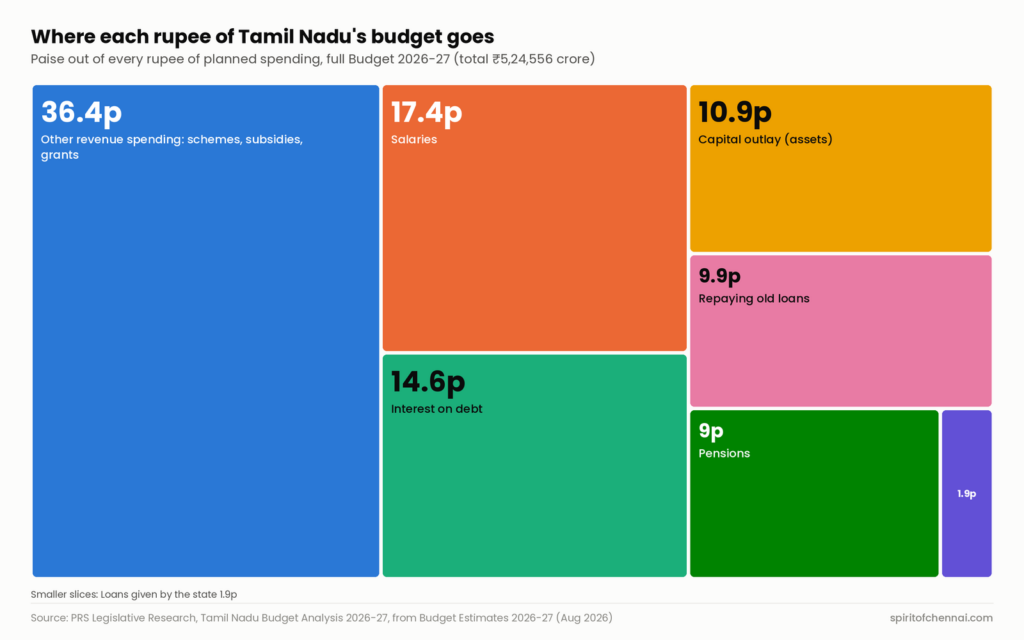
- Each rectangle is a slice of the ₹5,24,556 crore the state plans to pay out. Its area is its share, and the big number is paise out of one rupee.
- Salaries, pensions and interest are fixed bills the state must pay before any new scheme. Together they are about 41 paise.
- “Other revenue spending” is the day-to-day budget left after those three: welfare schemes, subsidies, grants to local bodies and running costs.
Where the money goes
The largest single block, 36 paise, is the broad pool of revenue spending outside salaries, pensions and interest. It holds most of what people notice: the women’s monthly entitlement scheme (₹14,414 crore), the food subsidy (₹14,000 crore), the transport corporations’ subsidy (₹7,675 crore) and free power for farm pump sets (₹7,432 crore), according to The South First’s reading of the budget papers.
Salaries take 17 paise and interest nearly 15. PRS notes that salaries, pensions and interest together come to 61% of the state’s revenue receipts, against an average of 50% for states in 2025-26. Interest alone has climbed from ₹59,909 crore in 2024-25 to ₹76,456 crore this year.
Only about 11 paise is capital outlay on roads, buildings and other assets. Another 10 paise repays old loans.
Interest the state expects to pay in 2026-27, more than its capital outlay of ₹56,985 crore, per PRS’s budget analysis.
Where the money comes from
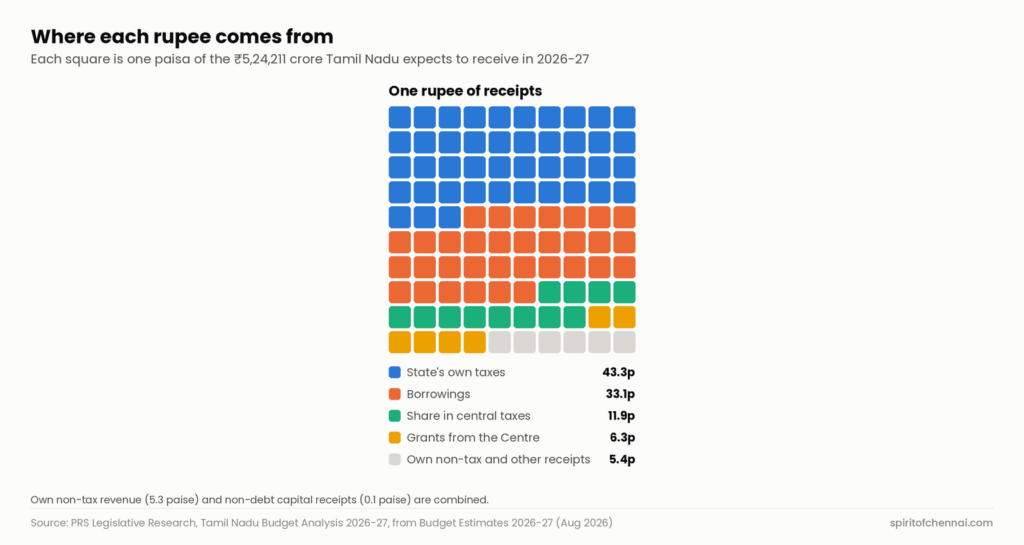
Tamil Nadu raises most of its own money. Its own taxes bring in about 43 paise of each rupee, led by state GST (₹85,200 crore), sales tax and VAT (₹70,976 crore), and stamp duty and registration fees (₹35,109 crore).
The Centre’s contribution is smaller: about 12 paise as the state’s share of central taxes and 6 paise as grants. Borrowing fills the gap at 33 paise. For a sense of pace, provisional accounts from the Principal Accountant General show ₹82,567 crore of tax revenue, including the central share, received by the end of July 2026.
What changed from the interim budget
The full budget shifted money between departments. Rural Development and Panchayat Raj rose from ₹28,687 crore in the interim budget to ₹39,609 crore, the biggest increase. School Education fell from about ₹48,534 crore to ₹44,527 crore, and Energy from ₹18,091 crore to ₹15,828 crore, The South First reported. The government said restoring financial stability would take at least two years, DT Next reported.
The numbers behind the graphic
| Item (2026-27 Budget Estimates) | ₹ crore | Paise per rupee |
|---|---|---|
| Where it goes (total ₹5,24,556 crore) | ||
| Salaries | 91,032 | 17.4 |
| Pensions | 47,240 | 9.0 |
| Interest payments | 76,456 | 14.6 |
| Other revenue spending | 1,91,074 | 36.4 |
| Capital outlay | 56,985 | 10.9 |
| Loans given by the state | 9,798 | 1.9 |
| Repayment of debt | 51,971 | 9.9 |
| Where it comes from (total ₹5,24,211 crore) | ||
| State’s own tax revenue | 2,26,740 | 43.3 |
| Borrowings | 1,73,445 | 33.1 |
| Share in central taxes | 62,531 | 11.9 |
| Grants from the Centre | 32,922 | 6.3 |
| Own non-tax revenue | 27,835 | 5.3 |
| Non-debt capital receipts | 739 | 0.1 |
Source: PRS Legislative Research, Tamil Nadu Budget Analysis 2026-27 (28 August 2026), Tables 1, 2, 3 and 5, Budget Estimates 2026-27. “Other revenue spending” is revenue expenditure (₹4,05,802 crore) minus salaries, pensions and interest. Paise are each item divided by the total, rounded to one decimal.
About the data
The figures are budget estimates from the full 2026-27 Budget of 5 August 2026, which replaced the February interim budget. They are plans, not results. The Finance Department’s own budget pages could not be opened during our check, so we used PRS’s tables, which are drawn from the budget documents, and the Principal Accountant General’s monthly accounts for collections so far.
We worked out the paise ourselves by simple division, so they may differ slightly from any “rupee comes from, rupee goes to” chart in the budget papers. Receipts and spending differ by ₹345 crore, which the state covers from its cash balance.
Quick answers
Which Tamil Nadu budget is current for 2026-27?
The full budget presented on 5 August 2026 by Finance Minister N. Marie Wilson. It replaced the interim budget presented on 17 February 2026.
How much will Tamil Nadu borrow in 2026-27?
Gross borrowings are estimated at ₹1,73,445 crore. After repaying ₹51,971 crore of old debt, net borrowing is ₹1,21,474 crore, close to the fiscal deficit of ₹1,21,819 crore (3% of GSDP).
What is Tamil Nadu’s biggest source of revenue?
State GST, estimated at ₹85,200 crore, or 38% of the state’s own tax revenue in 2026-27.
Information checked against official sources on 21 October 2026. Figures can be revised; confirm on the linked official pages before relying on them.
Sources
- Tamil Nadu Budget Analysis 2026-27 (PRS Legislative Research)
- Tamil Nadu Budget Analysis 2026-27, PDF (PRS Legislative Research)
- Accounts at a Glance, Government of Tamil Nadu, July 2026 (Comptroller and Auditor General of India)
- TVK’s first budget: tight on spending, big on justification (The South First)
- Thangam Thennarasu presents interim budget for 2026-27 (The South First)
- TN Budget 2026: TVK govt blames previous regime for fiscal stress (DT Next)


