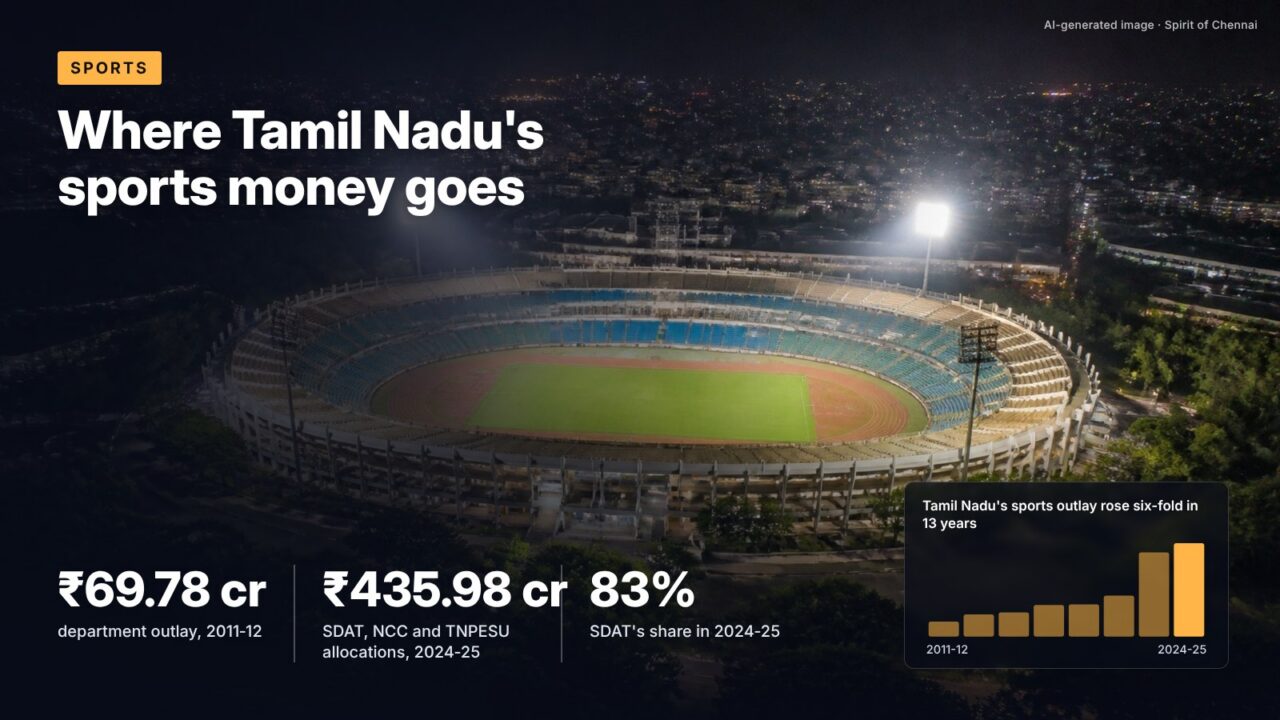
Tamil Nadu’s sports department spent about ₹70 crore in 2011-12. Its 2024-25 allocations add up to about ₹436 crore. The policy notes tabled in the Assembly show where that money goes and what changed along the way.
The numbers
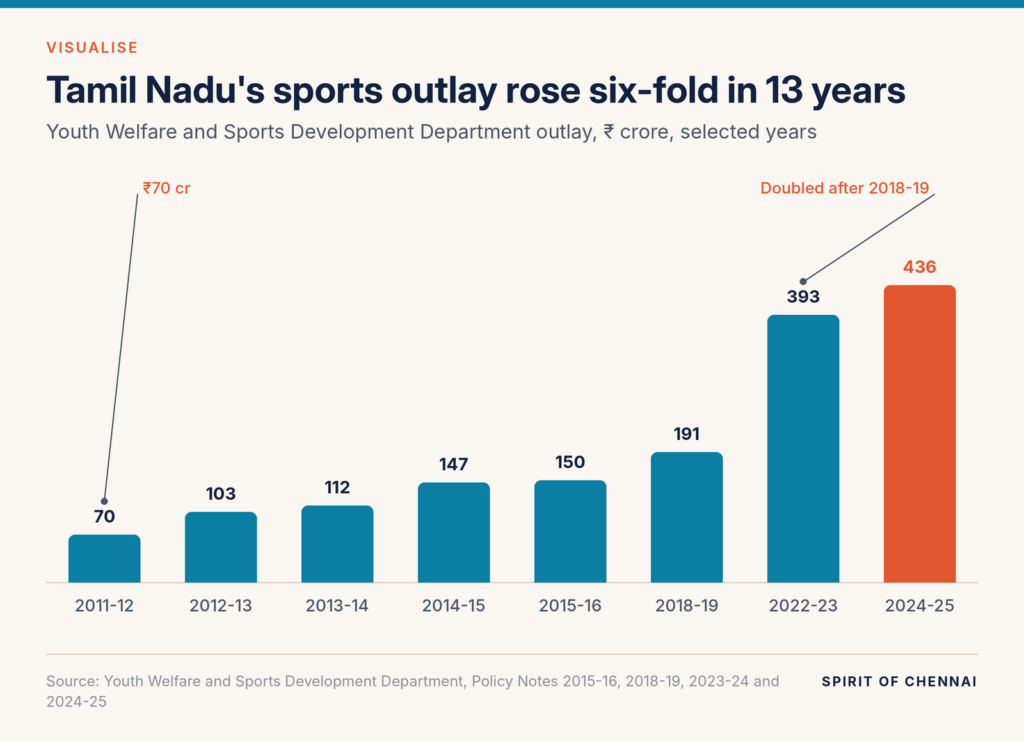
The Youth Welfare and Sports Development Department’s outlay rose from ₹69.78 crore in 2011-12 to ₹149.69 crore in 2015-16, according to the department policy note for 2015-16, and to ₹191.17 crore in 2018-19. The 2023-24 policy note said the outlay had reached ₹392.51 crore for 2022-23. In 2024-25 the department’s policy note listed allocations of ₹361.25 crore to SDAT, ₹66.37 crore to the National Cadet Corps and ₹8.36 crore to the Tamil Nadu Physical Education and Sports University, ₹435.98 crore together.
In nominal terms that is a little over six times the 2011-12 figure (₹435.98 crore divided by ₹69.78 crore). The growth was not steady: most of it came after 2018-19, and most of the new money went to SDAT rather than to the NCC or the sports university.
The early 2010s step-up
The first big rise came early in the period. The outlay grew from ₹69.78 crore in 2011-12 to ₹103.48 crore in 2012-13, a jump of nearly half in one year, then to ₹112.5 crore in 2013-14 and ₹146.64 crore in 2014-15. The 2015-16 note ties that period to an expansion of sports hostels, from about a dozen in 2011-12 to 28 with 2,060 students in 2015-16, and to a government order of January 2014 that set the hostel diet allowance at ₹250 a day.
Cash rewards also rose. The 2015-16 note records ₹4.8 crore sanctioned for medallists at the 2014 Incheon Asian Games and ₹2.7 crore for the Glasgow Commonwealth Games, plus a ₹2 crore special award to Viswanathan Anand. Five elite athletes were each receiving ₹25 lakh a year under the elite sportspersons scheme. Between 2015-16 and 2018-19, by contrast, the outlay grew by a little over a quarter, before the much larger rise that followed.
Three heads, one demand
Sport sits in Demand No. 49 of the state budget, but the department also carries the NCC, the cadet corps run with the defence ministry, and the sports university at Melakottaiyur. Splitting the totals shows how SDAT’s weight has grown.
| Year | SDAT (₹ cr) | NCC (₹ cr) | TNPESU (₹ cr) | Total (₹ cr) | SDAT share |
|---|---|---|---|---|---|
| 2015-16 | 98.73 | 45.11 | 4.50 | 149.69 | 66% |
| 2018-19 | 124.52 | 49.83 | 14.71 | 191.17 | 65% |
| 2024-25 | 361.25 | 66.37 | 8.36 | 435.98 | 83% |
Source: Youth Welfare and Sports Development Department, Policy Notes 2015-16, 2018-19 and 2024-25; 2024-25 total and all shares calculated
Two shifts stand out. SDAT’s allocation nearly tripled between 2018-19 and 2024-25, while the NCC’s rose by a third. And the sports university’s allocation fell from ₹14.71 crore to ₹8.36 crore over the same years. The 2024-25 total is the sum of the three allocations named in that note; it may leave out smaller items such as secretariat costs.
It’s often said The NCC is paid for entirely by the Centre.
The record shows The NCC is a central organisation, but the state carries its own share: Tamil Nadu’s sports department budgeted ₹66.37 crore for it in 2024-25, according to the policy note, about 15% of the three allocations combined.
What pushed spending up after 2021
The policy notes point to a handful of large items. The Chief Minister’s Trophy games, which cost ₹8.19 crore a year in the 2021-22 note, were sanctioned ₹50.86 crore for the 2023 edition. Mini-stadiums are being built in Assembly constituencies at an estimated ₹3 crore each; 61 of 234 constituencies had one by 2024-25. If the remaining 173 each get one at that estimate, the programme would cost about ₹519 crore more (173 times ₹3 crore), more than SDAT’s whole 2024-25 allocation. The TN Champions Foundation, which channels sponsorship to athletes, had sanctioned ₹8.84 crore to 397 beneficiaries.
One-off events added more. The 2023-24 note says the 44th Chess Olympiad at Mamallapuram in 2022 was organised with a budget of ₹114 crore. The WTA Chennai Open of 2022 received ₹5 crore and the Chennai Grand Masters chess event of 2023 ₹1.27 crore. New centres appear too: ₹7 crore for a sailing academy in Chennai and ₹2.58 crore for a canoeing and kayaking centre at Melakottaiyur.
Allocated in 2023-24 to maintain SDAT’s stadiums, pools and complexes, according to the 2024-25 policy note; in 2021-22 the named maintenance heads were in lakhs, such as ₹65 lakh for Jawaharlal Nehru Stadium.
People and upkeep
Coaching staff numbers moved in both directions. SDAT had 131 coaches in 2015-16 (100 regular, 18 diploma holders and 13 on contract) and 111 at the end of March 2018, according to the 2018-19 note. The 2024-25 note reports 615 sanctioned SDAT posts and 76 newly appointed coaches, without a total coaching strength. The same note lists 27 sports hostels with 1,925 students, whose daily allowances form a steady, recurring part of SDAT’s spending.
Maintenance shows the scale of the estate. The 2021-22 note listed ₹1.25 crore for the SAF Games stadia, ₹65 lakh for Jawaharlal Nehru Stadium, ₹66 lakh for district sports complexes and ₹7.5 lakh for swimming pools. SDAT then ran 26 indoor stadiums, 31 pools in 27 districts, eight synthetic athletics tracks, seven synthetic hockey turfs and 16 synthetic tennis courts.
What the policy notes do not tell you
The notes report allocations and sanctions, not audited spending, and they change format from year to year. The 2021-22 note gives no departmental total at all. None of the notes we could open link spending to outcomes such as athletes trained or facilities used. The department’s policy note for 2026-27 was not available to us, so this piece stops at 2024-25.
What this means for you
- Most state sports money flows through SDAT, so its district offices are the first stop for facilities, coaching and schemes.
- Large events and new stadium programmes, not routine coaching, explain most of the recent growth.
- The policy notes are tabled in the Assembly each year with the budget; they are the best public record of what the department plans to spend.
- Compare like with like: the 2024-25 figure here is a sum of three allocations, not an audited total.
What to watch
Pending
The 2026-27 policy note for Demand No. 49, which will show whether SDAT’s share keeps rising.
Pending
Costs for the proposed Global Sports City at Semmancheri, which the 2024-25 note named without a figure.
Checked against official sources on 23 October 2026. Figures and rules change; confirm on the linked official pages before relying on them.
Sources
- Policy Note 2015-16, Youth Welfare and Sports Development Department, Government of Tamil Nadu
- Policy Note 2018-19, Youth Welfare and Sports Development Department, Government of Tamil Nadu
- Policy Note 2021-22, Youth Welfare and Sports Development Department, Government of Tamil Nadu
- Policy Note 2023-24, Youth Welfare and Sports Development Department (Demand No. 49), Government of Tamil Nadu
- Policy Note 2024-25, Youth Welfare and Sports Development Department (Demand No. 49), Government of Tamil Nadu