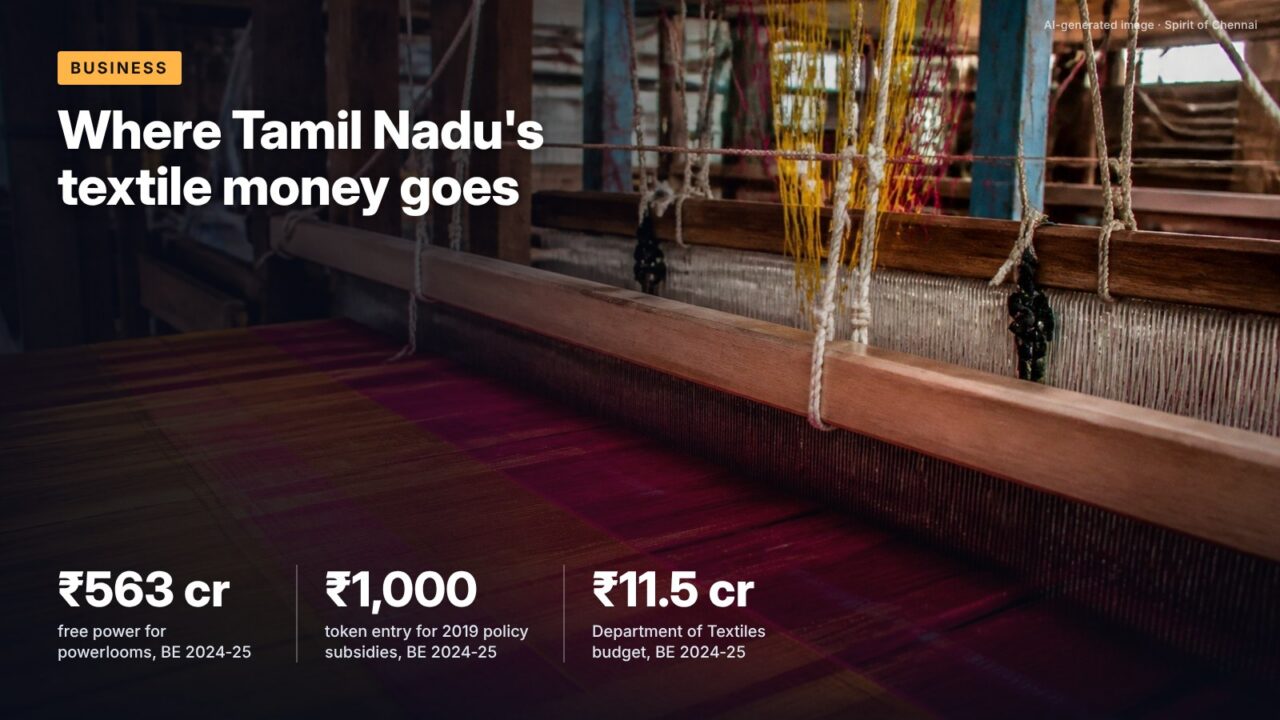
Tamil Nadu spends hundreds of crores a year keeping its looms running and its weavers paid. The state’s own budget for the mills that spin India’s yarn is a small fraction of that, and the 2019 textile policy’s incentives now carry token entries.
The numbers
The biggest single textile line in Tamil Nadu’s budget is not a factory subsidy. It is free electricity for powerloom weavers, budgeted at ₹563.18 crore for 2024-25 in the Handlooms department policy note, for 1,000 units every two months per weaver. By contrast, the Department of Textiles performance budget provides ₹1,146.29 lakh, about ₹11.46 crore, in total for 2024-25.
Inside that small sum, the incentives created by the state’s New Integrated Textile Policy, 2019, for spinning mills have been cut to token provisions of ₹0.01 lakh, which is ₹1,000, in both the revised estimate for 2023-24 and the budget estimate for 2024-25. A token entry keeps a scheme open in the accounts without funding it.
Read together, the two departments’ papers show where the state has chosen to put its money: into weavers’ incomes, through free power and large guaranteed orders, rather than into direct support for the mills.
Two departments since 2021
Until 2021, handlooms and textiles were handled together. The performance budget notes that the Department of Textiles was created in 2021 by splitting the old department. Handlooms now carries the weaver schemes and the cooperative societies. Textiles oversees the Commissioner of Textiles’ institutions: six cooperative spinning mills at Theni, Thoothukudi, Kanyakumari, Krishnagiri, Pudukkottai and Ramanathapuram, the Tamil Nadu Textile Corporation (TNTC) at Coimbatore and TANSPIN in Chennai.
The scale of the private industry dwarfs both. The 2015-16 policy note put Tamil Nadu’s share at 1,983 of India’s 3,301 textile mills, with 22.42 million spindles and about 46.78% of national spun yarn. The 2021-22 note gave 24.03 million of India’s 52.48 million spindles, about 46%, with mills employing about 2.80 lakh workers.
Free power is the largest line
The free electricity allowance has risen in steps. Powerloom weavers received up to 500 units every two months in 2014-15, 750 by 2021 and 1,000 from 3 March 2023. Handloom weavers moved from 100 units to 200 and then to 300 on the same date.
| Year | Powerloom free units (bimonthly) | Powerloom subsidy, ₹ crore | Handloom subsidy, ₹ crore |
|---|---|---|---|
| 2014-15 | 500 | 269.10 (sanctioned) | 8.33 (sanctioned) |
| 2020-21 | 750 | 383.96 (RE) | 7.46 (RE) |
| 2022-23 | 750, then 1,000 | 374.72 (sanctioned) | 6.77 (sanctioned) |
| 2023-24 | 1,000 | 496.39 (allocated) | 12.48 (spent) |
| 2024-25 | 1,000 | 563.18 (BE) | 14.72 (BE) |
Source: Tamil Nadu Handlooms and Textiles policy notes 2015-16, 2021-22, 2023-24 and 2024-25. RE is revised estimate, BE budget estimate.
The powerloom subsidy has roughly doubled over the decade, from ₹269.10 crore to ₹563.18 crore. The number of powerloom beneficiaries rose from 1,01,410 in 2015 to 1,62,799 for 2023-24. Handloom beneficiaries fell over the same period, from 1,33,764 to 75,364, which says as much about the shrinking number of active handloom households as about the scheme.
The guaranteed orders
The second pillar is state procurement. Under the free sarees and dhotis scheme, distributed at Pongal, weavers’ cooperatives produced 177.64 lakh sarees and 177.23 lakh dhotis for Pongal 2023 at a cost of ₹624.22 crore, according to the 2023-24 policy note. For Pongal 2024 the government ordered 1.77 crore of each. In 2015-16 the scheme’s budget was ₹499.16 crore.
The school uniform scheme works the same way. In 2023-24, 534.84 lakh metres of cloth were produced at a cost of ₹408.63 crore for 41,35,479 students. These two schemes keep tens of thousands of looms busy: the 2024-25 note credits the saree scheme alone with supporting about 2,664 handloom, 11,124 pedal loom and 41,983 powerloom weavers.
Value of cloth produced by handloom weavers’ cooperative societies in 2023-24; they sold ₹1,241.99 crore (policy note 2024-25).
What happened to the 2019 policy’s mill incentives
The New Integrated Textile Policy, 2019, offered spinning mills an interest subvention to modernise spindles, a capital subsidy for wider-width weaving machines and help with energy and water audits. The budget papers trace their funding.
| Scheme under 2019 policy | RE 2021-22 | BE 2023-24 | RE 2023-24 | BE 2024-25 |
|---|---|---|---|---|
| Interest subvention, spindle modernisation | ₹22.40 cr | ₹1.00 cr | ₹1,000 | ₹1,000 |
| Capital subsidy, wider-width machines | ₹1.00 cr | ₹30 lakh | ₹1,000 | ₹1,000 |
| Energy and water audit, compliance | ₹3.00 cr | ₹20 lakh | ₹1,000 | ₹1,000 |
Source: Policy Note 2021-22 (revised estimates) and Department of Textiles Performance Budget (BE 2023-24, RE 2023-24, BE 2024-25, given as ₹0.01 lakh)
The documents do not explain the cut. A token provision usually means a scheme has no new sanctions planned, has been folded into another scheme, or is awaiting a new policy. Textile units may also draw on incentives handled by the Industries department, which this budget does not show. What the Textiles department did spend in 2023-24 went mainly on administration (₹1,366.47 lakh), mini textile parks (₹500 lakh) and ways and means advances of ₹547 lakh to the functioning cooperative spinning mills.
The cooperative spinning mills
Those cooperative mills are a shadow of their past. The 2021-22 note records that 18 were set up between 1958 and 1985 with 4.70 lakh spindles; six remain, with 1,18,368 spindles, after ₹147.21 crore was spent modernising five of them.
It’s often said the state’s textile spending mainly supports big mills and exporters.
The record shows In 2024-25 the Department of Textiles had a budget of about ₹11.46 crore, while free power for powerloom weavers alone was budgeted at ₹563.18 crore, per the two departments’ budget papers.
What this means for you
- A powerloom weaver registered for the scheme gets 1,000 free units every two months; check the connection is listed under the weavers’ tariff with your electricity section office.
- Handloom weavers in cooperatives can draw on the rebate, interest subsidy and old age pension schemes listed in the policy note; the society secretary holds the application forms.
- Mill owners looking for the 2019 policy’s interest subvention should confirm with the Commissioner of Textiles whether any new sanctions are being made, given the token budget.
- For the full picture of textile incentives, read the Industries department’s policy note alongside the Handlooms and Textiles papers.
What to watch
Pending
The next policy notes for the Handlooms and Textiles departments, which will show whether the 2019 policy schemes receive real funding or are replaced.
Pending
Orders for the Pongal 2027 sarees and dhotis, the largest single procurement for the state’s looms each year.
Checked against official sources on 23 October 2026. Figures and rules change; confirm on the linked official pages before relying on them.
Sources
- Handlooms, Handicrafts, Textiles and Khadi Department Policy Note 2024-25 (Government of Tamil Nadu)
- Department of Textiles Performance Budget, Demand No. 17 (Government of Tamil Nadu, 2024)
- Handlooms, Handicrafts, Textiles and Khadi Department Policy Note 2023-24 (Government of Tamil Nadu)
- Handlooms, Handicrafts, Textiles and Khadi Department Policy Note 2021-22 (Government of Tamil Nadu)
- Handlooms and Textiles Department Policy Note 2015-16 (Government of Tamil Nadu)