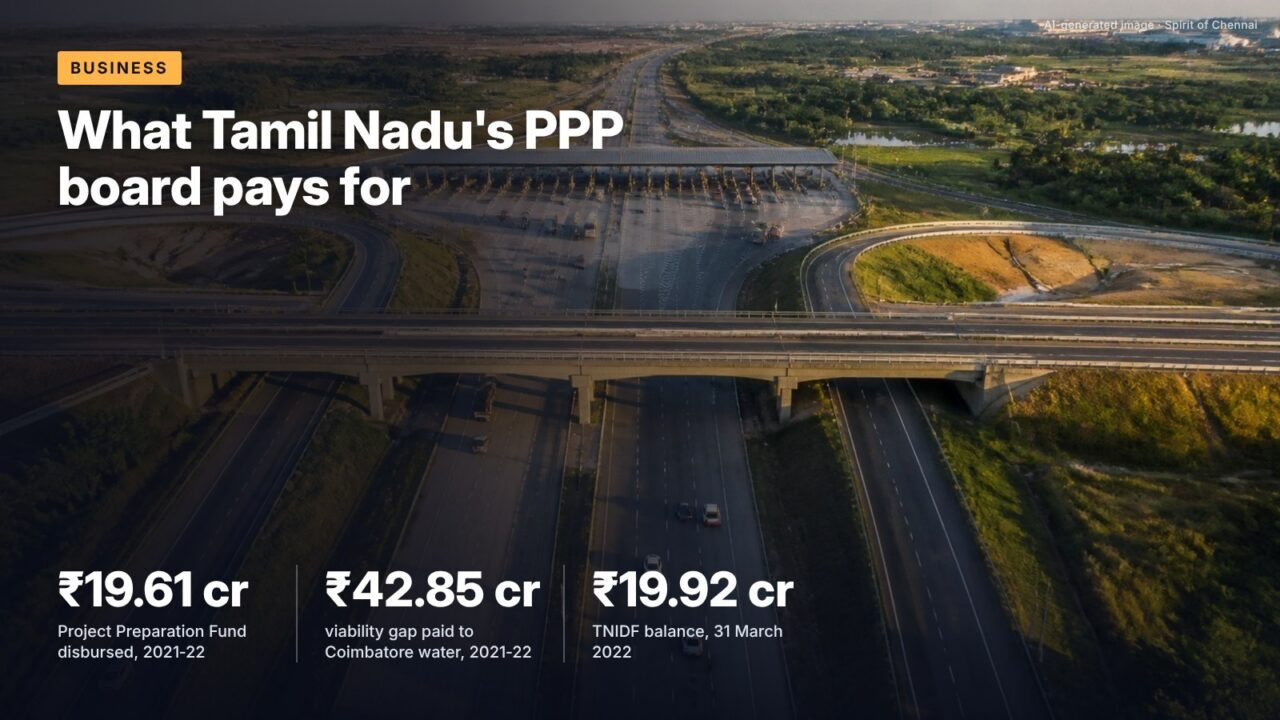
The Tamil Nadu Infrastructure Development Board was set up by a 2012 law to clear and structure the state’s big public-private projects. Its own accounts show a smaller, quieter role: paying for the studies that come before a project.
The numbers
The Tamil Nadu Infrastructure Development Board (TNIDB) is the state’s nodal agency for infrastructure development, created under the Tamil Nadu Infrastructure Development Act, 2012. Its website lists five roles: catalyst for project development, facilitator, policy driver, monitoring agency and manager of state support to projects.
Its annual reports tell a narrower story. In 2021-22 the Board disbursed ₹1,961.32 lakh, about ₹19.61 crore, from its Project Preparation Fund for studies and detailed project reports, and released ₹42.85 crore of viability gap funding to a single project, Coimbatore’s 24×7 water supply, according to its 2021-22 annual report. The separate infrastructure development fund held ₹19.92 crore at the year’s end.
In other words, the Board’s money mostly buys preparation: feasibility studies, project reports, legal and financial advice. The large sums that build roads, metro lines and treatment plants come from departments, lenders and private partners. TNIDB’s leverage lies in approving how those projects are structured.
What the 2012 law sets up
The Act gives the Board administrative authority and, with its Rules and Regulations, sets the procedure that infrastructure projects under it must follow. Two funds sit under it. The Project Preparation Fund (PPF) pays for studies. The Tamil Nadu Infrastructure Development Fund (TNIDF) supports projects financially, which in practice has meant viability gap funding, a grant that makes a project with weak revenues attractive to a private bidder.
The Board’s PPF guidance explains the rules. Section 25(4) of the Act lets the fund support the purposes set out in the rules. Rule 15 of the TNIDB Rules, 2012, lists them: technical, legal and financial studies, commercial assessments, environmental impact assessments, tender documents, papers needed before a concession agreement is signed, training and outreach. Any public agency can apply, whether or not the Board has already recommended the project. The fund can also meet the Board’s own meeting costs and the staff it hires, but not a department’s own staff or fees for serving officials working as consultants. Under Rule 17, sponsoring agencies must repay amounts recovered under the recovery provisions into the fund.
Three years of accounts
| Year | Income | Expenditure | Surplus | Corpus at year end |
|---|---|---|---|---|
| 2014-15 | ₹75.51 cr | ₹26.48 cr | ₹49.02 cr | ₹66.00 cr |
| 2018-19 | ₹26.22 cr | ₹13.39 cr | ₹12.83 cr | ₹86.22 cr |
| 2021-22 | ₹68.32 cr | ₹64.49 cr | ₹3.84 cr | ₹79.73 cr |
Source: TNIDB annual reports 2014-15, 2018-19 and 2021-22, income and expenditure accounts and balance sheets (rounded)
Almost all of the Board’s income is grant from the government: ₹75 crore of ₹75.51 crore in 2014-15 and ₹68.27 crore of ₹68.32 crore in 2021-22. Spending is mostly grants passed on to project agencies. Administrative costs are tiny; ₹3.00 lakh in 2021-22. The Board, in short, is a pass-through for preparation money rather than an investor.
The largest single PPF sanction in 2018-19, for detailed project reports covering 3,319 km of roads for the Highways department (TNIDB annual report 2018-19).
What the Board approved
The projects that reach the Board for approval are a mixed list. In 2014-15 it approved a world-class oceanarium at Mamallapuram, costed at ₹257.59 crore, as a public-private partnership, and an integrated cold chain for bananas and other produce in six regions, according to the 2014-15 report. In 2018-19 it approved the project structure and bid documents for the Athikadavu-Avinashi irrigation and drinking water scheme on a design-build-operate-transfer basis, the revised tender for integrated waste processing with waste-to-energy at Kodungaiyur and Perungudi, and a PPP for waste collection in Chennai Zones 9, 10 and 13. In 2021-22 the approval list was one item: toilets and lounges in Chennai Zones 5, 6 and 9 under a design, finance, build, operate and transfer model.
Where the preparation money went in Chennai
The PPF tables show how often Chennai’s big projects began with a TNIDB cheque. In 2014-15 the Board sanctioned ₹1 crore to Chennai Metro Rail for a master plan feasibility study and ₹14.59 crore to Metro Water for studies on the 400 MLD desalination plant at Perur. In 2018-19 it was paying instalments on the Metro Phase II detailed project report (₹4.06 crore disbursed in the year against an ₹8 crore instalment), an MRTS integration study and the first instalment of a report on extending Corridor 4. Metro Rail drew ₹7.87 crore in all that year.
In 2021-22 the list included a ₹5 crore sanction for a bus rapid transit report for Chennai, of which ₹46.61 lakh was disbursed, and ₹2.80 crore for a road safety action plan for the Chennai Metropolitan Area. Not every study becomes a project; the Perur plant and Metro Phase II did, the bus rapid transit plan has not.
It’s often said TNIDB finances Tamil Nadu’s big infrastructure projects.
The record shows Its infrastructure development fund held about ₹20 crore at the end of 2018-19 and 2021-22, and its main spending is on studies through the Project Preparation Fund. Construction money comes from departments, lenders and private partners, per its annual reports.
Gaps in the public record
The most recent annual report available on the Board’s site is for 2021-22. The reports do not give a consolidated list of every project processed under the Act, or how much has been recovered into the PPF under Rule 17. The site’s overview page also carries placeholder text in places. For a body whose purpose is transparency in project structuring, a current project register would be the most useful addition.
What this means for you
- If a Chennai project is said to be under study, the TNIDB annual report for that year often shows the sanction and how much has been disbursed.
- A PPF-funded study is not a commitment to build; check whether the project later appears as a Board approval.
- Agencies, including local bodies, can apply to the PPF for studies using the Appendix III form described on the TNIDB site.
- Viability gap funding from TNIDF has been used sparingly; a project claiming it should show a Board sanction.
What to watch
Pending
Publication of TNIDB annual reports after 2021-22 on its website.
Pending
Any amendment to the 2012 Act or Rules that changes which projects must come to the Board.
Checked against official sources on 23 October 2026. Figures and rules change; confirm on the linked official pages before relying on them.