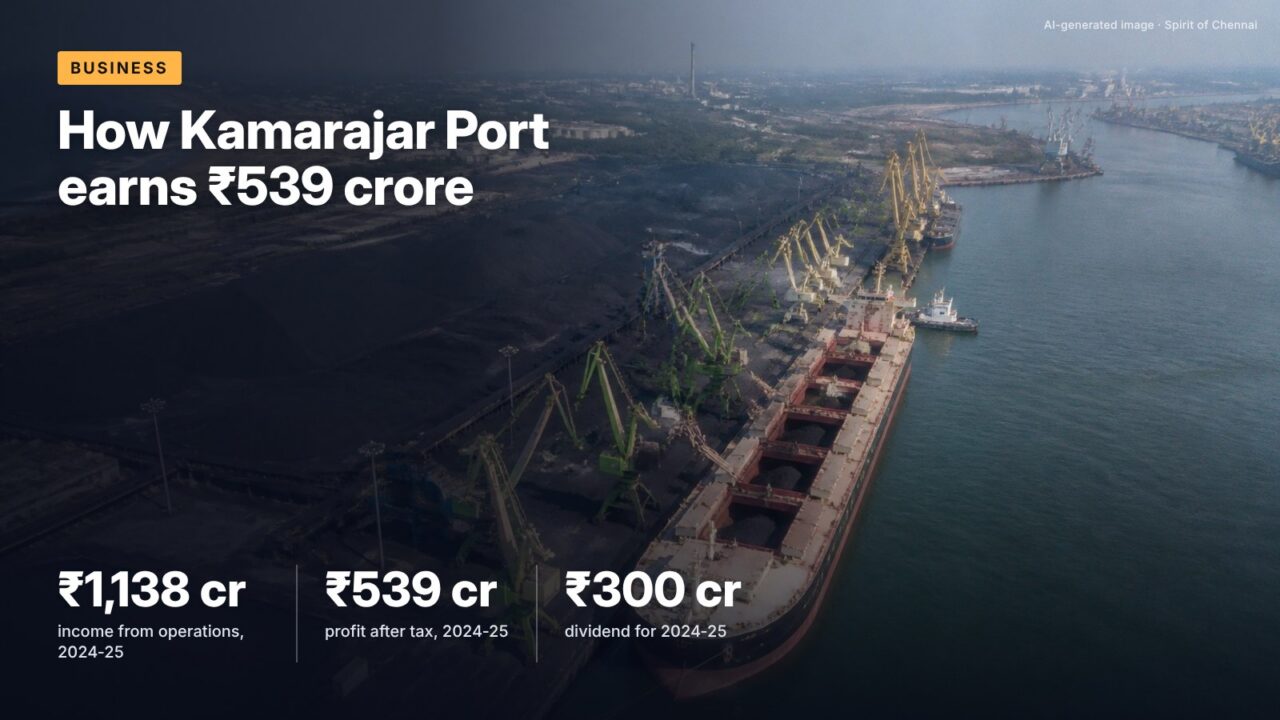
Kamarajar Port at Ennore turned ₹1,138 crore of operating income into ₹539 crore of profit in 2024-25 with 92 employees on its rolls. Its accounts show why a landlord port earns so much, and where that money goes.
The numbers
Kamarajar Port Limited (KPL) earned ₹1,138.42 crore from operations in 2024-25, up 7.17% on the year before, and kept ₹837.54 crore of it as profit before tax, according to its 25th annual report. After ₹298.21 crore of tax, the profit was ₹539.33 crore. The company declared dividends totalling ₹300 crore for the year, the same as in 2023-24.
Those are unusual figures for a business with so few employees. The reason is not high cargo charges. It is the way the port is organised: private and captive operators run most of its terminals and carry most of the operating cost, while KPL owns the land, the channel and the breakwaters, and collects revenue for providing them.
The comparison with its parent is harder to make than it should be. The Chennai Port Authority, which owns all of KPL, has filed its 2024-25 annual report and audited accounts with the shipping ministry, but the copy published there is a scanned file with no machine-readable text. This piece therefore rests on KPL’s own report and on figures the ministry has given Parliament.
A company, not a port authority
KPL is unusual among India’s major ports. It was declared a major port in March 1999 and incorporated as Ennore Port Limited under the Companies Act, 1956, in October 1999, according to its corporate page. It was commissioned on 1 February 2001 and began commercial operations on 22 June 2001, at first to land thermal coal for the state electricity board. The page calls it the first and only corporatised major port.
That status matters for the accounts. The other major ports are statutory authorities. KPL files company accounts, pays corporate income tax and declares dividends to its shareholder, which its annual report names as the Chennai Port Authority, describing KPL as a wholly owned subsidiary. A nominee of the Chennai Port Authority sits on its board.
How the landlord model shows up in the accounts
The annual report describes KPL as a landlord port. It provides the basic infrastructure, meaning road and rail links, dredged channels and marine services, and leaves cargo handling to terminal operators. Of nine operational terminals in 2024-25, four were run by build-operate-transfer (BOT) concessionaires, three were captive terminals built by users for their own cargo, and two were KPL’s own. The BOT operators named include Ennore Tank Terminals for liquids, Adani Ennore Container Terminal and the Chettinad group’s coal and multi-cargo terminals.
| Item, ₹ crore | 2023-24 | 2024-25 |
|---|---|---|
| Income from operations | 1,062.22 | 1,138.42 |
| Other income | 19.22 | 21.83 |
| Operating expenses | 176.67 | 192.06 |
| Finance costs | 62.63 | 43.67 |
| Depreciation and amortisation | 75.55 | 86.98 |
| Profit before tax | 766.59 | 837.54 |
| Taxes | 270.91 | 298.21 |
| Profit after tax | 495.68 | 539.33 |
Source: Kamarajar Port Limited, Annual Report 2024-25, financial highlights
Read down the columns and the shape is plain. Operating expenses were ₹192.06 crore in 2024-25, about 17% of operating income. Total expenses, including interest and depreciation, came to ₹322.71 crore, so roughly 72 paise of every rupee of income became pre-tax profit. Tax took 35.6% of that profit, ₹298.21 crore divided by ₹837.54 crore.
Operating income per employee in 2024-25: ₹1,138.42 crore divided by the 92 people on KPL’s rolls on 31 March 2025, 64 officers and 28 staff (KPL annual report 2024-25).
The small payroll is the clearest sign of the model. People who load coal, move containers and run cranes at Ennore are employed by the terminal operators, not by KPL. The port company is, in effect, a manager of concessions and marine assets.
Where the profit goes
The ₹300 crore dividend for 2024-25 was paid in two parts: an interim dividend of ₹90 crore, or ₹3 a share, paid on 28 March 2025, and a proposed final dividend of ₹210 crore, or ₹7 a share, subject to approval at the annual general meeting. Together they equal about 56% of the year’s profit after tax. Because KPL is wholly owned by the Chennai Port Authority, that cash goes to the parent port’s books.
Debt is falling. Finance costs dropped from ₹62.63 crore to ₹43.67 crore, a fall of about 30%. The report lists repayments during the year of ₹10 crore to HDFC Bank, ₹25 crore of a ₹40 crore facility, and ₹23.01 crore to the Chennai Port Authority, as well as interest paid on tax-free bonds. Four rating agencies rate the company AA or AA-minus with a stable outlook.
Depreciation rose about 15%, which reflects new assets coming onto the books. The report gives capital expenditure of ₹201.16 crore against ₹327.39 crore the year before, though it labels the latest figure as 2023-24 in a report for 2024-25, so the year should be confirmed with the company. KPL also spent ₹7.45 crore on corporate social responsibility in 2024-25.
Capacity: two numbers, two meanings
Readers will meet two capacity figures for Ennore. In a Lok Sabha answer of 20 December 2024, the shipping ministry said Kamarajar Port’s capacity rose from 37.00 million tonnes a year in 2014-15 to 94.00 million tonnes in 2023-24, an increase of 154%, the fastest of the 12 major ports. Chennai Port’s went from 86.04 to 136.00 million tonnes over the same period.
KPL’s own report gives operational berth capacity of 57.44 million tonnes. The two are not in conflict so much as measuring different things; the ministry’s series counts capacity as it defines it across ports, while the company figure refers to berths in operation. Against the company’s figure, the 48.41 million tonnes handled in 2024-25 used about 84% of capacity. Against the ministry’s, it used about half.
It’s often said Kamarajar Port makes its money by loading and unloading ships itself.
The record shows Most cargo at Ennore is handled by concessionaires or captive users on KPL land. Of nine operational terminals in 2024-25, only two were KPL’s own, and its operating expenses were ₹192 crore against ₹1,138 crore of operating income, per its annual report.
The projects that will shape the next accounts
The annual report lists the investments that will add to depreciation and, if cargo follows, to income. Coal berths 3 and 4, about ₹500 crore and 9 million tonnes a year each, were expected in 2025-26 and 2026-27. Indian Oil’s ₹921 crore captive jetty was completed on 31 December 2024. A ₹440.70 crore Phase VI capital dredging contract went to Van Oord. The ₹3,339 crore Northern Port Access Road was expected to be completed in December 2026. A second marine liquid terminal, costed at ₹393 crore, was waiting for its concession to be signed because of litigation.
Over the longer run, the company’s Master Plan 2047 proposes going from 9 to 27 berths and from 57.44 to 254.52 million tonnes of capacity. Those are plans, not commitments, and the pace will depend on concessionaires being willing to invest.
What this means for you
- KPL’s profit flows to the Chennai Port Authority as dividend, so the two ports’ finances are linked; read them together when the Chennai Port’s accounts are available in searchable form.
- Cargo charges at Ennore are largely set and collected by terminal operators, so a shipper’s bill reflects the concessionaire’s tariff as well as port dues.
- When you see a capacity figure for Ennore, check whether it is the ministry’s capacity series or the company’s operational berth capacity before comparing it with cargo.
- The annual report is the most complete public record of KPL’s finances; it is published on the company’s website each year after the AGM.
What to watch
December 2026
Expected completion of the ₹3,339 crore Northern Port Access Road, as given in KPL’s 2024-25 annual report.
2026-27
Coal berth 4 is scheduled for this year in the same report; coal berth 3 was due in 2025-26.
Pending
Signing of the ₹393 crore second marine liquid terminal concession, held up by litigation, and a searchable copy of the Chennai Port Authority’s 2024-25 accounts.
Checked against official sources on 23 October 2026. Figures and rules change; confirm on the linked official pages before relying on them.
Sources
- Kamarajar Port Limited, 25th Annual Report 2024-25
- Kamarajar Port Limited, Corporate information
- Lok Sabha Unstarred Question 4325, Expansion of port capacity, 20.12.2024 (Ministry of Ports, Shipping and Waterways)
- Annual Report and Annual Audited Accounts, Chennai Port Authority, 2024-25 (Ministry of Ports, Shipping and Waterways)
- Chennai Port Authority reports and accounts listing (Ministry of Ports, Shipping and Waterways)