Tamil Nadu teaches two languages in its state schools, Tamil and English, and the government formed in May 2026 has said it will keep it that way. Governor Rajendra Vishwanath Arlekar’s address to the new Assembly on 18 June 2026 restated the two-language system and the government’s opposition to the National Education Policy 2020, IANS reported; the Assembly then debated the address in a Motion of Thanks listed for 22 June.
The policy is nearly six decades old and touches every Chennai family with a child in a state board school. This explainer sets out where it came from, how it is written into school law, what changed with the 2025 State Education Policy, and where the funding dispute with the Union government stands, keeping to what each side has said on record.
How the policy began
The history goes back to the Madras Presidency. A Deccan Herald explainer lists the main dates:
| Year | Event |
|---|---|
| 1937 | Hindi made compulsory in schools by the Rajagopalachari ministry; protests until 1940, when the order was withdrawn; 1,271 people jailed |
| 1948 | Hindi made compulsory again, followed by protests |
| 1963 to 1965 | Official Languages Act and the 1964-65 agitation, in which nearly 60 people died; the Centre assured that English would continue as an official language |
| 23 January 1968 | Chief Minister C.N. Annadurai moved a resolution in the Madras Assembly; after a three-day debate it dropped the three-language formula |
Since 1968, state schools have taught Tamil and English only. Hindi is taught in Tamil Nadu mainly in CBSE and other central board schools, which follow their own language schemes.
How it sits in school law
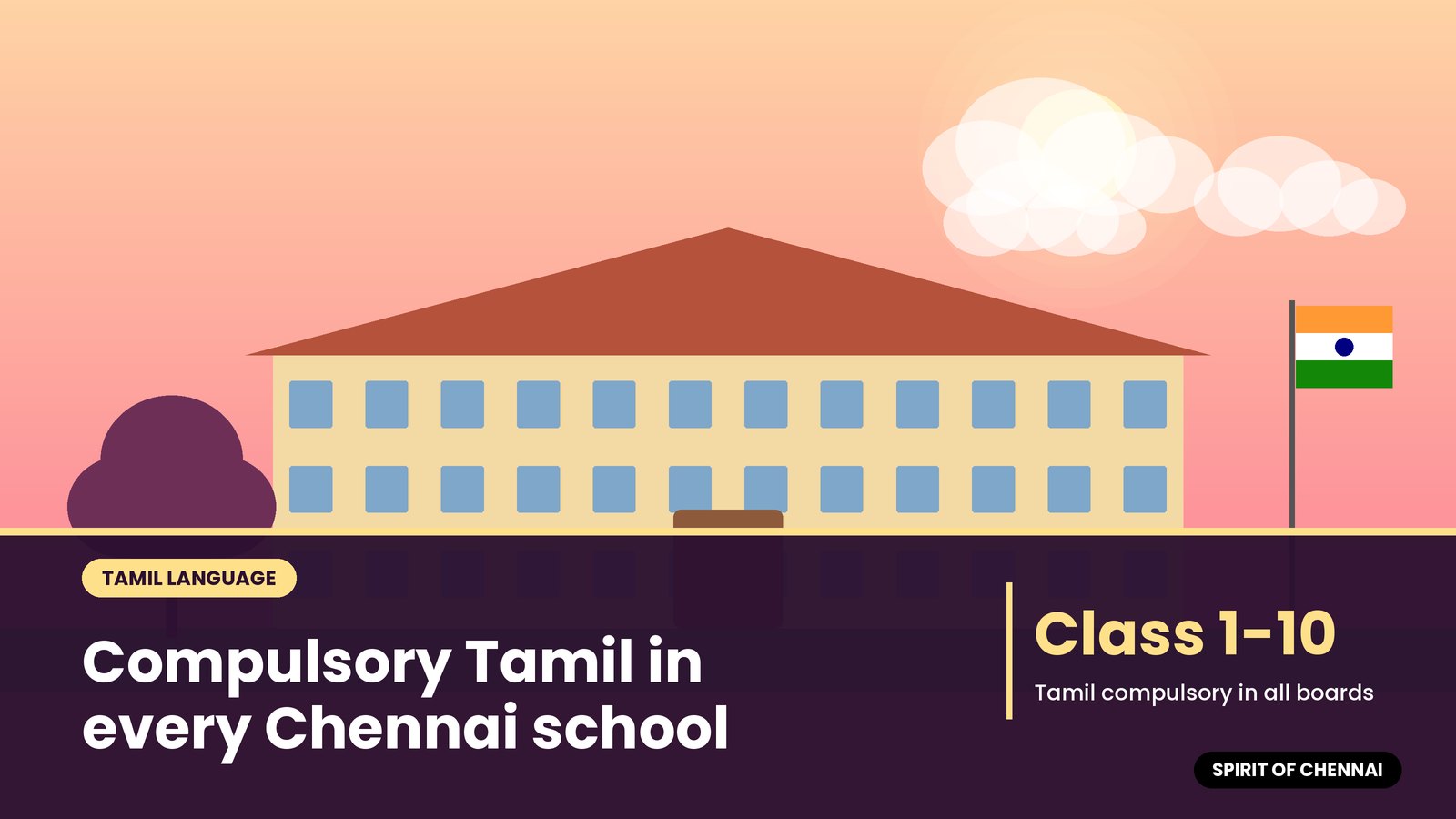
The Tamil Nadu Tamil Learning Act, 2006 fixes the language pattern for Classes 1 to 10: Part I is Tamil and Part II is English, both compulsory, according to the Act’s text. A child whose mother tongue is neither Tamil nor English may take that language as an optional Part IV subject. The 2025-26 School Education policy note says all students from Classes 1 to 10 must study Tamil, including those in CBSE and other-board schools.
So in practice there are two layers. State board schools teach exactly two languages. Central board schools must include Tamil but may add a third language under their own board’s scheme.
The 2025 State Education Policy
On 8 August 2025 the previous government released Tamil Nadu’s State Education Policy in Chennai. It was drafted by a committee formed in 2022 under retired judge D. Murugesan, which reported in 2024. The policy kept the two-language system, rejected the three-language formula in NEP 2020 and scrapped the Class 11 board exam, Deccan Herald reported.
The 2026 position and the funding dispute
After the change of government, School Education Minister Rajmohan said on 19 May 2026 that the two-language policy would continue without change and that the state would first study the conditions of the PM SHRI scheme before deciding whether to join, according to IANS in The News Minute. He said Tamil remains the language for communication within the state and English the link to the wider world.
The money question has been running since 2025. In February 2025 the Union Education Minister said states not implementing NEP 2020 would not receive Samagra Shiksha funds. In August 2025 the amount being withheld was put at Rs 2,152 crore, and the state had moved the Supreme Court. In the June 2026 Governor’s address, the state government put the withheld Samagra Shiksha amount at Rs 3,458 crore, said central funds should not be tied to the three-language formula, and said it would seek to move education from the Concurrent List to the State List. The Union government’s stated position, since February 2025, is that the funds are linked to implementing the national policy.
What it means for Chennai families
- In a state board school, your child studies Tamil and English, with no third language required.
- In a CBSE, ICSE or Kendriya Vidyalaya school, Tamil is compulsory to Class 10 and the school may also teach Hindi or another language.
- Families who want Hindi or another Indian language for a child in a state board school usually arrange it outside school hours.
- Any change in board rules is announced through the School Education Department; watch its policy notes and circulars rather than social media posts.
Quick answers
When did Tamil Nadu adopt the two-language policy?
The Madras Assembly passed the resolution moved by C.N. Annadurai on 23 January 1968.
Is Hindi taught in Tamil Nadu schools?
Not in state board schools. Central board schools may teach it in addition to compulsory Tamil.
Has the 2026 government changed the policy?
No. The School Education Minister and the Governor’s address both said it will continue.
What is the Samagra Shiksha dispute?
The state says the Centre is withholding funds because it has not adopted the three-language formula; the Centre links the funds to NEP implementation.
Information checked against official sources on 18 October 2026. Fees, dates and rules can change; confirm on the linked official pages before acting.
Sources
- Explained: Tamil Nadu’s 2-language policy and opposition to NEP, Hindi (Deccan Herald)
- Tamil Nadu Tamil Learning Act, 2006, text (PRS Legislative Research)
- School Education Department Policy Note 2025-26 (Government of Tamil Nadu)
- No going back: Stalin reiterates two-language formula, releases Tamil Nadu education policy (Deccan Herald)
- TVK govt rules out shift from Tamil Nadu’s two-language formula (The News Minute / IANS)
- Tamil Nadu government will continue to follow two language system: Governor Arlekar (IANS via Newswav)
- Tamil Nadu Legislative Assembly List of Business, 22 June 2026, Motion of Thanks on Governor’s Address (NeVA)