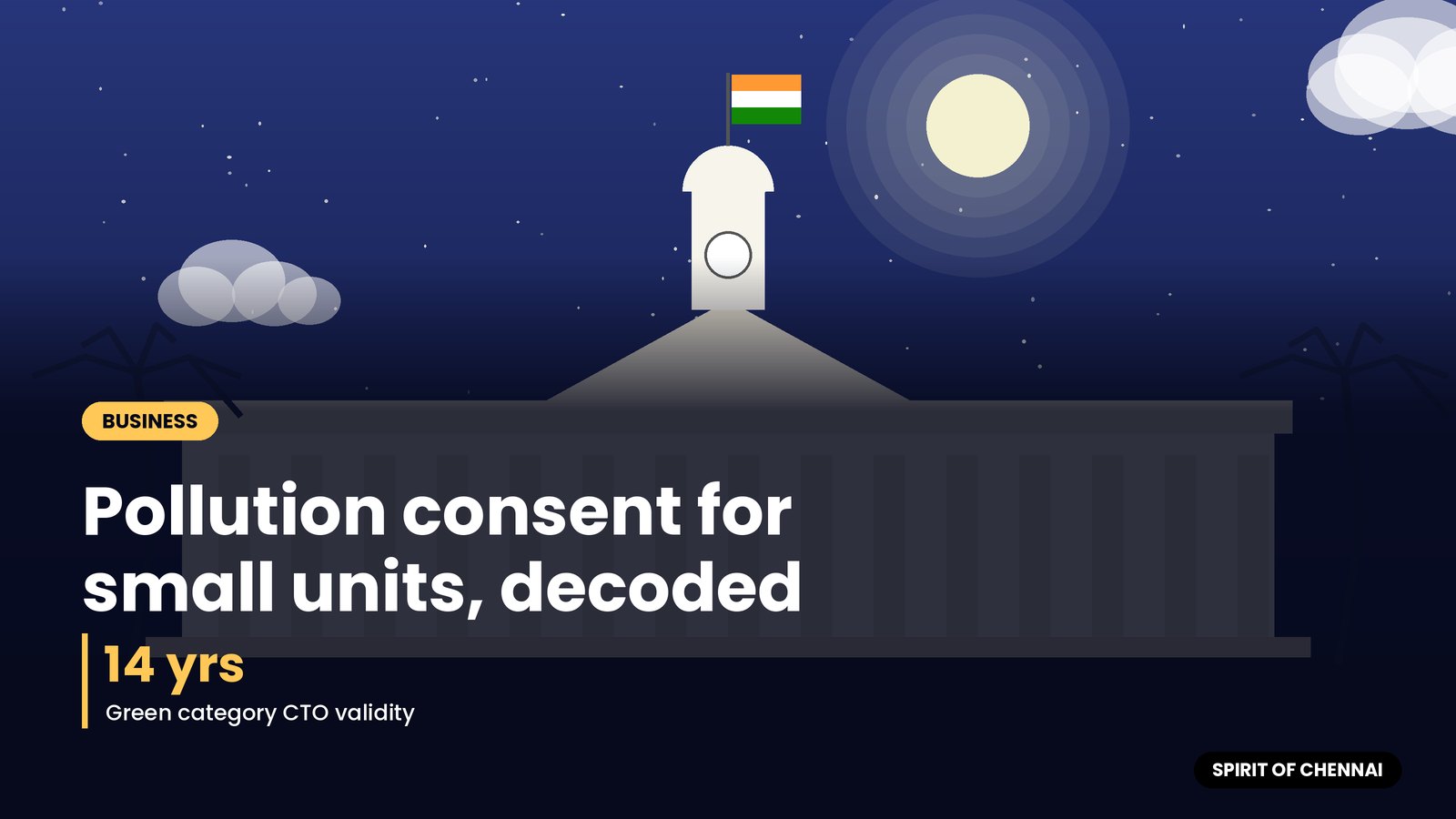
Before a small factory, workshop or processing unit in or around Chennai is built, it needs a Consent to Establish (CTE) from the Tamil Nadu Pollution Control Board, and before it starts running, a Consent to Operate (CTO). Since a 2021 government order, the board issues CTO for the full block period up front: 5 years for red category units, 10 years for orange and 14 years for green, if the whole fee is paid in advance, according to G.O. (D) No. 144.
White category units, the least polluting, need no consent at all, only an intimation to the board. Knowing which colour your activity falls in is the first step.
The four colours
The Central Pollution Control Board sorts industries by a pollution index score, as reproduced by the Maharashtra board from CPCB directions of 2016, revised in February 2025:
| Category | Pollution index | Consent needed in Tamil Nadu |
|---|---|---|
| Red | 60 and above | CTE and CTO; CTO valid 5 years |
| Orange | 41 to 59 | CTE and CTO; CTO valid 10 years |
| Green | 21 to 40 | CTE and CTO; CTO valid 14 years |
| White | Up to 20 | Intimation only |
CPCB issued fresh directions on 12 February 2025 revising the list. The CPCB list names specific activities under each colour, so look up your exact process rather than guessing. A unit that changes its process or capacity may move category.
How many units are in the system
The board’s 2021-22 policy note counted 49,524 industries under consent management statewide: 12,153 red, 26,343 orange and 11,028 green. Small units dominated every category, with 22,776 small orange units alone. Large red category units numbered 1,875, which shows how much of the board’s workload is small and medium enterprises like those in Chennai’s industrial estates.
Applying online
Applications go through the board’s Online Consent Management and Monitoring System (OCMMS), running since 19 January 2015. You file CTE, CTO and renewal applications, upload documents, pay fees, answer queries and track status online. The board runs care centres at its head office and district offices to help first-time applicants.
- Confirm your category against the CPCB list.
- Gather site documents: ownership or lease, layout plan, process description, water use and effluent details, and air emission sources.
- Apply for CTE before construction. The board checks site suitability.
- Once built and CTE conditions are met, apply for CTO before commissioning.
- Pay the full block-period fee to get the multi-year CTO.
What it costs
Consent fees depend on category and gross fixed assets, under separate water and air fee tables, according to TNPCB and You. A few rows from the water consent table show the scale:
| Gross fixed assets | Red (Rs) | Orange (Rs) | Green (Rs) |
|---|---|---|---|
| Up to Rs 1 lakh | 400 | 300 | 200 |
| Rs 9 to 10 lakh | 2,600 | 2,400 | 2,000 |
| Rs 1 crore to 5 crore | 21,800 | 17,900 | 14,200 |
Larger units pay per-lakh rates on assets beyond the table. The air consent table carries the same figures, so most units pay both. These rates are from the board’s 2020 guide, based on 2018 government orders; check the current figure at payment.
Common mistakes by first-time applicants
Small units in places like Ambattur, Thirumudivakkam or Guindy often run into the same problems with consent applications.
- Starting work on CTE alone. CTE allows you to build, not to run. Operating before CTO is a violation.
- Understating gross fixed assets. The fee is linked to it, and a mismatch with your balance sheet can lead to queries or demands later.
- Ignoring expansion. Adding machinery, raising output or changing the product can need fresh consent or an amendment. Apply before making the change.
- Letting conditions slide. The block CTO depends on continued compliance with the conditions in your consent order, so keep records of effluent treatment, stack monitoring and waste disposal.
Hazardous waste, plastic waste and e-waste rules can bring separate authorisations on top of CTO, depending on what your unit generates.
Which district office handles you
The Chennai zone has several district offices. The Chennai office at Arumbakkam (044-2622 3603) covers Chennai district, while Ambattur Industrial Estate (044-2688 0130) covers Ambattur, Madhavaram, Tiruvottiyur and Maduravoyal taluks. Maraimalai Nagar handles Alandur and Sholinganallur taluks, and there are offices at Gummidipoondi, Sriperumbudur (Oragadam) and Tiruvallur. Confirm the current jurisdiction on the board’s site, as taluks have been reorganised.
Quick answers
Does a white category unit need TNPCB consent?
No. It only needs to inform the board.
How long is a CTO valid?
Five years for red, 10 for orange and 14 for green, if the full fee is paid in advance.
Can I build first and apply later?
No. CTE is needed before construction, and CTO before you start operating.
Where do I apply?
Online through TNPCB’s OCMMS portal; district offices run help desks.
For borderline category questions, consult an environmental consultant before investing.
Information checked against official sources on 18 October 2026. Fees, dates and rules can change; confirm on the linked official pages before acting.
Sources
- TNPCB and You, 2020: consent procedure, fees and district offices (Tamil Nadu Pollution Control Board)
- G.O. (D) No. 144, 8 October 2021, consent validity (Environment, Climate Change and Forests Department)
- Policy Note 2021-22 (Tamil Nadu Pollution Control Board)
- Revised categorisation of industries (Maharashtra Pollution Control Board, reproducing CPCB directions)