Swamimalai Bronze Icons were one of Tamil Nadu’s early Geographical Indications: the application was filed on 26 July 2006 and the certificate issued on 22 April 2008, the GI register shows. The register lists 85 authorised users and gives the registration as valid until 25 July 2026, so anyone buying an icon sold as GI-tagged should check that the registration has been renewed.
The icons are cast by hand in Swamimalai near Kumbakonam, but Chennai is where most residents first see the tradition, in the Government Museum’s bronze gallery and in the state emporium’s showrooms. Here is how they are made, what the GI covers and where to look in the city.
The craft and its home
Swamimalai is a small temple town in Kumbakonam taluk of Thanjavur district. Tamil Nadu Tourism says more than 2,000 craftspeople live there and work in the lost-wax method, following the Shilpa Shastra, the traditional texts on proportion and iconography. The makers are known as sthapathis. The tradition peaked under the Cholas, between the ninth and 13th centuries.
A travel feature in Outlook Traveller puts the number of families in bronze casting at about 300. The two figures measure different things, families versus individual workers, and neither has been counted officially in recent years.
How a bronze is made
The method is called cire perdue, or lost wax, and in Sanskrit madhuchchishta vidhana, according to the Government Museum’s Guide to the Bronze Gallery. In outline:
- Wax model: the sthapathi shapes the full figure in wax, a mix of beeswax, resin and groundnut oil, to measurements from the texts.
- Clay coat: the model is covered in fine alluvial clay and dried, then given thicker layers of clay and sand and bound with wire. Channels are left for metal to enter and wax to escape.
- Burning out: the mould is heated so the wax melts and drains away, leaving a hollow in the exact shape of the figure.
- Pouring: molten metal is poured into the still-hot mould, since a cooled one could crack.
- Finishing: the mould is broken open and the figure is chased with chisels and polished.
Because the mould is destroyed, each icon is unique. Solid casting is the norm.
What the metal really is
Temple icons are traditionally described as panchaloha, a five-metal alloy of copper, silver, gold, brass and lead. The museum guide notes that its laboratory analysis found something more modest: mainly copper, with tin and lead and traces of arsenic and iron. Gold and silver were rarely detected. Keep that in mind if a seller prices an icon on its precious-metal content.
The GI tag
The GI was filed by the Development Commissioner (Handicrafts), New Delhi, under class 6, which covers metal goods. A separate logo registration, application 514, was certified on 31 March 2016. A GI means only producers in the defined area, registered as authorised users, may use the name. It does not certify the alloy or the quality of a particular piece, so ask the seller for the maker’s name and authorised-user status.
Where to see the tradition in Chennai
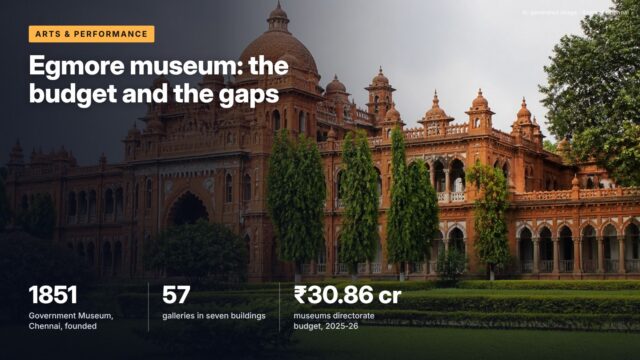
- Government Museum, Egmore: its bronze collection traces the Pallava, Chola and Vijayanagara periods. Its best-known piece is an 11th-century Nataraja from Tiruvalangadu in Tiruvallur district, 115 cm high, which the museum notes was admired by Rodin. Entry is Rs 50 for Indian adults and Rs 25 for children, and a still camera costs Rs 250, per the booking page. The museum is closed on Fridays.
- Poompuhar showrooms: the Tamil Nadu Handicrafts Development Corporation, set up in July 1973, sells Swamimalai bronze icons among its products. It lists about 15 showrooms and outlets at Chennai Airport, Vandalur and the Chennai Museum.
Old bronzes are a different matter. Antiquities cannot be freely bought or exported, and new icons from Swamimalai are sometimes mistaken for old ones.
Quick answers
When did Swamimalai bronzes get the GI tag?
The certificate was issued on 22 April 2008, on an application filed in July 2006.
Are Swamimalai icons really made of five metals?
Tradition says panchaloha, but the Chennai museum’s analysis found mostly copper with tin and lead.
Where can I see Chola bronzes in Chennai?
At the bronze gallery of the Government Museum, Egmore, open daily except Fridays from 10.30 am to 6.30 pm.
Information checked against official sources on 18 October 2026. Fees, dates and rules can change; confirm on the linked official pages before acting.
Sources
- Swamimalai Bronze Icons, GI application 64 (Intellectual Property India)
- Swamimalai Bronze Icons (Logo), GI application 514 (Intellectual Property India)
- Bronze idols and statues (Tamil Nadu Tourism)
- Guide to the Bronze Gallery, Government Museum Chennai (Tamil Digital Library)
- Nataraja, Tiruvalangadu (Government Museum, Chennai)
- Online booking and entrance fees (Government Museum, Chennai)
- About Poompuhar (Tamil Nadu Handicrafts Development Corporation)
- The GI-tagged Swamimalai bronze statues of Tamil Nadu (Outlook Traveller)