After the December 2015 floods, the Comptroller and Auditor General audited how Chennai’s drains, canals and reservoirs were planned, built and run. Its findings remain the most detailed official account of why water stayed on the streets, and a checklist for works under way now.
The numbers
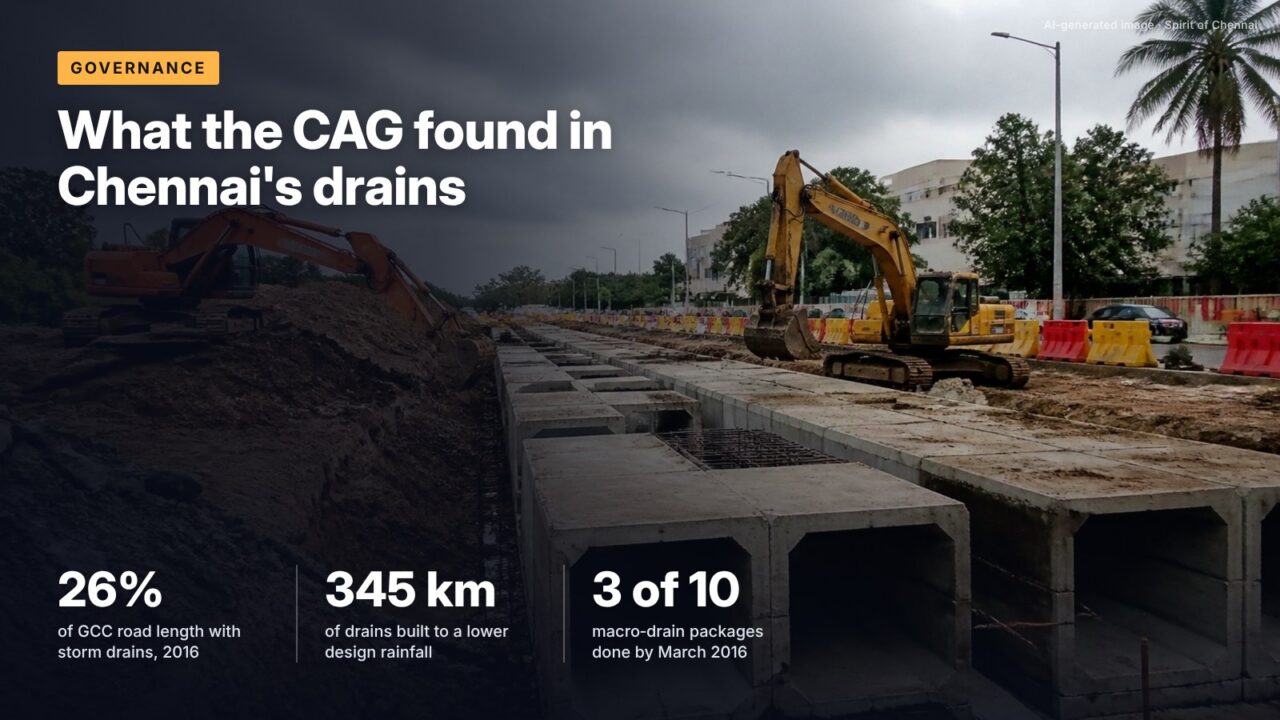
When the CAG examined Chennai’s drainage in 2016, it found that only 1,894 km of the Greater Chennai Corporation’s 7,303 km of roads had storm water drains, about 26 per cent. In four of the five zones sampled, 4,854 of 9,225 streets (53 per cent) had none. The corporation had no storm water drain master plan, and 345 km of drains built between 2011 and 2014 at a cost of ₹610.55 crore had been designed for a lower rainfall intensity than its own consultants recommended.
The findings are in Chapter 5 of Report No. 4 of 2017, the performance audit of flood management and response in Chennai and its suburbs. The audit covered April 2011 to March 2016 and was conducted between June and November 2016. Its executive summary records that 289 people died and 23.25 lakh houses were inundated in the December 2015 floods.
What the auditor found in the city’s drains
The design flaw was specific. Consultants had put the design rainfall intensity at 48.63 to 49 mm an hour; GCC designed drains using 31.39 mm an hour, so the drains could carry less water than the city’s rain demands. Of 52 missing links identified in November 2014, 42 had been fixed and 10 were in progress two years later. Rainwater harvesting was far behind: about 63,133 recharge structures were needed along existing drains, and 9,113 (14.43 per cent) had been built.
Spending was modest relative to the problem. Storm water drains took ₹855.80 crore of GCC’s ₹15,131.87 crore total expenditure between 2011 and 2016, about 6 per cent. Maintenance was patchy: in Kodambakkam, cleaning was skipped on 163 of 614 streets over 2013-16, and in Perungudi on all 898 streets in 2015-16. The audit also cited 233 illegal sewer connections into drains.
| Programme | Planned | Delivered (as audited) |
|---|---|---|
| JNNURM drains, approved April 2009 | 533.32 km, ₹814.88 crore, 1,203 works | 345 km in 885 works by June 2015; 147 works dropped |
| Macro drainage, four basins (WRD), sanctioned 2009 | ₹633.03 crore, revised to ₹699.86 crore; 10 packages | 3 packages complete by March 2016, ₹274.05 crore spent |
| TNSUDP drains in added areas, approved January 2015 | ₹2,212.89 crore, 39 packages | 25 packages missed the first 20% milestone; 4 canal packages not started |
| Rainwater harvesting along drains | About 63,133 structures | 9,113 built (14.43%) |
Source: CAG of India, Report No. 4 of 2017, Performance Audit of Flood Management and Response in Chennai, Chapter 5, paras 5.1 to 5.3
The big canals and the encroachment problem
The Water Resources Department’s macro drainage scheme, sanctioned in October 2009 and funded 35 per cent by JNNURM and 65 per cent by the state, was meant to give each basin a bigger outlet. The CAG found three packages stalled because encroachments had not been removed. The Velachery diversion, due in November 2012, had its cost revised from ₹58.15 crore to ₹88.34 crore and was still incomplete in May 2017, with ₹72.42 crore treated as unfruitful. On the Central Buckingham Canal, the planned wall was cut from 14,200 m to 1,115 m because of slum encroachment, and bridge vents were 5 to 6 m wide where 15 to 17 m were needed.
The executive summary links the floods to encroachment of tanks, lakes and riverbeds, and notes that the CMDA’s Second Master Plan (2008) did not demarcate flood plain zones, which allowed large buildings along waterways.
Flow in the Adyar on 1 December 2015, against a carrying capacity of 30,229 to 49,652 cusec for a 100-year flood, per the CAG audit.
What the audit said about Chembarambakkam
The reservoir’s operating rules had not been revised in 23 years. Storage peaked at 3.481 TMC against a capacity of 3.645 TMC, and releases rose from 12,000 to 29,000 cusec, with outflow exceeding inflow for 13 hours; the executive summary records 29,000 cusec discharged for 21 hours on 1 and 2 December 2015. Wireless communication had been down for six months before the floods, and no early warning system had been installed on the Adyar. The audit’s Recommendation No. 18 called for updated operating rules and fixed accountability. These are the auditor’s findings; the government’s replies, up to May 2017, are recorded in the report.
It’s often said the 2015 floods were simply too much rain for any system.
The record shows The rain was extreme, but the CAG audit found decisions that made it worse: drains designed for lower rainfall, a master plan without flood plain zoning, stalled diversion channels and reservoir rules unrevised for 23 years.
What has changed in the accounts since
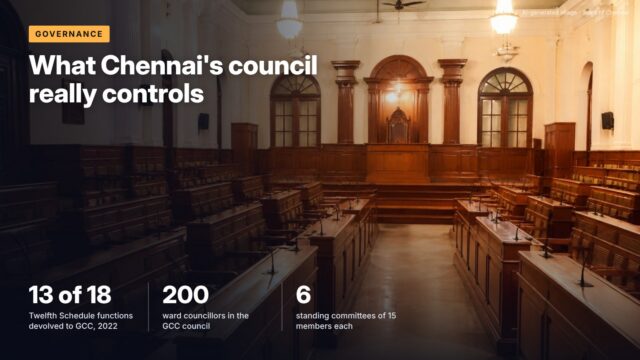
Later audits are less specific to drains but show the institutional picture. The CAG’s Report No. 1 of 2024 on local government (year ended March 2022) records that GCC had 13 of the 18 functions in the Constitution’s Twelfth Schedule devolved to it as of October 2022, that its accounts up to 2021-22 had been finalised under the National Municipal Accounting Manual, and that 61 per cent of pending local fund audit paragraphs for municipal corporations related to periods up to 2017-18. The 74th Amendment audit tabled in March 2022 separately found water supply and sewerage schemes run by state parastatals delayed.
The money now flows through loans. GCC’s 2026-27 budget books ₹350 crore of KfW loan for the Kovalam basin storm water drain project, after ₹180 crore actually drawn in 2024-25.
What this means for you
- If your street floods, check whether it has a drain at all; in 2016 more than half the streets in sampled zones did not.
- Ask your zonal office what design rainfall new drains in your ward use; the audit found older ones were under-sized.
- Encroachment of canals and lake beds was the most common reason big works stalled; complaints about blocked channels matter.
- Desilting before the monsoon is a maintenance job that the audit found was skipped on whole streets; it is worth reporting.
What to watch
Oct to Dec 2026
The northeast monsoon, which set in over Tamil Nadu on 15 October 2026, is the annual test of drains built since the audit.
Pending
Progress on the KfW-funded Kovalam basin drains, budgeted at ₹350 crore for 2026-27; revised estimates will show actual drawdown.
Checked against official sources on 23 October 2026. Figures and rules change; confirm on the linked official pages before relying on them.
Sources
- Report No. 4 of 2017, Performance Audit of Flood Management and Response in Chennai: Chapter 5, Drainage System, CAG of India
- Report No. 4 of 2017, Performance Audit of Flood Management and Response in Chennai: Executive summary, CAG of India
- Report No. 1 of 2024, Compliance Audit (Local Government) for the year ended March 2022, Government of Tamil Nadu, CAG of India
- Press brief: Performance Audit on Implementation of the 74th Constitutional Amendment Act, CAG of India (Tamil Nadu), 2022
- Budget 2026-27 at a glance, Greater Chennai Corporation, 2026