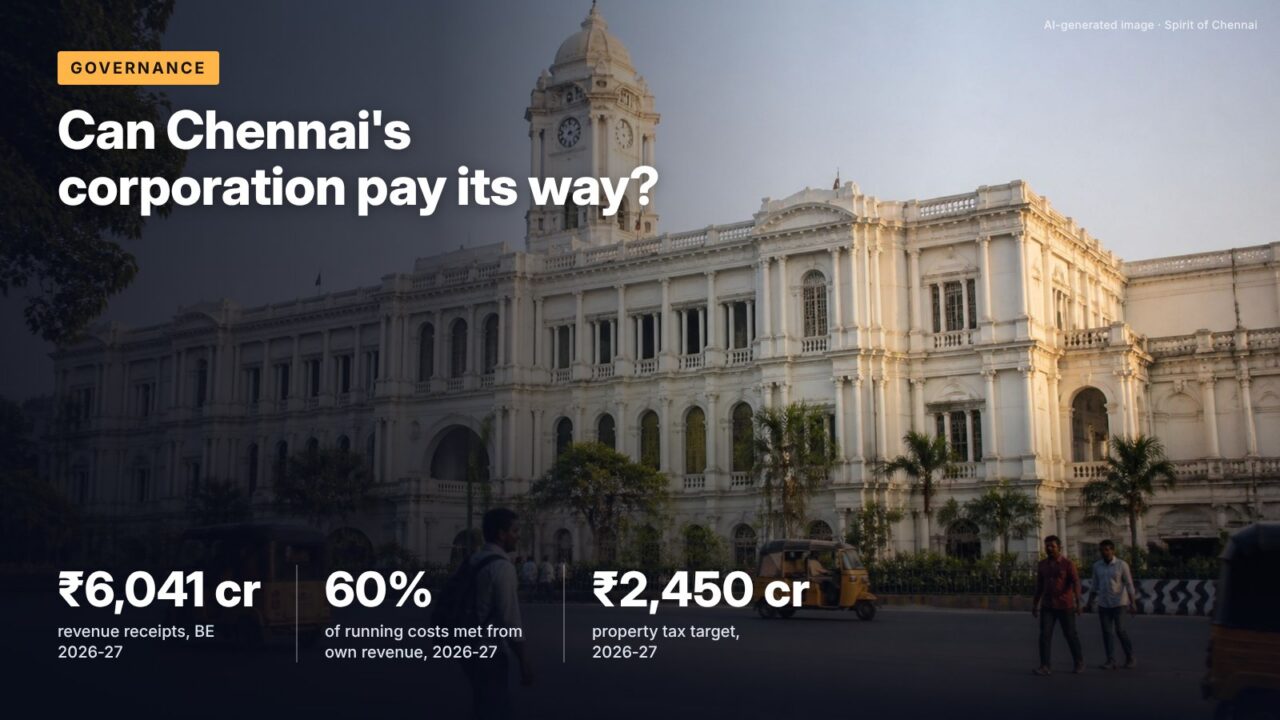
Chennai’s corporation will raise about ₹3,666 crore from its own taxes and fees in 2026-27 and spend about ₹6,146 crore on running the city. The budget papers show how the gap is filled, and why a city this size still leans on the state.
The numbers
Greater Chennai Corporation (GCC) expects revenue receipts of ₹6,040.97 crore in 2026-27 against revenue expenditure of ₹6,146.29 crore, according to its Budget 2026-27 at a glance. Of that income, only ₹3,665.97 crore is money the corporation raises itself: property tax, profession tax and smaller taxes (₹3,106 crore) plus fees, rents, interest and other income (about ₹560 crore). That covers 59.6 per cent of the cost of running the city, almost exactly the 59.2 per cent of 2024-25, when actual own revenue was ₹3,102.43 crore against ₹5,242.47 crore of revenue spending.
The rest arrives from the state and the Centre: ₹1,800 crore as “assigned revenue” (a share of state taxes and of stamp duty on property sales) and ₹575 crore as revenue grants. Capital works, from storm water drains to new schools, depend even more heavily on grants and loans. The corporation’s own accounts end 2026-27 with a projected cumulative deficit of ₹1,602.28 crore.
Where the corporation’s own money comes from
Property tax is the backbone. The budget puts it at ₹2,450 crore for 2026-27, up from an actual ₹2,070.85 crore in 2024-25 and a revised ₹2,300 crore for 2025-26. Profession tax, the half-yearly levy on salaries and businesses, is held flat at ₹600 crore for the second year running after an actual ₹573.61 crore. Entertainment tax (₹50 crore) and company tax (₹6 crore) barely register.
Non-tax income is thin for a city of Chennai’s size. Fees and user charges are budgeted at ₹398.89 crore, rent from municipal properties at ₹62.47 crore and interest earned at ₹32.55 crore. Together the non-tax items the corporation controls come to about ₹560 crore, roughly a sixth of its own revenue.
| Revenue head (₹ crore) | 2024-25 actual | 2025-26 revised | 2026-27 budget |
|---|---|---|---|
| Property tax | 2,070.85 | 2,300.00 | 2,450.00 |
| Profession tax | 573.61 | 600.00 | 600.00 |
| Total tax revenue | 2,686.40 | 2,956.00 | 3,106.00 |
| Fees and user charges | 293.16 | 398.80 | 398.89 |
| Assigned revenue (state tax share and stamp duty) | 1,347.98 | 1,600.00 | 1,800.00 |
| Revenue grants | 228.97 | 399.22 | 575.00 |
| Total revenue receipts | 4,679.38 | 5,511.77 | 6,040.97 |
| Total revenue expenditure | 5,242.47 | 6,268.48 | 6,146.29 |
Source: Greater Chennai Corporation, Budget 2026-27 at a glance (detail sheets in ₹ thousand, converted to crore), 2026
What the state hands over, and on what formula
The biggest transfer line is “assignment from tax revenue”, budgeted at ₹1,350 crore, plus ₹450 crore as the corporation’s share of duty on transfer of property. The first is the city’s slice of the pool set by the State Finance Commission (SFC). Under G.O.(Ms) No. 60 of 28 February 2023, which implemented the Sixth SFC, Tamil Nadu continues to pass 10 per cent of its net own tax revenue to local bodies. GCC is allotted 16 per cent of the urban share, and of that, 82 per cent goes to the corporation and 18 per cent to the Chennai Metropolitan Water Supply and Sewerage Board.
Central money has jumped on paper. The Central Finance Commission grant is budgeted at ₹500 crore for 2026-27, against ₹16.82 crore actually received in 2024-25. That line is a budget estimate, and Finance Commission grants usually carry conditions, so the figure is the corporation’s expectation rather than money in hand.
Budgeted salaries and establishment costs for 2026-27, within ₹13 crore of the entire property tax target, in the GCC budget at a glance.
Where the running money goes
Two heads swallow most of the revenue budget: salaries and establishment (₹2,437.40 crore) and operation and maintenance (₹2,232.70 crore). Together they take 76 per cent of revenue spending. The corporation also pays ₹493.95 crore into the elementary education fund, ₹328.21 crore in administrative costs and ₹95.20 crore in interest. Another ₹500 crore is moved to the capital fund to help pay for works.
The 2025-26 year shows how quickly the balance can swing. Revenue spending was budgeted at ₹5,214.09 crore but is now revised to ₹6,268.48 crore, largely because operation and maintenance rose from ₹1,864.44 crore to ₹2,504.07 crore. The revenue deficit for that year is revised to ₹756.71 crore, against the ₹68.57 crore first budgeted.
How the works budget is financed
Capital spending is budgeted at ₹2,754.05 crore in 2026-27, down from a revised ₹3,915.34 crore in 2025-26. It is financed by ₹1,092 crore of capital grants, ₹470 crore of loans and ₹955.34 crore of the corporation’s own funds. The loans include ₹350 crore from Germany’s KfW for the Kovalam basin storm water drain project. The 2025-26 revised figures also show a ₹405 crore municipal bond and ₹700 crore borrowed through TUFIDCO’s infrastructure funds; neither is repeated in 2026-27.
It’s often said Chennai’s property tax pays for its roads and drains.
The record shows Property tax (₹2,450 crore budgeted) roughly equals the salary bill (₹2,437.40 crore). New roads and drains are paid for mostly from capital grants, loans and transfers, according to the 2026-27 budget.
How Chennai compares with the auditors’ benchmark
The Reserve Bank of India’s Report on Municipal Finances (November 2024), which studied 232 municipal corporations, found that for most of them own revenue does not cover revenue spending, which limits their financial independence. Chennai fits the pattern: about six rupees of every ten it spends on running the city are its own.
The Comptroller and Auditor General’s performance audit of the 74th Amendment in Tamil Nadu (tabled 24 March 2022, covering 2015-16 to 2019-20) measured the same thing across urban local bodies. It found that only 43 of 200 bodies met more than 70 per cent of spending from own revenue in 2018-19, and 32 in 2019-20. It also estimated that not accepting a property tax revision proposal cost urban bodies ₹2,598.20 crore between 2013 and 2018, and that arrears of taxes and fees had reached ₹2,847.53 crore by March 2020. Those are statewide findings, not Chennai’s alone.
The Sixth SFC’s action-taken report records two decisions that bear directly on Chennai’s own revenue: the government accepted area-based valuation for urban property tax, and accepted that general revisions every five years should not be postponed, with the modification that local bodies would not be compensated for any loss if they were.
What this means for you
- Your property tax is the corporation’s largest single source of money, and the 2026-27 target is 18 per cent above what was actually collected in 2024-25.
- Profession tax collections are flat, so growth has to come from property tax, fees and state transfers.
- Watch the revised estimates, not just the budget: in 2025-26 running costs ended up ₹1,054 crore above plan.
- Large drain and road projects are tied to loans and grants, so delays in central or state releases slow works in your ward.
What to watch
Pending
The Seventh State Finance Commission, constituted on 28 May 2025, is due to report on how state taxes are shared with local bodies; its formula will set Chennai’s assigned revenue (see the Commission website).
2026-31
The 16th Finance Commission has recommended ₹25,069 crore of grants for Tamil Nadu’s urban local bodies over 2026-31, according to PRS; how much reaches GCC depends on conditions and state distribution.
Pending
The corporation’s revised estimates for 2026-27, presented with the next budget, will show whether the ₹2,450 crore property tax target was met.
Checked against official sources on 23 October 2026. Figures and rules change; confirm on the linked official pages before relying on them.
Sources
- Budget 2026-27 at a glance, Greater Chennai Corporation, 2026
- G.O.(Ms) No. 60, Finance (SFC-MC), 28 February 2023: Sixth State Finance Commission recommendations, Government of Tamil Nadu
- Action Taken Report on the Sixth State Finance Commission, Finance Department, Government of Tamil Nadu
- Press brief: Performance Audit on Implementation of the 74th Constitutional Amendment Act, CAG of India (Tamil Nadu), 2022
- Report on Municipal Finances, press release, Reserve Bank of India, 13 November 2024
- Seventh State Finance Commission, Tamil Nadu (official website)
- Tamil Nadu Budget Analysis 2026-27, PRS Legislative Research, 2026