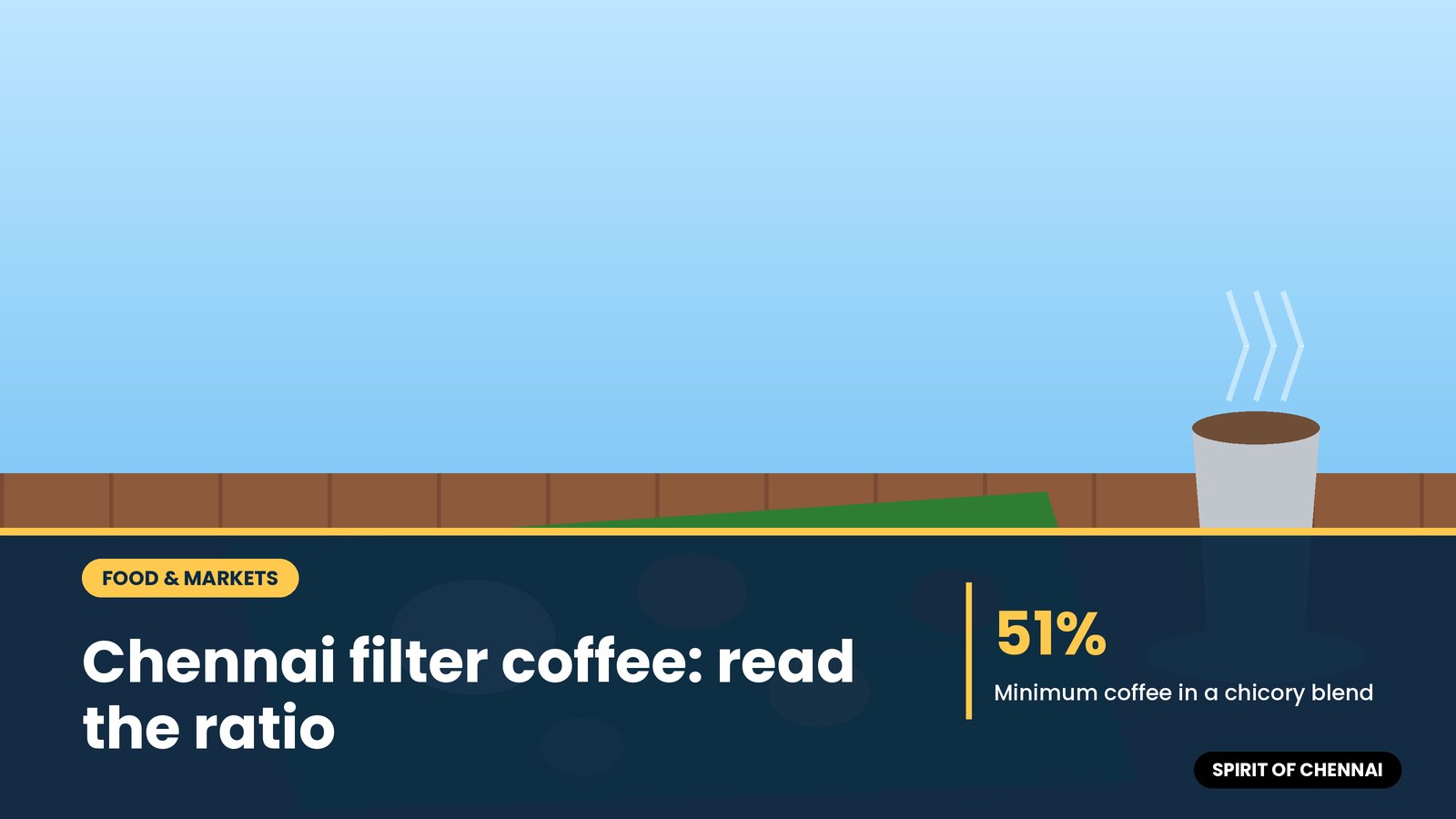
The single most useful thing to know before you buy filter coffee powder in Chennai is a food-standards rule: a coffee-chicory blend must contain at least 51% coffee by mass, and the pack must print the exact percentage of each. That is the position the Food Safety and Standards Authority of India restated to regulators in a November 2021 compliance letter, and it is the number to look for on every pouch and every handwritten board at your neighbourhood grinding shop.
The second useful thing is where the beans come from. Almost all of it is grown a few hundred kilometres west of the city, in the hills of Karnataka, Kerala and Tamil Nadu, and the Coffee Board of India publishes how much each state produces.
What the Coffee Board’s numbers say
For the 2025-26 crop year, Coffee Board statistics put India’s output at about 4.03 lakh tonnes, up from about 3.63 lakh tonnes the year before, according to a report in AgroSpectrum citing the Board’s figures. A commodity note from StoneX in February 2026 gave the same estimate split as 1,18,125 tonnes of arabica and 2,84,875 tonnes of robusta. Robusta, in other words, is well over two-thirds of what India grows.
The state picture is lopsided:
| State | 2025-26 estimate |
|---|---|
| Karnataka | about 2.80 lakh tonnes |
| Kerala | 85,150 tonnes |
| Tamil Nadu | 20,315 tonnes |
The Press Information Bureau’s coffee backgrounder adds that Karnataka, Kerala and Tamil Nadu together produce about 96% of the country’s coffee, that smallholders hold nearly 99% of coffee holdings, and that roughly 70% of production is exported. Tamil Nadu has three recognised coffee regions: the Anamalais, the Nilgiris and the Shevaroys around Yercaud. So when a Chennai shop says its blend uses “estate” beans, they are most likely from Coorg or Chikkamagaluru, with some from Wayanad or the Tamil Nadu hills.
Arabica, robusta and peaberry: what the words on the board mean
The PIB note describes arabica as the highland crop prized for flavour, while robusta grows in warmer, humid tracts and gives a stronger, more bitter cup. Many Chennai grinding shops sell a house mix of the two, plus a chicory option. A blend heavy in robusta holds up well against the large amount of hot milk a traditional davara-tumbler coffee uses, which is one reason it remains popular. Plantation A, peaberry and similar terms are trade grades, not brands, and a good shop will tell you which grades are in its mix.
India also has Geographical Indication tags for several regional coffees, including Coorg Arabica, Chikmagalur Arabica, Wayanad Robusta, Araku Valley Arabica, Bababudangiris Arabica, and the specialty Monsooned Malabar Robusta, according to the PIB backgrounder. None of these is a Tamil Nadu GI, so be sceptical of any claim of a “GI” Nilgiris or Yercaud blend unless the seller can show you the certificate.
The chicory rule, in plain terms
Chicory is a roasted root that adds body and a darker colour at lower cost. It is legal and many families prefer it. The FSSAI letter sets three practical points:
- A mixture must be at least 51% coffee. A 70:30 or 80:20 pack is fine; a 40:60 pack sold as coffee is not.
- Every package of a mixture must declare the coffee and chicory percentages on the label.
- A blend cannot be sold as “pure coffee”. FSSAI says the word “pure” may describe only a single-ingredient food with nothing added.
Loose powder ground in front of you at a small shop is still a food sale. Ask for the ratio and expect a straight answer. If a printed pack says “pure filter coffee” and lists chicory in the ingredients, that is a labelling problem.
How to buy well in Chennai
- Buy small, buy often. Ground coffee loses aroma within days. Buying 100 to 250 grams a week beats half a kilo a month.
- Ask for the roast date or watch the roasting. Shops that roast on site will usually tell you when the current batch was done.
- Name your ratio. Ask for pure coffee, or say “80:20” or “70:30”.
- Ask about the grind. Filter coffee needs a medium-fine grind for the traditional steel filter.
- Store it airtight and away from the stove. Chennai’s humidity, especially in the October-December monsoon, makes powder clump quickly.
- Read the pack. For branded powders, check the coffee-chicory percentages, the FSSAI licence number and the packing date.
Prices, taxes and the wider trade
Coffee prices in Chennai follow what happens in the plantation districts and in world markets, since most of India’s crop is exported. The PIB note records that exports hit a record of about USD 1.8 billion in 2024-25. It also notes that GST on instant coffee and coffee extracts was cut from 18% to 5%, which was expected to reduce retail prices of those products. Local powder prices change with each batch; compare per-100-gram rates.
For growers’ data and quality standards, the Coffee Board, set up under the Coffee Act of 1942, is the reference point.
Quick answers
Is chicory in filter coffee allowed?
Yes. A blend must be at least 51% coffee by mass and the label must state both percentages, according to FSSAI.
Where do Chennai’s coffee beans come from?
Mostly Karnataka, which grows about 70% of India’s coffee, followed by Kerala and Tamil Nadu’s Anamalais, Nilgiris and Shevaroys.
Is arabica or robusta better for filter coffee?
Neither is “better”. Robusta gives body and strength that stands up to milk; arabica adds aroma. Most shop blends mix them.
How long does ground filter coffee stay fresh?
Aroma fades within days of grinding. Buying small quantities and storing them airtight gives the best cup.
Information checked against official sources on 18 October 2026. Fees, dates and rules can change; confirm on the linked official pages before acting.