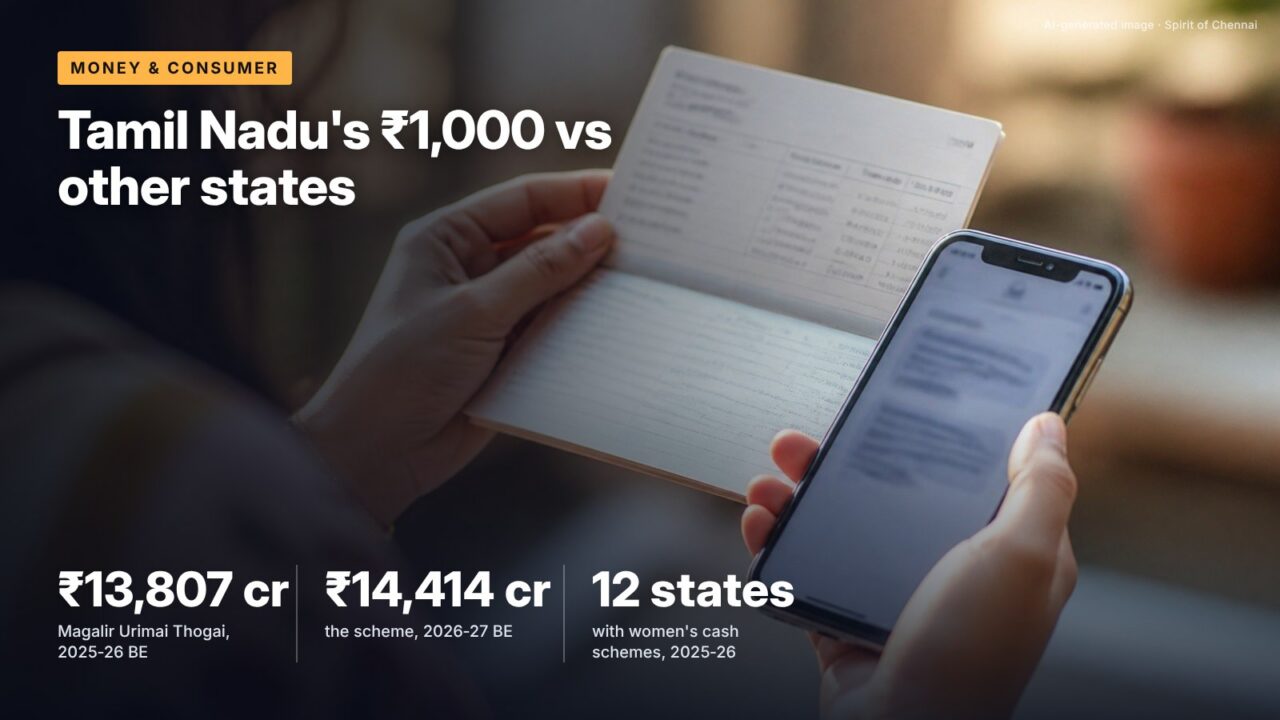
In 2022-23 only two states paid women a regular unconditional cash sum. By 2025-26 there were twelve, Tamil Nadu among them. Set side by side, the official budget figures show where Tamil Nadu’s ₹1,000 sits on cost, generosity and fiscal room.
The numbers
Tamil Nadu budgeted ₹13,807 crore for Magalir Urimai Thogai in 2025-26, paying ₹1,000 a month to eligible women aged 21 and above, according to the comparison table in PRS Legislative Research’s State of State Finances 2025. The 2026-27 budget presented on 5 August 2026 raises the line to ₹14,414 crore, 4.4% more, as recorded in PRS’s analysis of that budget.
Across the twelve states in the PRS table, such schemes were estimated to cost ₹1,68,040 crore in 2025-26, about 0.5% of India’s GDP. Tamil Nadu’s is the fifth largest by money, but its monthly payment is among the smallest, and its fiscal position differs from some of the states that pay more.
Twelve schemes side by side
| State | Scheme | ₹ a month | 2025-26 BE (₹ cr) |
|---|---|---|---|
| Maharashtra | Majhi Ladki Bahin | 1,500 | 36,000 |
| Karnataka | Gruha Lakshmi | 2,000 | 28,608 |
| West Bengal | Lakshmir Bhandar | 1,000-1,200 | 26,700 |
| Madhya Pradesh | Ladli Behna | 1,250 | 18,669 |
| Tamil Nadu | Magalir Urimai Thogai | 1,000 | 13,807 |
| Jharkhand | Maiyan Samman | 2,500 | 13,363 |
| Odisha | Subhadra | 833 | 10,145 |
| Chhattisgarh | Mahtari Vandan | 1,000 | 5,500 |
| Delhi | Mahila Samriddhi | 2,500 | 5,110 |
| Assam | Orunodoi | 1,250 | 5,000 |
| Haryana | Lado Laxmi | 2,100 | 5,000 |
| Himachal Pradesh | Pyari Behna Sukh Samman Nidhi | 1,500 | 138 |
Source: PRS Legislative Research, State of State Finances 2025, Table 6 (budget estimates 2025-26), sorted by allocation for this article
Only Odisha, at ₹833, pays less a month than Tamil Nadu’s ₹1,000; Chhattisgarh matches it and West Bengal pays ₹1,000 to ₹1,200. Karnataka pays double, Jharkhand and Delhi two and a half times. Eligibility also varies: Tamil Nadu sets a lower age of 21 with no upper limit in the PRS table, while Madhya Pradesh, Odisha and West Bengal stop at 60 and Maharashtra at 65.
At the young end, Assam and Haryana start at 18, and Jharkhand pays women only from 18 to 50. Himachal Pradesh’s scheme is being phased in for women aged 18 to 59, which explains its ₹138 crore allocation. Comparing schemes on the monthly figure alone therefore misleads: a state with a narrow age band can pay more per woman and still spend less in total, while Tamil Nadu’s open upper age limit widens its pool of eligible women.
What the money implies about reach
Neither PRS nor the budget documents I opened give a beneficiary count. A rough reach can be read from the money: ₹13,807 crore divided by ₹12,000 a year per woman gives about 1.15 crore women paid for a full year. The 2026-27 figure of ₹14,414 crore works out to about 1.2 crore on the same basis. These are implied numbers, not official counts, and they ignore administrative costs and months of partial payment.
Set against the state’s 2.24 crore family cards counted in May 2024, the implied figure suggests a little over half of card-holding families receive the payment, consistent with a scheme designed for selected rather than all households.
Combined 2025-26 spending of the twelve states on unconditional cash transfers to women, which PRS estimates at about 6% of their revenue expenditure (State of State Finances 2025).
The fiscal room around it
PRS notes that six of the twelve states budgeted a revenue deficit in 2025-26, meaning they borrow to meet day-to-day spending, and shows how much the transfers weigh on budgets: for Karnataka the difference between its revenue balance with and without the scheme is 0.9% of GSDP, and for Madhya Pradesh 0.7%.
Tamil Nadu is one of the states already in revenue deficit. Its 2025-26 revised estimate shows a revenue deficit of ₹69,219 crore, 1.9% of GSDP, and the 2026-27 budget estimate ₹55,775 crore, 1.4%. The Urimai Thogai allocation for 2026-27 is equal to about a quarter (25.8%) of that year’s budgeted revenue deficit. Committed spending on salaries, pensions and interest takes 61% of revenue receipts in 2026-27, leaving welfare schemes to share the rest.
The CAG’s State Finances Audit Report for 2024-25 adds that Tamil Nadu’s own tax revenue, at 5.78% of GSDP, is below the all-states average, which limits how far such schemes can grow without new revenue.
It’s often said Tamil Nadu’s women’s payment is the most generous in India.
The record shows On PRS’s 2025-26 table, ten of the twelve states pay as much or more each month. Tamil Nadu ranks fifth on total allocation, behind Maharashtra, Karnataka, West Bengal and Madhya Pradesh.
Cash, work and what the data cannot say
Unconditional transfers are not tied to work, and their effect on women’s employment is not measured in the official data reviewed here. For context, the Periodic Labour Force Survey annual report for 2025 puts India’s female labour force participation at 40.0% for women aged 15 and above, against 79.1% for men. Whether a monthly ₹1,000 changes that in Tamil Nadu is a question for evaluation studies, none of which appear in the budget papers.
What the numbers do show is the scale of commitment. At ₹14,414 crore, the scheme is larger than the ₹10,500 crore the state provided for its whole food subsidy in 2024-25 and larger than the ₹8,452 crore budgeted for domestic power subsidy in 2026-27.
How big the line is in Tamil Nadu’s budget
PRS’s 2026-27 analysis puts the state’s total expenditure at ₹5,24,556 crore and net expenditure, excluding debt repayment, at ₹4,72,585 crore. The ₹14,414 crore for Urimai Thogai is about 3.1% of net expenditure. PRS’s national estimate is that the twelve states together will spend about 6% of their revenue expenditure on such transfers in 2025-26, so Tamil Nadu’s scheme is substantial but not an outlier in weight. The rise from ₹13,807 crore to ₹14,414 crore, ₹607 crore, is small beside the state’s ₹1,21,819 crore fiscal deficit budgeted for 2026-27.
What this means for you
- The payment is ₹1,000 a month; the 2026-27 budget raises the allocation by 4.4%, not the monthly amount by itself.
- Coverage depends on eligibility rules, not the budget line; a larger allocation can mean more women, more months paid, or both.
- Compare schemes on monthly amount and age limits together; a higher payment with a 60-year cap may exclude older women Tamil Nadu covers.
- Because the state is in revenue deficit, any increase is financed partly by borrowing unless new revenue is found.
What to watch
2026-27 revised estimates
Due with the 2027-28 budget. They will show whether the ₹14,414 crore was spent, and therefore whether coverage grew.
Pending
Any change to the monthly amount or eligibility, which would need a government order and show in the budget line.
Checked against official sources on 23 October 2026. Figures and rules change; confirm on the linked official pages before relying on them.
Sources
- State of State Finances 2025 (PRS Legislative Research, 2025)
- Tamil Nadu Budget Analysis 2026-27 (PRS Legislative Research, August 2026)
- State Finances Audit Report, Tamil Nadu, 2024-25: Executive Summary (Comptroller and Auditor General of India, 2026)
- Food and Consumer Protection Department Policy Note 2024-25, Demand No. 13 (Government of Tamil Nadu)
- Periodic Labour Force Survey Annual Report 2025 released, 27.03.2026 (PIB, Ministry of Statistics and Programme Implementation)