The Street Vendors Act of 2014 gave hawkers a legal right to trade, but how that right works on a Chennai pavement depends on a 2015 Tamil Nadu scheme that sets fees, zones and eviction rules. Here is what the law and the scheme say, and what the official numbers show.
The numbers
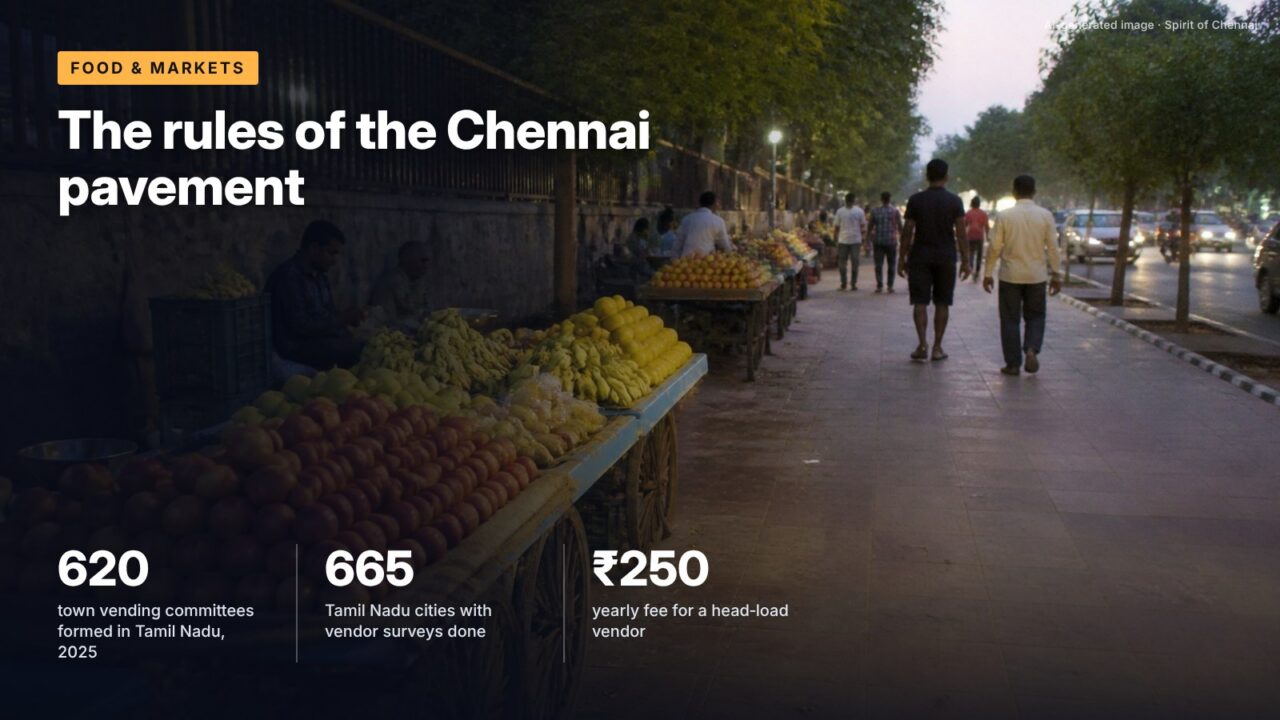
Tamil Nadu reported to Parliament that 665 of its cities and towns had completed street-vendor surveys and that 620 town vending committees had been constituted, according to a Lok Sabha answer of 20 March 2025. Those committees are the hinge of the system: they survey vendors, issue certificates of vending and help decide where vending is allowed.
The rules they apply come from the Tamil Nadu Street Vendors scheme and rules notified on 2 November 2015 through G.O. (Ms) No. 159 of the Municipal Administration department. That scheme turns broad rights in the central Act into specific fees, categories and procedures, and in a few places it reads more strictly than the Act.
What the 2014 Act guarantees
The Street Vendors (Protection of Livelihood and Regulation of Street Vending) Act, 2014 (Act 7 of 2014) requires a survey of existing vendors at least once every five years (section 3). Until the survey is done and certificates issued to everyone found, no vendor may be evicted or relocated (section 3(3)). Vendors with a certificate have a right to trade on its terms (section 12), and police and other authorities may not stop them (section 27). Relocation or eviction needs 30 days’ notice (section 18), and seized goods must be listed and released within two working days, or the same day for perishables (section 19).
The Act also sets a planning norm: vending zones should accommodate vendors equal to 2.5% of the population, and a no-vending zone cannot be declared over a natural market or before the survey and street-vending plan are complete (First Schedule). Vending without a certificate, or breaking its terms, attracts a penalty of up to ₹2,000 (section 28).
How Tamil Nadu prices a pitch
The state scheme links the fee for a fixed stall to the local guideline value, the government’s minimum land value for the street, so a pitch in a costly locality pays more. Mobile vendors pay flat amounts.
| Vendor type | Up to 10 sq ft | 10 to 25 sq ft | Over 25 sq ft |
|---|---|---|---|
| Stationary, full-time | 1% of guideline value, min ₹750 | 2%, min ₹1,500 | 3%, min ₹3,000 |
| Stationary, part-time | 0.5%, min ₹375 | 1%, min ₹750 | 1.5%, min ₹1,500 |
| Mobile, motor vehicle | ₹750 | ₹1,500 | ₹3,000 |
| Mobile, cart or cycle | ₹375 | ₹750 | ₹1,500 |
| Head-load | ₹250 (flat) |
Source: Tamil Nadu Street Vendors (Protection of Livelihood, Regulation of Street Vending and Licensing) Scheme, 2015, clause 9; all amounts per year
Fees must be revised at least once every three years and published on the local body’s notice board. A certificate is valid for five years or until the next survey, whichever comes first, and renewal costs ₹100 if applied for at least 60 days before expiry. The certificate cannot be sold, leased or transferred, and a vendor must have no other livelihood and be at least 14 years old.
Who sits on a vending committee
Under section 22 of the Act, at least 40% of a town vending committee’s members must be street vendors elected by vendors, and a third of those must be women, with at least 10% from NGOs and community organisations. Tamil Nadu’s rules provide for a 15-member committee chaired by the Commissioner, with six vendor representatives, which meets the 40% floor. The other listed seats are a medical officer, two police officers including traffic, a local body officer, a traders’ association, two NGO or community representatives and a resident welfare association.
The listed seats add up to 14 against the stated 15, a gap the published rules do not explain. Appeals against a committee decision go to the local authority within 30 days, with a fee of ₹200, or ₹500 for an appeal against a grievance committee decision.
It’s often said Police can clear any hawker off a footpath at any time.
The record shows A vendor holding a certificate has a right to trade on its terms, and section 27 of the Act bars police and other authorities from preventing that. The protection does not cover vendors in a declared no-vending zone, as the Union housing ministry noted in its March 2025 answer, nor vendors without a certificate once the survey is done.
Where the state scheme is stricter
Clause 14 of the Tamil Nadu scheme allows vendors without a valid certificate, or trading in a no-vending zone, to be evicted immediately and their goods seized under an inventory. Unclaimed perishable goods may be auctioned after 24 hours and other goods after 15 days, with unclaimed proceeds forfeited after three months. The Act’s own seizure section speaks of release within two working days, or the same day for perishables, so a vendor whose goods are taken should ask which provision is being used.
The scheme also caps vending in any ward, zone or city at 2.5% of its population, and applies the same cap to private vending sites. Vending zones were to be identified within six months, with traffic police consulted and a 15-day window for objections, and reviewed every five years.
Loans as a proxy for numbers
Tamil Nadu publishes no consolidated count of certificates issued. The closest official measure of the vendor population is the central PM SVANidhi working-capital loan scheme. As of 29 November 2023, Tamil Nadu had 6,58,158 eligible applications, 4,89,118 loans sanctioned and 4,61,079 disbursed, worth ₹593.9 crore, according to a Lok Sabha answer of 7 December 2023. Chennai district alone accounted for 1,57,888 eligible applications, about 24% of the state total.
First-tranche loans disbursed to Tamil Nadu vendors in 2023-24 up to 29 November 2023, double the 87,712 in the scheme’s first year, according to a second answer the same day.
Repeat borrowing shows how many vendors stayed in the scheme. By late 2023 Tamil Nadu had disbursed 55,698 second loans and 9,932 third loans in 2023-24 alone. Loans are not certificates, and some applicants may not have a certificate of vending, but the counts give a sense of scale that the survey figures do not.
What this means for you
- If you vend, keep your certificate and ID card on display; the scheme makes that a condition of the certificate.
- Apply for renewal at least 60 days before the five-year expiry to keep your pitch, at a fee of ₹100.
- An eviction notice should give 30 days under the Act; ask for it in writing and approach the town vending committee or grievance committee.
- Residents can object to a proposed vending zone during the 15-day window when zones are notified.
What to watch
Pending
The next five-yearly vendor survey, which section 3 of the Act requires and which resets certificate validity.
Pending
Publication of certificate counts by city; the 2025 Parliament answer reported surveys and committees but not certificates for Tamil Nadu.
Checked against official sources on 23 October 2026. Figures and rules change; confirm on the linked official pages before relying on them.
Sources
- Street Vendors (Protection of Livelihood and Regulation of Street Vending) Act, 2014, text hosted by PRS Legislative Research
- Tamil Nadu Street Vendors Scheme and Rules, 2015, G.O. (Ms) No. 159, MA.IV, Tamil Nadu Government Gazette Extraordinary No. 230, 2 November 2015
- Lok Sabha Starred Question 300, Constitution of Town Vending Committees, Ministry of Housing and Urban Affairs, 20 March 2025
- Lok Sabha Starred Question 71, Loan Applications under PM SVANidhi, Ministry of Housing and Urban Affairs, 7 December 2023
- Lok Sabha Unstarred Question 793, PM SVANidhi Scheme, Ministry of Housing and Urban Affairs, 7 December 2023