Tamil Nadu’s budget for 2025-26 expected its share of GST to jump by almost a third. The revised estimate cut that by more than ₹14,000 crore. Reading the budget lines alongside the GST rules explains why the state’s biggest tax is now its hardest to forecast.
The numbers
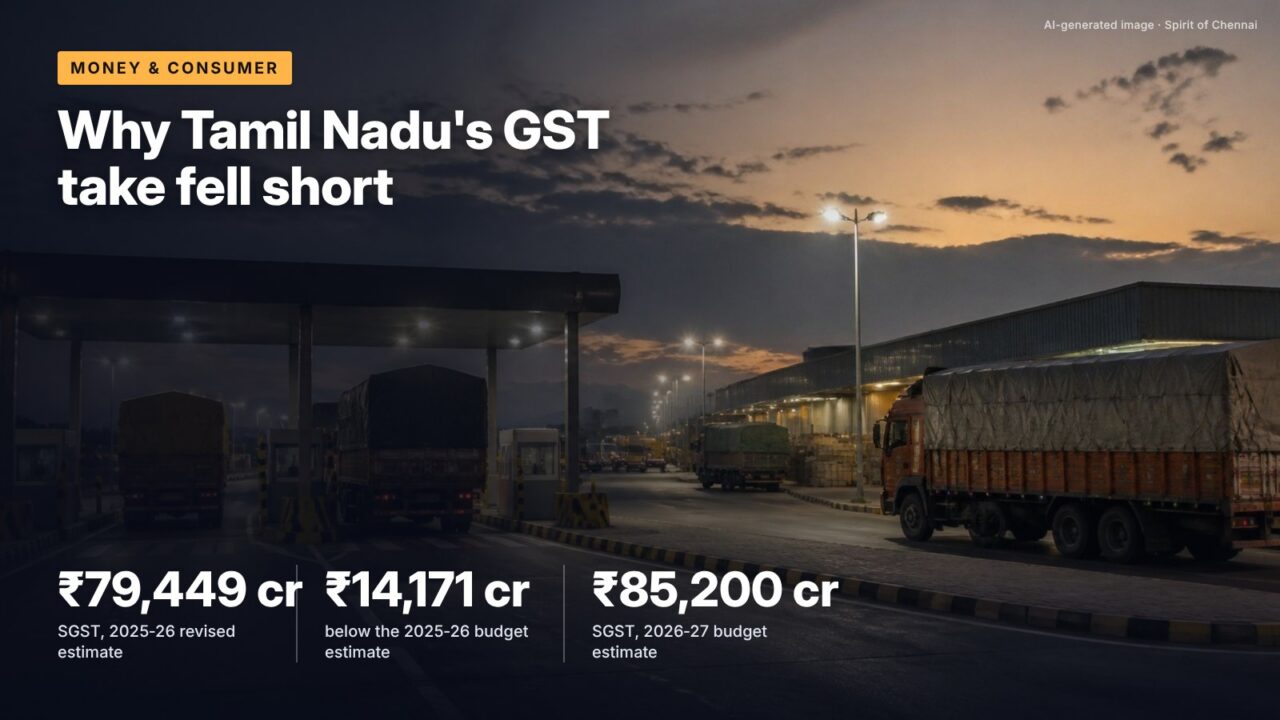
State GST (SGST) is Tamil Nadu’s largest own tax, and in 2025-26 it fell well short of plan. The budget estimate was ₹93,620 crore; the revised estimate presented with the 2026-27 budget is ₹79,449 crore, a gap of ₹14,171 crore, according to PRS Legislative Research’s analysis of the 2026-27 budget. The 2026-27 budget then pitched SGST at ₹85,200 crore.
The shortfall was less a collapse than an over-reach in forecasting. Actual SGST in 2024-25 was ₹70,887 crore. The 2025-26 budget had assumed growth of 32% on that; the revised figure still represents growth of about 12%. Two changes in the GST system made the original target harder still: the end of guaranteed compensation in 2022 and the rate rationalisation of September 2025.
The budget lines
| Year and stage | SGST (₹ crore) | Change |
|---|---|---|
| 2024-25 actuals | 70,887 | |
| 2025-26 budget estimate | 93,620 | +32.1% on 2024-25 actuals |
| 2025-26 revised estimate | 79,449 | +12.1% on 2024-25 actuals |
| 2026-27 budget estimate | 85,200 | +7.2% on 2025-26 revised |
Source: PRS Legislative Research, Tamil Nadu Budget Analysis 2026-27, Table 6. Percentage changes calculated for this article
The 2026-27 assumption is more cautious, at about 7% over the revised figure. It also has to absorb a full year of the lower rates introduced in September 2025.
How SGST is earned
Under GST, a sale within the state carries central GST and state GST in equal halves; the state keeps its SGST share. Sales between states carry integrated GST, which is collected by the Centre and later settled to the consuming state. Because GST is a destination tax, Tamil Nadu earns on what is consumed in the state, not on what its factories ship elsewhere, which limits the benefit of a strong manufacturing base.
PRS’s State of State Finances 2025 shows the system-wide effect. Taxes that GST replaced brought states an average of 2.8% of GDP in the four years before 2017; SGST has averaged 2.6% of GDP over the seven GST years. It was 2.3% in the pandemic year 2020-21 and back to 2.8% in 2024-25 on provisional accounts. SGST is now 44% of states’ own tax revenue on 2025-26 budget figures.
The SGST growth that states were guaranteed for the first five years of GST, with any shortfall made good from the compensation cess until June 2022 (PRS, State of State Finances 2025).
After compensation ended
For five years, Tamil Nadu’s GST revenue was protected: if collections grew more slowly than 14% a year, the Centre paid the difference from a cess on luxury and sin goods. In the pandemic years, the Centre borrowed on the states’ behalf instead; the Union finance ministry told the Lok Sabha in February 2023 that ₹1.10 lakh crore in 2020-21 and ₹1.59 lakh crore in 2021-22 were released to states as back-to-back loans in place of compensation, and that provisional dues up to 31 May 2022 had been cleared.
Since July 2022, there is no floor. A year of weak consumption or a rate cut now flows straight into the state’s revenue, and forecasting errors are no longer covered.
It’s often said Tamil Nadu still receives GST compensation to make up for lost revenue.
The record shows Compensation for revenue shortfall ran only until June 2022. The cess that continued after that has been used to repay the loans taken during the pandemic in place of compensation, not to top up current state revenue.
The September 2025 rate change
In September 2025 the GST Council collapsed most rates into two main slabs, 5% and 18%, with a 40% rate for a short list of demerit goods. PRS observed that this could hurt SGST revenue. For a state whose 2025-26 budget was drafted before the change, the cut arrived halfway through the year, and the revised estimate reflects it.
Early 2026-27 figures show recovery from a low base. The monthly accounts for Tamil Nadu to July 2026 record SGST of ₹27,384 crore for April-July 2026, against ₹22,190 crore in the same four months of 2025-26, a rise of 23%. That is 31.46% of the full-year figure used in the accounts, which is ₹87,049.65 crore, slightly different from the PRS headline. These are unaudited monthly figures and the four months are a short window.
Why this matters for the budget
The CAG’s State Finances Audit Report for 2024-25 found Tamil Nadu’s own tax revenue grew 7.74% that year but was 5.78% of GSDP, below the all-states average. With grants from the Centre falling 34.86% in 2024-25, the state leans harder on its own taxes, of which SGST is the largest. A ₹14,000 crore miss on one tax line is roughly the size of the women’s cash transfer scheme.
The other half of the GST story is the Centre’s share of taxes passed to the state through devolution, which is set by the Finance Commission formula and is separate from SGST. The finance ministry’s 2023 answer showed devolution to Tamil Nadu of ₹27,099.72 crore in 2017-18 and ₹37,458.60 crore in 2021-22.
The same July 2026 accounts show the state’s total tax revenue at ₹82,566.57 crore for April-July, up 8.3% on ₹76,217.99 crore a year earlier, so SGST is growing faster than other taxes and made up about a third of tax revenue in those months. The state’s share of Union taxes over the same four months was ₹15,255.35 crore, 24.40% of its budgeted ₹62,530.65 crore.
What this means for you
- The GST you pay at a Chennai shop is split equally between the Centre and the state; lower rates mean lower revenue for both.
- Since 2022 the state carries the full risk of a GST shortfall, which feeds into borrowing and spending choices.
- Watch revised estimates, not just budget figures; for SGST in 2025-26 the gap was 15% of the original target.
- Monthly CAG accounts are the earliest official check on how the year is going.
What to watch
Monthly
The Principal Accountant General’s monthly key indicators for Tamil Nadu, which show SGST collected to date against the 2026-27 target.
Pending
The Sixteenth Finance Commission’s devolution share for 2026-31 and any GST Council decision on the compensation cess once pandemic loans are repaid.
Checked against official sources on 23 October 2026. Figures and rules change; confirm on the linked official pages before relying on them.
Sources
- Tamil Nadu Budget Analysis 2026-27 (PRS Legislative Research, August 2026)
- State of State Finances 2025 (PRS Legislative Research, 2025)
- Monthly Key Indicators, Government of Tamil Nadu, July 2026 (Office of the Principal Accountant General / CAG)
- State Finances Audit Report, Tamil Nadu, 2024-25: Executive Summary (Comptroller and Auditor General of India, 2026)
- Lok Sabha Starred Question No. 143, Support to States for their Capital Expenditure, 13.02.2023 (Ministry of Finance)