Tamil Nadu helps pay for Haj, Jerusalem, Manasarovar and Kasi pilgrimages through two departments. How each scheme is designed, what a pilgrim gets, and what the policy notes reveal.
The numbers
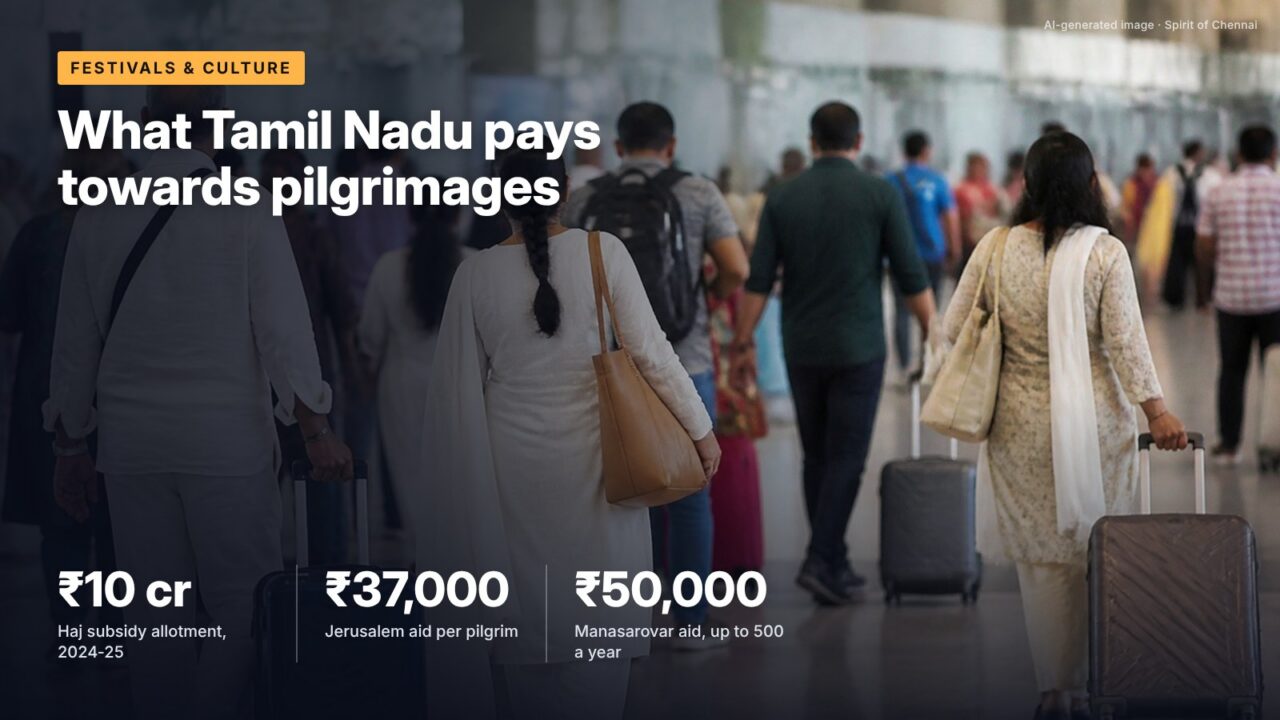
Tamil Nadu pays part of the cost of pilgrimages for all three of its largest faith communities, through two departments. For 2024-25 the Minorities Welfare Department set aside ₹10 crore for first-time Haj pilgrims and ₹2.34 crore for Christians travelling to Jerusalem, according to its policy note. The HR&CE Department offers ₹50,000 each to up to 500 Hindu pilgrims a year for Manasarovar and ₹20,000 each to 500 for Muktinath in Nepal, says the HR&CE policy note 2024-25.
The schemes look similar but work very differently. Some pay a fixed sum per head, some divide a fixed pot among however many pilgrims qualify, and some pay for a whole state-organised trip. That design choice decides how much each pilgrim actually receives.
The schemes side by side
| Scheme | Department | Support | Scale (latest note) |
|---|---|---|---|
| Haj, first-timers | Minorities Welfare, via State Haj Committee | Share of a fixed ₹10 cr | 5,728 pilgrims, Haj 2024 |
| Jerusalem | Minorities Welfare | ₹37,000; ₹60,000 for nuns | 600 a year, 50 for nuns |
| Manasarovar | HR&CE | ₹50,000 | Up to 500 a year |
| Muktinath | HR&CE | ₹20,000 | Up to 500; 302 paid for 2022-23 |
| Rameswaram to Kasi | HR&CE | Trip paid by government | 300 pilgrims, ₹75 lakh, 2023-24 |
| Arupadai Veedu (six Murugan shrines) | HR&CE | Organised tour | 1,000 planned, 609 by June 2024 |
Source: Minorities Welfare Department policy note 2024-25; HR&CE Department policy note 2024-25, Govt of Tamil Nadu
How the Haj subsidy shrinks per head
The Haj support is a fixed annual pot, raised from ₹6 crore to ₹10 crore, divided among first-time pilgrims who go through the Tamil Nadu State Haj Committee. The policy notes show what that does as numbers rise. For Haj 2022, ₹4.56 crore went to 1,649 pilgrims at ₹27,628 each, the 2023-24 note says. For Haj 2023, 3,987 pilgrims received the subsidy from the ₹10 crore allotment; had all of it been paid out, that is about ₹25,000 each. For Haj 2024, 5,728 pilgrims were being paid from the same ₹10 crore, which would be at most about ₹17,500 each.
Most a Haj 2024 pilgrim could receive if the ₹10 crore allotment were split evenly among 5,728 pilgrims, calculated from the 2024-25 policy note.
The Haj Committee also gets its own administrative grant, raised from ₹50 lakh to ₹80 lakh for 2024-25, and ₹10.29 lakh to send volunteers to Saudi Arabia. The committee’s total allocation for 2024-25 is ₹10.61 crore. Saudi Arabia cancelled the Haj for 2020 and 2021 because of COVID-19, the 2021-22 note records.
The Jerusalem scheme’s fixed quota
The Jerusalem scheme works the other way: a fixed sum for a fixed number of places. The arithmetic matches the budget exactly. Fifty nuns at ₹60,000 and 550 other pilgrims at ₹37,000 come to ₹233.50 lakh, the allotment printed in the 2023-24 and 2024-25 notes. The allotment was ₹120 lakh in 2021-22 and 2022-23, per the department’s scheme page, which would have covered fewer places.
One figure in this scheme needs care. Every note since 2021-22 says 4,128 Christians have made the pilgrimage with ₹825.60 lakh of assistance. A cumulative total that does not move across four years is a sign the line has not been updated, not that no one travelled.
It’s often said only one community gets state help for pilgrimages.
The record shows The policy notes show schemes for Muslims (Haj), Christians (Jerusalem) and Hindus (Manasarovar, Muktinath, Kasi and the Arupadai Veedu tour), run by the Minorities Welfare and HR&CE departments.
Repairs to places of worship
The same two departments also pay to repair places of worship, and here the gap between allotment and spending is striking. For churches, the annual provision was ₹6 crore in 2021-22 and ₹10 crore in 2023-24, but the notes report cumulative sanctions of ₹59.40 lakh to 23 churches (2021-22), ₹77.90 lakh to 30 churches (2023-24) and ₹101.90 lakh to 34 churches (2024-25). The maximum grant per church has been raised to ₹20 lakh. A separate heritage church programme sanctioned ₹6 crore for four churches in 2022-23 and ₹2 crore for St George’s Church, Madurai, in 2023-24.
For mosques, dargahs and other waqf institutions, the major repair grant rose from ₹60 lakh to ₹5 crore in 2020-21, when 45 institutions benefited, then to ₹6 crore in 2021-22 (77 institutions) and ₹10 crore from 2023-24, which helped 134 institutions. A ₹3 crore corpus funds minor repairs from its interest. Ulema pensions of ₹3,000 a month reached 1,263 people in 2021-22, 1,399 in 2023-24 and 1,461 in 2024-25, against a ceiling of 2,600.
The waqf side has its own administrative money. The Tamil Nadu Waqf Board receives an administrative grant of ₹2.5 crore a year and a total allotment of ₹19.70 crore for 2024-25, and ulema family pensions, at half the last pension drawn, had been sanctioned to 19 families. The church series also has a 2022-23 point on the department’s scheme page: ₹65.40 lakh sanctioned to 25 churches in 18 districts by then, against ₹6 crore allotted for the year.
How to read these numbers
The schemes are small against total spending: the whole Minorities Welfare budget for 2024-25 was ₹153.60 crore. Their value to an individual depends on the design. A fixed-sum scheme like Jerusalem guarantees the amount but rations places. A pot-based scheme like Haj guarantees a place for eligible first-timers but lets the per-head sum fall when demand rises. The Kasi trip, at ₹25,000 a pilgrim in both 2022-23 and 2023-24 (₹75 lakh for 300), pays the whole journey for very few.
What this means for you
- Haj subsidy is for first-time pilgrims going through the Tamil Nadu State Haj Committee; the per-head amount depends on how many go that year.
- Jerusalem aid is a fixed ₹37,000 (₹60,000 for nuns) for 600 places a year; apply through the district Backward Classes and Minorities Welfare office.
- Muktinath aid has been paid after the journey: the 2023-24 payments covered 2022-23 pilgrims. Check HR&CE’s current notice for application dates.
- Churches, mosques and dargahs can apply for repair grants; the church grant now goes up to ₹20 lakh.
What to watch
Pending
The 2026-27 policy notes of both departments, which will show whether allotments change under the new government.
Pending
Haj 2027 allocations, which will decide the per-head subsidy for first-time pilgrims from Tamil Nadu.
Checked against official sources on 23 October 2026. Figures and rules change; confirm on the linked official pages before relying on them.
Sources
- Minorities Welfare Department Policy Note 2024-25 (Govt of Tamil Nadu)
- Minorities Welfare Department Policy Note 2023-24 (Govt of Tamil Nadu)
- Minorities Welfare Department Policy Note 2021-22 (Govt of Tamil Nadu)
- Schemes for minorities welfare (BC, MBC and Minorities Welfare Department, Govt of Tamil Nadu)
- HR&CE Department Policy Note 2024-25 (Govt of Tamil Nadu)