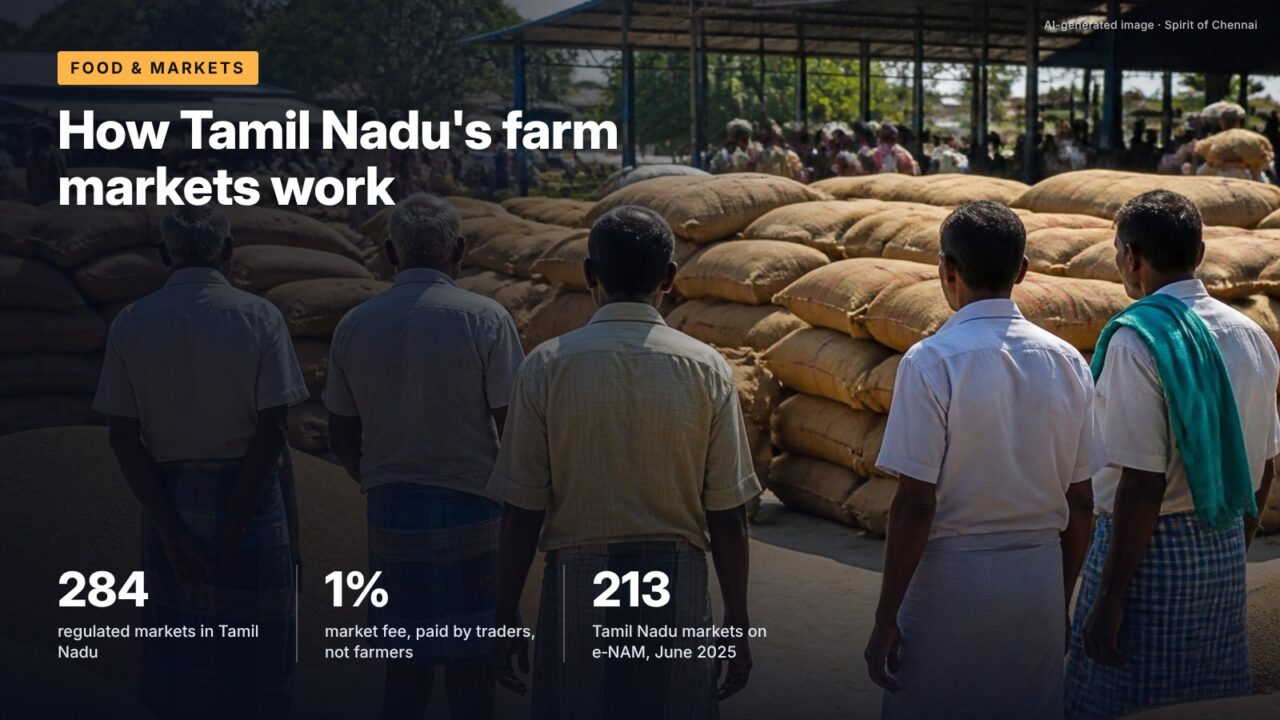
Tamil Nadu’s 284 regulated markets, run under a 1987 law, are where farm produce is auctioned under official supervision, and a growing share of that trade now happens online through e-NAM. Chennai, notably, has none. Here is how the system works and how it compares.
The numbers
Tamil Nadu has 27 market committees running 284 regulated markets under the Tamil Nadu Agricultural Produce Marketing (Regulation) Act, 1987, according to the Department of Agricultural Marketing and Agri Business handbook. Traders pay a market fee of 1% of the sale value; farmers pay nothing for the market’s services. The markets hold 525 godowns with about 6.68 lakh tonnes of storage.
By 30 June 2025, 213 of those markets were trading on the national electronic market, e-NAM, and had handled produce worth ₹8,283.95 crore since joining, according to a Lok Sabha answer of 29 July 2025. That is a large number of markets but a modest trade value per market by national standards, for reasons the data helps explain.
How a regulated market works
A regulated market is a notified place where the sale of notified farm produce is supervised by a market committee, with open auction, standard weights and a published price. Section 10 of the 1987 Act sets out the committee: eight producer members, three traders licensed under the Act, one producer nominated by the government in consultation with the Registrar of cooperative societies, and three official nominees. The handbook puts the total at 16, one more than those categories add up to.
Besides auction sheds, the markets offer drying yards (421), transaction sheds (395) and traders’ shops (863). A pledge loan scheme lets farmers store produce in market godowns and borrow up to ₹5 lakh at 5% interest, interest-free for the first 15 days; traders can borrow up to ₹2 lakh at 9%. Produce in 150 godowns registered with the warehousing regulator can back electronic warehouse receipts worth up to 80% of its value at nationalised banks.
It’s often said Farmers have to pay a commission or fee to sell in a regulated market.
The record shows The market fee of 1% is paid by the trader who buys. The state handbook says no fee is collected from farmers for the services rendered, which include grading, storage and the auction itself.
From 23 markets to 213 on e-NAM
Tamil Nadu joined e-NAM in its third phase. The first 15 regulated markets went online from 24 October 2017, starting at Ammoor, and eight more followed in March 2018, according to the department page on the scheme. At that stage the 23 markets had traded 26.95 lakh quintals worth ₹484.12 crore, and the Centre had given ₹16.10 crore for them at ₹70 lakh each. Traders can now hold a single unified licence, valid for three years, covering every notified market in the state; 1,235 such licences had been issued.
The pace picked up later. By 31 March 2024, 157 markets were integrated and 127 remained, according to a Lok Sabha answer of 3 December 2024. The state received and spent ₹19.20 crore for 64 markets in 2022-23 and ₹8.93 crore for 30 markets in 2023-24 on e-NAM equipment. By June 2025 the count stood at 213.
| Date | Tamil Nadu markets on e-NAM | Source |
|---|---|---|
| March 2018 | 23 | Agricultural Marketing Department |
| 31 March 2024 | 157 (127 still to join) | Lok Sabha, 3 December 2024 |
| 30 June 2025 | 213 | Lok Sabha, 29 July 2025 |
Source: Department of Agricultural Marketing and Agri Business, e-NAM scheme page; Ministry of Agriculture and Farmers Welfare, Lok Sabha Unstarred Questions 1266 (2024) and 1504 (2025)
How Tamil Nadu compares
| State | Markets on e-NAM | Trade value (₹ cr) | Value per market (₹ cr) |
|---|---|---|---|
| Rajasthan | 173 | 1,19,691 | 692 |
| Andhra Pradesh | 33 | 59,677 | 1,808 |
| Madhya Pradesh | 139 | 34,814 | 250 |
| Telangana | 57 | 28,439 | 499 |
| Maharashtra | 133 | 21,130 | 159 |
| Uttar Pradesh | 162 | 14,962 | 92 |
| Gujarat | 144 | 11,754 | 82 |
| Tamil Nadu | 213 | 8,284 | 39 |
Source: Ministry of Agriculture and Farmers Welfare, Lok Sabha Unstarred Question 1504, 29 July 2025, cumulative to 30 June 2025; value per market calculated
Tamil Nadu has more markets on e-NAM than any other state in this table but the lowest value per market (₹8,283.95 crore divided by 213). Two things explain part of the gap. Much of Tamil Nadu’s online trade is in countable items such as coconuts, measured in numbers rather than tonnes: the state traded 29.13 crore such units, the highest of these states and over half the national 49.15 crore. And the state’s markets are many and small, spread across districts rather than concentrated in a few large grain yards.
Farm commodities traded on e-NAM in Tamil Nadu, including coconut, according to the state handbook; nationally 238 commodities are notified for online auction.
Storage, cold chain and loans for buildings
Physical infrastructure has been financed mostly through loans and central funds rather than market income. The state obtained ₹112.38 crore in NABARD loan assistance for godowns, bidding rooms, grading halls, transaction sheds and drying yards, and ₹217.92 crore under the Warehouse Infrastructure Fund for 90 regulated markets, the December 2024 answer says. Thirty markets have working assaying laboratories.
Cold storage figures in the handbook do not agree with each other: its district tables total 268 cold storages with 19,865 tonnes of capacity, while its facilities section says 187. For the Chennai region the numbers are small either way: Kancheepuram district’s three regulated markets have five godowns holding 6,200 tonnes, and Tiruvallur’s eight markets have eight godowns with 11,500 tonnes. Tiruvallur is one of six districts with a mega cold storage.
Why Chennai has no regulated market
The handbook’s district tables list regulated markets in Kancheepuram (three) and Tiruvallur (eight) but no market committee or regulated market in Chennai. Chennai hosts the department’s Commissionerate at Guindy and the principal AGMARK grading laboratory, but its wholesale produce trade runs through Koyambedu, which operates under a different law, the Tamil Nadu Specified Commodities Markets (Regulation of Location) Act, 1996. That Act controls where wholesale trade happens, not how farm produce is auctioned.
For the city’s consumers, the farm-gate system shows up instead in the 192 Uzhavar Sandhai farmers’ markets across the state, where farmers sell directly without a fee and prices are published daily on the department’s Uzhavar app.
What this means for you
- Farmers near Chennai sell through regulated markets in Tiruvallur and Kancheepuram districts, or at Uzhavar Sandhais, rather than in the city.
- A farmer can store produce in a market godown and take a pledge loan of up to ₹5 lakh at 5%, interest-free for 15 days.
- Prices realised in e-NAM markets are visible online, which helps a farmer compare offers before selling.
- Traders who buy across districts can apply for a unified licence valid in every notified market for three years.
What to watch
Pending
Integration of the remaining regulated markets with e-NAM; 213 of 284 were online by June 2025.
Pending
Updated state figures on farmers registered and trade value, which the 2025 Parliament answer gave only nationally.
Checked against official sources on 23 October 2026. Figures and rules change; confirm on the linked official pages before relying on them.
Sources
- Handbook, Department of Agricultural Marketing and Agri Business, Government of Tamil Nadu
- e-NAM scheme, Department of Agricultural Marketing and Agri Business, Government of Tamil Nadu
- Lok Sabha Unstarred Question 1504, Agricultural Markets Linked to e-NAM, Ministry of Agriculture and Farmers Welfare, 29 July 2025
- Lok Sabha Unstarred Question 1266, APMC Markets Integrated with e-NAM Platform, Ministry of Agriculture and Farmers Welfare, 3 December 2024
- Tamil Nadu Specified Commodities Markets (Regulation of Location) Act, 1996, copy hosted by PRS Legislative Research