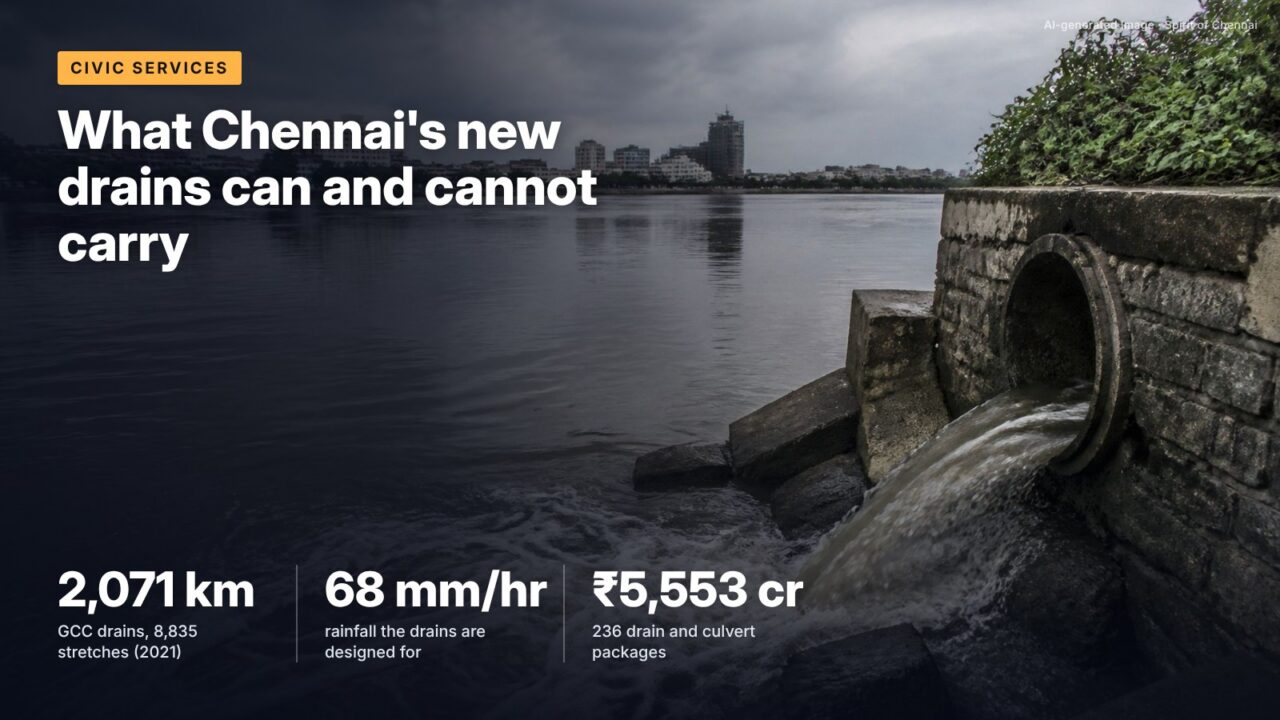
Chennai’s stormwater drains are being rebuilt at a cost running into thousands of crores, but the official design documents show what they were built to carry, who owns which channel, and why a new drain on your street cannot stop every flood.
The numbers
The Greater Chennai Corporation maintained 2,071 km of stormwater drains in 8,835 separate stretches when it prepared the environmental assessment for its missing-links project in January 2021. The new drains in that World Bank-funded package are designed for a maximum rainfall of 68 mm an hour. Rain heavier than that, or rain falling on outfalls that are already full, will still flood streets.
Money has been flowing steadily. The Corporation’s Climate Budget Report 2025-26 tags ₹803.19 crore of that year’s capital spending to the stormwater drain department, and puts the total cost of 236 ongoing drain and culvert packages at ₹5,553.3 crore. That makes drains the single biggest item in the city’s climate-tagged spending.
Two systems, two owners
Chennai’s drainage works in tiers. The big channels, called macro drains, belong to the state Water Resources (PWD) department: 16 canals totalling 67.95 km plus four waterways, the Cooum, Adyar, Kosasthalaiyar and Buckingham Canal. The Corporation looks after the micro drains, including 74 major drains, of which 43 are closed and 31 open, and the street-level network that feeds them.
| Macro drain (PWD) | Length |
|---|---|
| Puzhal surplus canal | 15.13 km |
| Otteri Nullah | 8.70 km |
| Virugambakkam canal | 6.36 km |
| Porur surplus canal (Manapakkam) | 4.46 km |
| Velachery to Pallikaranai channel | 2.76 km |
| All 16 canals | 67.95 km |
Source: Greater Chennai Corporation, EA Report for Missing Links Storm Water Drains, January 2021, Tables 4 and 5
A street drain is only as good as the canal it empties into. If a macro drain is silted, encroached or backed up by a high river, the Corporation’s new street drain will hold water rather than shed it.
What was built after 2015
The same assessment records that after the December 2015 floods, when one day brought 32 cm of rain and more than 50,000 people were evacuated, a ₹4,034 crore integrated drain programme was announced. Its first phase covered 406 km in the Adyar and Cooum basins at ₹1,385.48 crore and was completed by March 2019. The southern Kovalam basin is funded by the German development bank KfW, and the northern Kosasthalaiyar basin by the Asian Development Bank.
The core-city missing-links project the assessment describes was smaller and targeted: 11.95 km of new drains to join broken stretches and 32.93 km of drains demolished and rebuilt, 44.88 km in all, across 144 stretches in seven zones, at ₹119.93 crore under the Tamil Nadu Sustainable Urban Development Programme.
Integrated drain programme announced after the 2015 floods; the first 406 km phase cost ₹1,385.48 crore, the GCC assessment records.
The design limit
The 68 mm an hour design figure is the most important number in the file and the least discussed. It describes how much rain the drain can carry in an hour, not in a day. The 2015 event of 32 cm in 24 hours averages about 13 mm an hour (320 divided by 24), well within that limit on paper. Floods follow when rain comes in short, heavy bursts, when the downstream canal or river is full, or when the sea is high at the outfall.
The Chennai Climate Action Plan puts the risk in plain terms: about 32% of the current Corporation area would be inundated in a 1-in-10-year flood event and 46% in a 1-in-25-year event. Drains reduce how long water stands; they do not remove the risk.
History supports that caution. The 2021 assessment lists catastrophic floods in 1943, 1978, 1985, 2002 and 2005 before the 2015 disaster. It also notes that residents reported fewer inundated spots during the 2017 northeast monsoon after the first phase of new drains, which is the kind of gain drains can deliver: shorter, shallower waterlogging rather than none.
It’s often said new stormwater drains mean streets will no longer flood.
The record shows The Corporation’s own design note limits new drains to 68 mm of rain an hour, and the Climate Action Plan still projects 32% of the city inundated in a 1-in-10-year event. Drains depend on canals and outfalls owned by other agencies.
Sewage in the stormwater drains
A drain built for rain often carries sewage. A 2021 National Green Tribunal case was opened on the tribunal’s own motion over illegal diversion of sewage into stormwater drains. Metro Water told the tribunal that 385 outfalls into the Cooum, Adyar and Buckingham Canal and their drains were to be plugged in a first phase costing ₹1,001 crore, according to its filing. Sewage in drains leaves silt and solids that reduce carrying capacity before the monsoon even starts. Planners have long treated the two as linked: a CMDA seminar session around 2008 took up water supply, sanitation, solid waste and flood alleviation together, with presentations from Metro Water, the PWD and the Corporation.
Where the money sits now
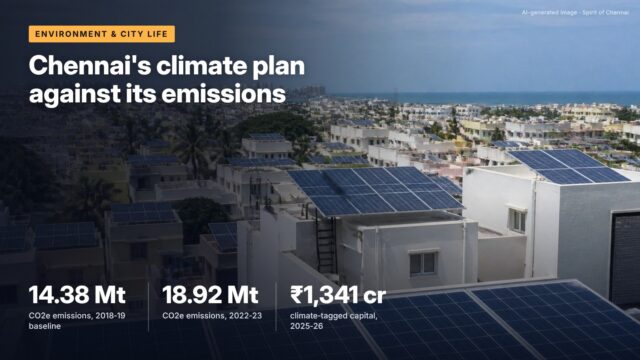
The Climate Budget assigns the stormwater department 59.89% of all climate-tagged capital spending for 2025-26. Of the city’s climate-tagged total of ₹1,341.2 crore, ₹704.46 crore is tied to one objective: managing stormwater to prevent rain-driven flooding. The report itself gives two different figures for drain length completed (“over 240 km” and “over 1,168 kilometres”) in different sections, so the cumulative length built is not settled by this document.
Unit costs give a sense of scale. Phase one of the post-2015 programme cost about ₹3.41 crore per km (₹1,385.48 crore divided by 406 km). The core-city missing-links package worked out to about ₹2.67 crore per km (₹119.93 crore divided by 44.88 km), cheaper because much of it rebuilt existing drains. The 236 packages now under way average about ₹23.5 crore each (₹5,553.3 crore divided by 236). These are averages across very different jobs, from small culverts to large trunk drains, so they are a guide rather than a benchmark for any single street.
What this means for you
- Find out whether the drain on your street is a Corporation micro drain or feeds a PWD canal; complaints go to different agencies.
- A new drain will not help if its outlet is blocked. Report blocked outlets and culverts before the monsoon, not during it.
- If you see sewage entering a stormwater drain, report it to Metro Water as well as the Corporation: it is a tribunal-monitored issue.
- Short, intense bursts above 68 mm an hour will still cause waterlogging, even on newly drained streets.
What to watch
October to December 2026
The northeast monsoon, which set in on 15 October, is the first test of packages completed since the last season.
Pending
The 2027-28 Climate Budget, expected with the Corporation’s budget, should update the 236-package total and the length completed.
Checked against official sources on 23 October 2026. Figures and rules change; confirm on the linked official pages before relying on them.
Sources
- EA Report for Missing Links Storm Water Drains in Core City Areas, Greater Chennai Corporation, January 2021
- Climate Budget Report 2025-26, Greater Chennai Corporation with C40 Cities, 2025
- Chennai Climate Action Plan, GCC and TN Department of Environment, Climate Change and Forests, 2023
- CMWSSB report in O.A. 171 of 2021 (SZ) on sewage in stormwater drains, National Green Tribunal, 2021
- Session III: Water Supply, Sanitation, Solid Waste and Flood Alleviation, CMDA seminar, c. 2008