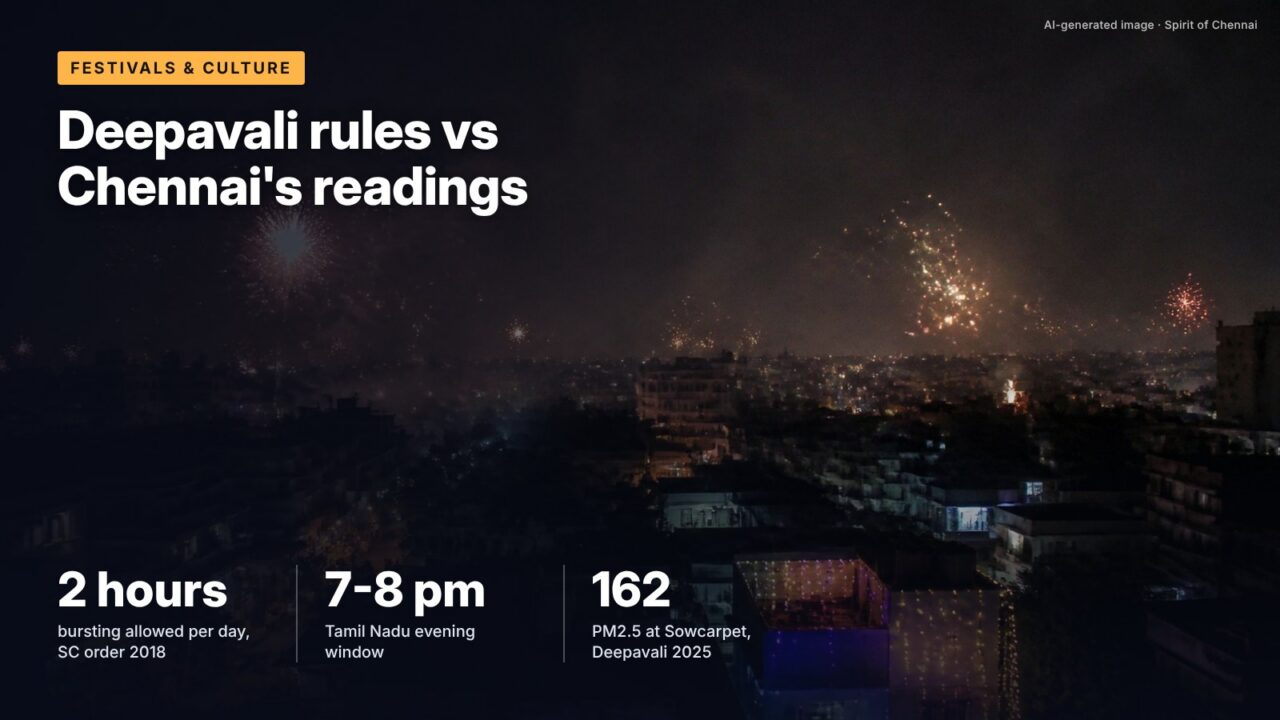
The Supreme Court’s 2018 cracker rules give Tamil Nadu two hours of bursting on Deepavali. The state pollution board’s own readings show what happens to Chennai’s air and noise anyway.
The numbers
On Deepavali 2025, every Chennai air monitoring station with a valid reading went from “satisfactory” a week earlier to “moderate”, “poor” or “very poor”, according to the Tamil Nadu Pollution Control Board’s Deepavali monitoring report. At Sowcarpet the 24-hour PM2.5 level rose from 22 to 162 micrograms per cubic metre, and at Nungambakkam from 23 to 154. The board attributed the spike to crackers burst near its stations.
Those numbers are the test of a legal regime that the Supreme Court built in 2018 and that Tamil Nadu has applied every year since: two hours of bursting a day, only reduced-emission crackers, and no barium. Read across the board’s reports for 2022, 2023 and 2025, the rules have not prevented sharp spikes in Chennai’s air and noise.
What the Supreme Court ordered
The rules come from Arjun Gopal v Union of India, a petition on Delhi’s air filed in 2015. In its 23 October 2018 judgment the court refused a complete ban on sales but allowed only “improved” and green crackers to be made and sold, and asked the Petroleum and Explosives Safety Organisation (PESO) to review cracker chemistry with the Fireworks Research and Development Centre, a summary of the judgment records. The court originally fixed evening hours for Deepavali. On 30 October 2018 it modified the timing direction for Tamil Nadu, Puducherry and other southern states.
The court’s order of 31 October 2018 then clarified how far the directions reach. The two-hour duration applies throughout India. Barium salts are banned in manufacture, with PESO’s affidavit on record. The restriction on e-commerce sales and several other directions apply across the country, while the stricter sales ban stays limited to Delhi and the National Capital Region.
How Tamil Nadu applies it
Tamil Nadu has used its two hours as two one-hour windows on Deepavali day: 6 to 7 am and 7 to 8 pm. The TNPCB’s 2023 report restates those windows as following the court’s directions and notes that crackers are restricted in silence zones. The board’s 2022 release gives the same hours. Enforcement is by police and district administrations; the board’s job is to measure.
It measures at seven manual stations in Chennai: Besant Nagar, T. Nagar, Nungambakkam, Triplicane, Sowcarpet, Valasaravakkam and Tiruvottiyur. Air is sampled over 24 hours and noise from 6 pm to midnight, on Deepavali day and on a baseline day a week or so before.
| Station | PM2.5, Deepavali 2023 | AQI 2023 | PM2.5, Deepavali 2025 | AQI 2025 |
|---|---|---|---|---|
| Besant Nagar | 92 | 207 Poor | 87 | 190 Moderate |
| T. Nagar | 128 | 306 Very poor | 112 | 273 Poor |
| Nungambakkam | 203 | 364 Very poor | 154 | 326 Very poor |
| Triplicane | 106 | 253 Poor | 98 | 227 Poor |
| Sowcarpet | 167 | 336 Very poor | 162 | 332 Very poor |
| Valasaravakkam | 204 | 365 Very poor | 92 | 207 Poor |
| Tiruvottiyur | 98 | 227 Poor | no valid reading | – |
Source: TNPCB Deepavali ambient air quality reports 2023 (12 Nov 2023) and 2025 (20 Oct 2025); PM2.5 in micrograms per cubic metre, 24-hour average
Two cautions apply. Weather matters: the 2025 report notes drizzle and partly cloudy skies on Deepavali day, which can wash particles out, and the 2022 release blamed high humidity and low wind for trapping smoke. And these are single-day readings, so one station’s change between years can reflect where people happened to burst crackers. Even so, the 2025 values were lower at every comparable station than in 2023.
Comparing the two years
The baseline matters as much as the peak. In 2023 Nungambakkam’s PM2.5 went from 20 on the baseline day to 203 on Deepavali, about ten times higher; in 2025 it went from 23 to 154, about 6.7 times. Valasaravakkam rose from 28 to 204 in 2023, a sevenfold jump, but from 22 to 92 in 2025. Valasaravakkam’s PM10 of 379 in 2023 was the highest coarse-dust reading in either year. Sowcarpet, the dense trading area near Parry’s, was in the very poor band in both years, with near-identical PM2.5 readings of 167 and 162.
Chennai’s average noise level on Deepavali day 2023, against 58.7 dB(A) on the baseline day, in the TNPCB 2023 report.
The noise record
Noise is where the gap between rule and practice shows most. In 2022 the board recorded Deepavali-day levels from 66.0 dB(A) at Besant Nagar to 79.7 dB(A) at Tiruvottiyur between 6 pm and midnight, against 54.8 to 64.5 dB(A) on the baseline day, and said the readings exceeded national ambient standards. The 2023 report lists the night-time limits: 45 dB(A) in residential areas, 55 in commercial areas, 70 in industrial areas and 40 in silence zones. Because the decibel scale is logarithmic, a rise of 10 dB(A) is roughly a doubling of perceived loudness. The 2025 report’s hour-by-hour noise tables put the highest 6 pm to 7 pm reading at Tiruvottiyur, 93.7 dB(A), the hour before the evening window opened.
It’s often said green crackers are exempt from the timing rules.
The record shows The court’s 31 October 2018 order says the two-hour limit applies throughout India, and Tamil Nadu’s 6 to 7 am and 7 to 8 pm windows apply to all crackers. “Green” refers to the formulation, not to when it may be burst.
What the data cannot tell you
The board’s reports describe outcomes, not causes. They do not record how many people were booked for bursting outside the windows, and the 2022 release does not mention cases at all. They cannot separate crackers from traffic and weather beyond the baseline comparison. Continuous monitors run by the Central Pollution Control Board give hourly readings that the manual reports do not, so the two sources measure different things and should not be mixed in a single comparison.
What this means for you
- Bursting is allowed only from 6 to 7 am and 7 to 8 pm on Deepavali day, and not near hospitals, courts or other silence zones.
- Buy only crackers marked as green or reduced-emission; barium-based crackers are banned in manufacture.
- People with asthma, older residents and infants should stay indoors with windows shut on Deepavali night and the morning after.
- Bursting outside the windows can be reported to the local police station or the 100 helpline.
What to watch
Sunday 8 November 2026
Deepavali this year, per the state holiday G.O.; TNPCB will monitor the seven Chennai stations around it.
Pending
The board’s 2026 Deepavali report, usually published after the monitoring window closes.
Checked against official sources on 23 October 2026. Figures and rules change; confirm on the linked official pages before relying on them.
Sources
- Arjun Gopal v Union of India, W.P.(C) 728 of 2015, order of 31 Oct 2018 (Supreme Court of India)
- Supreme Court judgment on firecrackers, 23 Oct 2018, summary (India Environment Portal)
- Ambient air quality and noise survey, Deepavali 2025 (Tamil Nadu Pollution Control Board)
- Ambient air quality and noise survey, Deepavali 2023 (Tamil Nadu Pollution Control Board)
- Air quality and noise in Chennai during Deepavali 2022, Press Release No. 1862, 25 Oct 2022 (TNPCB via DIPR)
- G.O. Ms. No. 708, Public (Misc.), 11 Nov 2025: public holidays 2026 (Govt of Tamil Nadu)