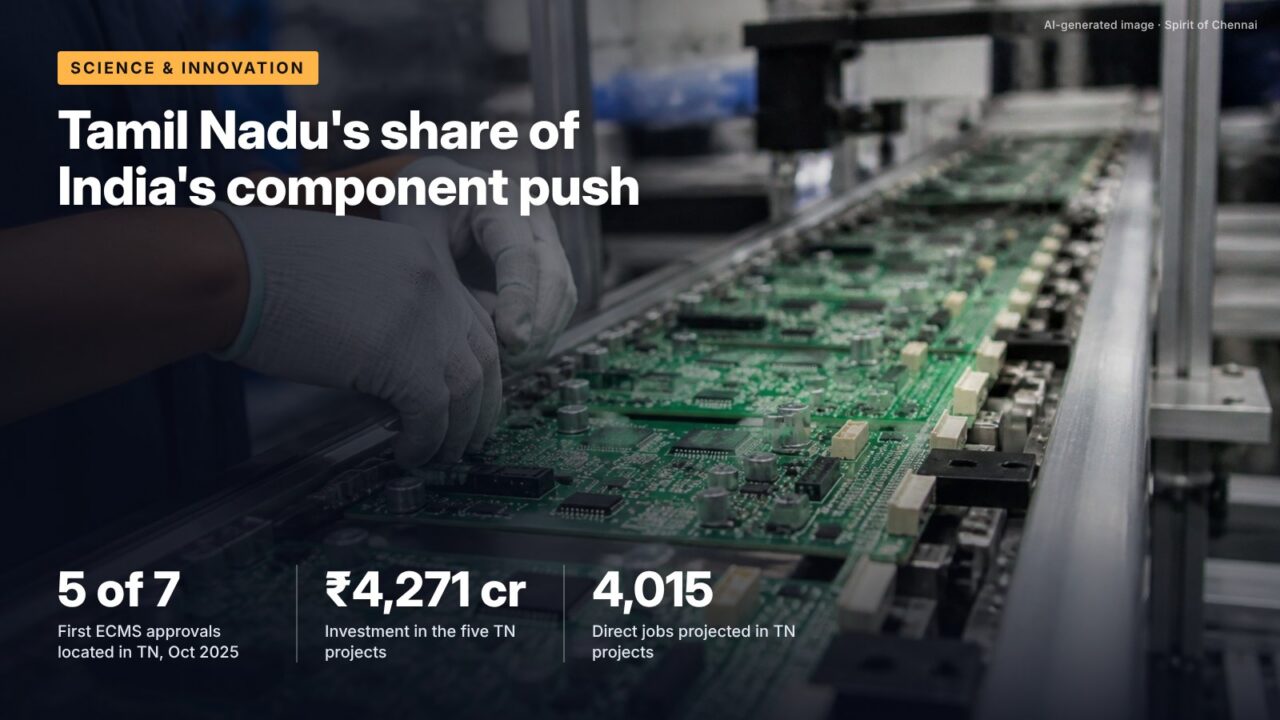
When the Union government approved the first projects under its ₹22,919 crore electronics components scheme in October 2025, five of the seven were in Tamil Nadu. They make the boards and laminates inside phones and cars, not chips.
The numbers
Five of the seven projects approved in the first batch of the Electronics Component Manufacturing Scheme (ECMS) on 27 October 2025 are in Tamil Nadu, the Ministry of Electronics and Information Technology said in a Press Information Bureau release. Four belong to Kaynes Circuits India and one to Ascent Circuits. Together they account for ₹4,271 crore of the batch’s ₹5,532 crore investment, about 77%, and 4,015 of its projected direct jobs.
The scheme was notified on 8 April 2025 with an outlay of ₹22,919 crore over six years, according to a PIB backgrounder. It pays companies to make the parts that go into electronic products in India rather than import them.
What the scheme pays for
ECMS offers three kinds of incentive, set out on the scheme portal: a turnover-linked incentive paid on sales for six years including a one-year gestation period, a capital expenditure incentive paid over five years on investment in plant and machinery, and a hybrid of the two. It covers five segments: sub-assemblies such as display and camera modules; bare components such as multi-layer printed circuit boards, lithium-ion cells for digital devices and enclosures; selected advanced components such as high-density interconnect (HDI) and flexible boards; the supply chain and capital equipment for all of these; and optical transceivers for telecom.
A printed circuit board (PCB) is the green or brown board on which chips and other parts are mounted and wired. HDI boards pack connections more densely and are used in phones. Copper clad laminate, the base sheet from which PCBs are made, is currently imported, the ministry said. A camera module sub-assembly is the lens, sensor and housing unit that is fitted into a phone.
| Company | Product | Investment (₹ cr) | Direct jobs |
|---|---|---|---|
| Kaynes Circuits India | Multi-layer PCB | 104 | 220 |
| Kaynes Circuits India | Camera module sub-assembly | 325 | 480 |
| Kaynes Circuits India | HDI PCB | 1,684 | 1,480 |
| Kaynes Circuits India | Copper clad laminate | 1,167 | 300 |
| Ascent Circuits | Multi-layer PCB | 991 | 1,535 |
| Tamil Nadu total | 4,271 | 4,015 |
Source: PIB backgrounder, ‘Driving India’s Electronics Future’, 27 October 2025. Totals are the sum of the rows. The release names the state but not the town for each project.
Reading the job numbers
The five Tamil Nadu projects differ sharply in how many jobs each rupee buys. The copper clad laminate plant is the most capital-heavy: ₹1,167 crore for 300 jobs, about ₹3.9 crore of investment per job. Ascent’s multi-layer PCB plant plans 1,535 jobs on ₹991 crore, about ₹0.65 crore per job, and the camera module line 480 jobs on ₹325 crore, about ₹0.68 crore per job. Laminate making is a continuous chemical and pressing process with few workers; board fabrication and module assembly need many more hands. For the state, that means the laminate plant matters for supply security and the PCB and module lines matter more for employment.
It’s often said ECMS is a scheme to make semiconductor chips in Tamil Nadu.
The record shows ECMS funds passive components, circuit boards, laminates, modules and related equipment. The ministry describes it as complementing the separate India Semiconductor Mission and the production-linked incentive schemes, not replacing them (PIB, 27 October 2025).
Why the first batch matters
The ministry said the seven projects together would produce components worth ₹36,559 crore and create more than 5,100 direct jobs. It claimed they would meet all of India’s domestic demand for copper clad laminate, 20% of PCB demand and 15% of camera module sub-assembly demand, and that 60% of their output would be exported. Those are projections made at approval, not results, and the release did not say when the plants are expected to begin production.
Demand for the scheme was far larger than its budget. By the time of the first approvals the ministry had 249 applications proposing ₹1.15 lakh crore of investment, ₹10.34 lakh crore of production and 1.42 lakh jobs (PIB). The backgrounder put the projected incentive outgo at ₹41,468 crore against an original estimate of ₹22,805 crore, which means either the outlay will be raised or not every application can be paid on the original terms.
ECMS applications approved across 11 states by 2 January 2026, with ₹54,567 crore of investment and about 51,000 direct jobs (PIB, January 2026).
Later tranches
A third tranche of 22 proposals, announced on 2 January 2026, added ₹41,863 crore of projected investment, ₹2,58,152 crore of production and 33,791 direct jobs across eight states, Tamil Nadu among them, the ministry said. That release did not break the tranche down by state. Subtracting the first and third tranches from the cumulative totals implies a second tranche of 17 projects worth about ₹7,172 crore. Further approvals have been announced since; this article uses only the figures in the official releases cited.
What it means for Tamil Nadu’s electronics base
Tamil Nadu already assembles phones and other devices at scale. Components are the weak link nationally because the value sits there and most are imported. The first ECMS batch is the first official sign that board and laminate production, the layer below assembly, is being placed in the state. The application window for four of the five segments closed on 30 September 2025; the supply chain and capital equipment segment stays open until 30 April 2027, according to the portal.
What this means for you
- Jobs in these plants will be in manufacturing, process engineering and quality control. Diploma and engineering students in electronics may find PCB and laminate skills newly in demand.
- Suppliers to component makers, such as chemical, machine and tooling firms, can still apply under the supply chain segment until 30 April 2027.
- Approval figures are commitments. Track actual commissioning before treating jobs and output as delivered.
- Locations within the state were not named in the releases; check company filings for plant sites.
What to watch
30 April 2027
Application window closes for ECMS’s supply chain and capital equipment segment.
Pending: commissioning of TN projects
Whether the five Tamil Nadu plants begin production on schedule will decide when turnover-linked incentives start to flow.
Checked against official sources on 23 October 2026. Figures and rules change; confirm on the linked official pages before relying on them.
Sources
- Government approves first batch of seven projects under ECMS, PIB, Ministry of Electronics and IT, 27 October 2025
- Driving India’s Electronics Future: first 7 projects under ECMS, PIB backgrounder, 27 October 2025
- PIB release of 27 October 2025 on ECMS first batch (copy hosted by NeGD, MeitY)
- Government approves 22 proposals under the 3rd tranche of ECMS, PIB, 2 January 2026 (copy hosted by NeGD, MeitY)
- Electronics Component Manufacturing Scheme portal, Ministry of Electronics and IT