Chennai’s National Institute of Ocean Technology designed a way to make drinking water from the sea using only the ocean’s own temperature difference. It works in Lakshadweep, costs about 61 paise a litre to run there, and is unlikely to work off Tamil Nadu’s coast for a basic physical reason.
The numbers
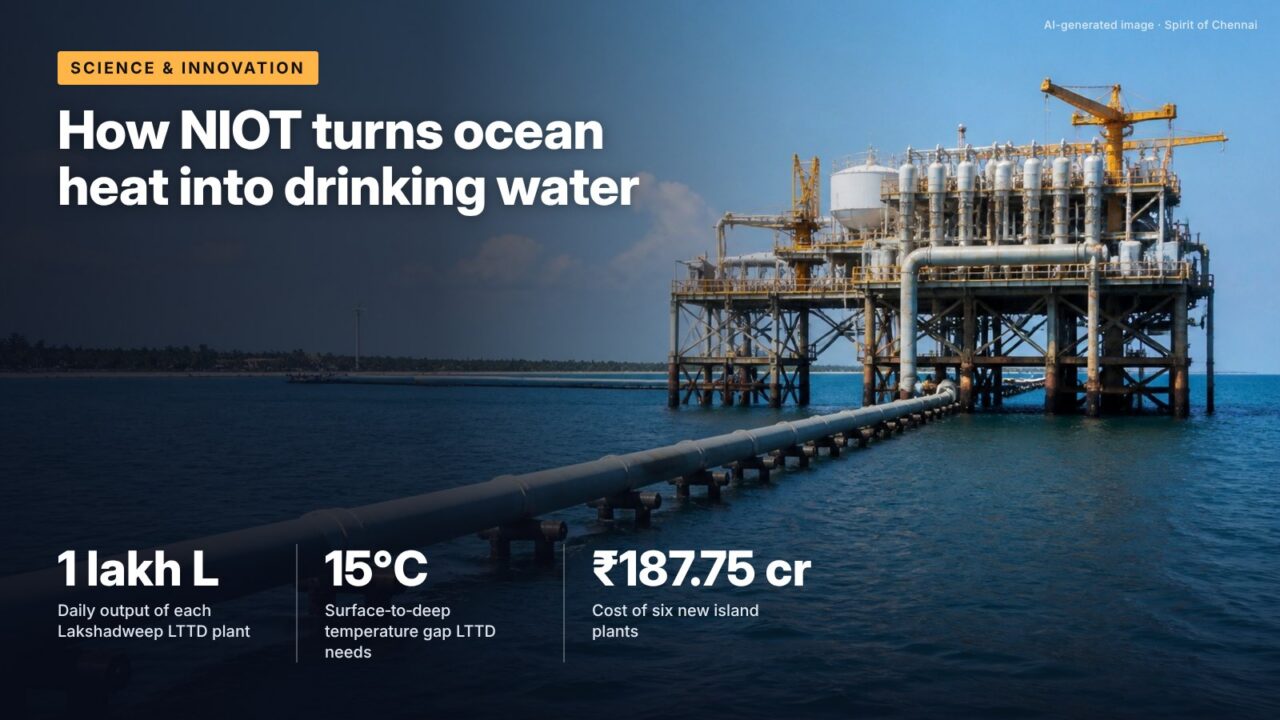
Three desalination plants built by the National Institute of Ocean Technology (NIOT) in Chennai, at Kavaratti, Agatti and Minicoy in Lakshadweep, each produce one lakh litres of drinking water a day using Low Temperature Thermal Desalination (LTTD), the Ministry of Earth Sciences told the Rajya Sabha on 8 December 2022. Six more, at Amini, Androth, Chetlet, Kadmat, Kalpeni and Kiltan, were entrusted to the institute by the Lakshadweep administration at a total cost of ₹187.75 crore, the ministry said in a July 2022 reply.
The technology is entirely indigenous, the ministry says. But it needs a temperature difference of about 15°C between warm surface seawater and cold deep water, and that condition is found near the Lakshadweep coasts, not off Chennai.
How LTTD works
Water boils at a lower temperature when the pressure around it is lower. An LTTD plant exploits this. Warm surface seawater is drawn into a chamber held at very low pressure, where some of it flashes into vapour without any heater. The salt stays behind. The vapour then passes over pipes carrying cold seawater pumped up from depth, condenses, and is collected as fresh water. The ministry’s 2014 Lok Sabha reply describes exactly this: warm surface water flash-evaporated at low pressure and the vapour condensed with cold deep seawater.
The only significant energy needed is for pumps and for holding the vacuum. There are no membranes to foul, and little chemical pre-treatment. That is the contrast with reverse osmosis, the method used at Chennai’s large plants, which forces seawater through membranes at high pressure and depends on a steady electricity supply.
It’s often said Ocean thermal desalination could replace Chennai’s reverse-osmosis plants.
The record shows The Ministry of Earth Sciences says LTTD needs a 15°C gap between surface and deep water and that this is currently found only near the Lakshadweep coasts (Rajya Sabha, 2022). Each island plant makes one lakh litres a day, 0.1 million litres, a tiny fraction of a city’s supply.
Why Lakshadweep, and not the Tamil Nadu coast
Lakshadweep’s coral islands rise from very deep water, so cold water lies close to the shore and a relatively short intake pipe can reach it. Most of Tamil Nadu’s coast sits on a wide, shallow continental shelf, so the pipe to cold water would have to run far out to sea. For islands with no rivers, thin groundwater lenses and expensive diesel, the trade-off favours LTTD. For a mainland city with grid power and large demand, it does not.
Scale is the other half of the argument. One lakh litres a day is enough to give 10,000 people 10 litres each of drinking and cooking water, which is what a small island community needs. A Chennai neighbourhood of that size draws far more for all household uses, and the city as a whole is supplied in hundreds of millions of litres a day.
| Item | Figure | Source and year |
|---|---|---|
| Plants operating | Kavaratti, Agatti, Minicoy | MoES, Rajya Sabha, 2022 |
| Output per plant | 1 lakh litres a day | MoES, 2014 and 2022 |
| Planned plants | Amini, Androth, Chetlet, Kadmat, Kalpeni, Kiltan | MoES via PIB, 2022 |
| Planned capacity | 1.5 lakh litres a day (per plant, as worded) | MoES via PIB, 2022 |
| Cost of six plants | ₹187.75 crore | MoES via PIB, 2022 |
| Running cost (island plants) | About 61 paise a litre | MoES, Lok Sabha, 2014 |
| Tamil Nadu prototype | 2 MLD at Tuticorin Thermal Power Station, work initiated | MoES, Lok Sabha, 2014 |
Source: Ministry of Earth Sciences replies in Parliament, Lok Sabha Unstarred Question 937 (16 July 2014), Rajya Sabha Unstarred Question 180 (8 December 2022), and PIB release 1843523 (21 July 2022).
The cost question
An independent agency estimated LTTD running costs at about 61 paise a litre for island plants, the ministry said in 2014, adding that costs depend on the technology and local electricity prices. That is about ₹610 per kilolitre (1,000 litres). The Lakshadweep plants were fully funded by the Union government. For the six new plants, ₹187.75 crore divided by six is about ₹31 crore each, though the ministry gave no per-plant figure and said cost depends on location.
Capacity of the prototype LTTD plant on which work was initiated at the Tuticorin Thermal Power Station, using the station’s warm discharge water, the ministry said in July 2014.
The Tuticorin experiment
Tamil Nadu did get one LTTD project, of a different kind. At a coal power station the temperature difference comes not from the deep ocean but from the warm water discharged after cooling the plant’s condensers, set against ordinary seawater. In 2014 the ministry said work had been initiated on a 2 MLD prototype at Tuticorin, twenty times the size of a Lakshadweep plant. The official documents read for this article do not report whether it was completed or what it produced, so its outcome is unconfirmed here.
The 2022 Rajya Sabha reply mentioned only one other desalination project in Tamil Nadu supported by the Union’s science departments: a solar-powered reverse-osmosis plant in Ramanathapuram district, backed by the Department of Science and Technology. It gave no capacity.
What NIOT is
NIOT was set up in November 1993 as an autonomous society under what is now the Ministry of Earth Sciences, to develop indigenous technology for using the living and non-living resources of India’s exclusive economic zone. LTTD is one of its few technologies in everyday public use, supplying drinking water to island communities year round.
What this means for you
- LTTD is not coming to Chennai’s taps. The city’s desalinated water will continue to come from reverse-osmosis plants.
- For engineering and ocean-science students, NIOT is the Chennai institution behind this work and publishes recruitment and project openings on its site.
- If you see LTTD proposed for a mainland coastal town, ask where the cold water will come from and how far offshore the pipe must go.
- The 61 paise figure is a 2014 running-cost estimate for islands, not a tariff.
What to watch
Pending: six new Lakshadweep plants
The ministry has not, in the replies read, reported commissioning of the plants at Amini, Androth, Chetlet, Kadmat, Kalpeni and Kiltan.
Pending: Tuticorin prototype outcome
A report on whether the 2 MLD power-station prototype was built and how it performed would settle LTTD’s mainland potential.
Checked against official sources on 23 October 2026. Figures and rules change; confirm on the linked official pages before relying on them.
Sources
- Rajya Sabha Unstarred Question 180, Coastal Desalination Plants, Ministry of Earth Sciences, 8 December 2022
- Indigenous technology for conversion of sea water to potable water, PIB release 1843523, Ministry of Earth Sciences, 21 July 2022
- Lok Sabha Unstarred Question 937, Conversion of Sea Water into Potable Water, Ministry of Earth Sciences, 16 July 2014
- Lok Sabha Unstarred Question 937, 16 July 2014, Parliament Digital Library copy
- National Institute of Ocean Technology, Ministry of Earth Sciences