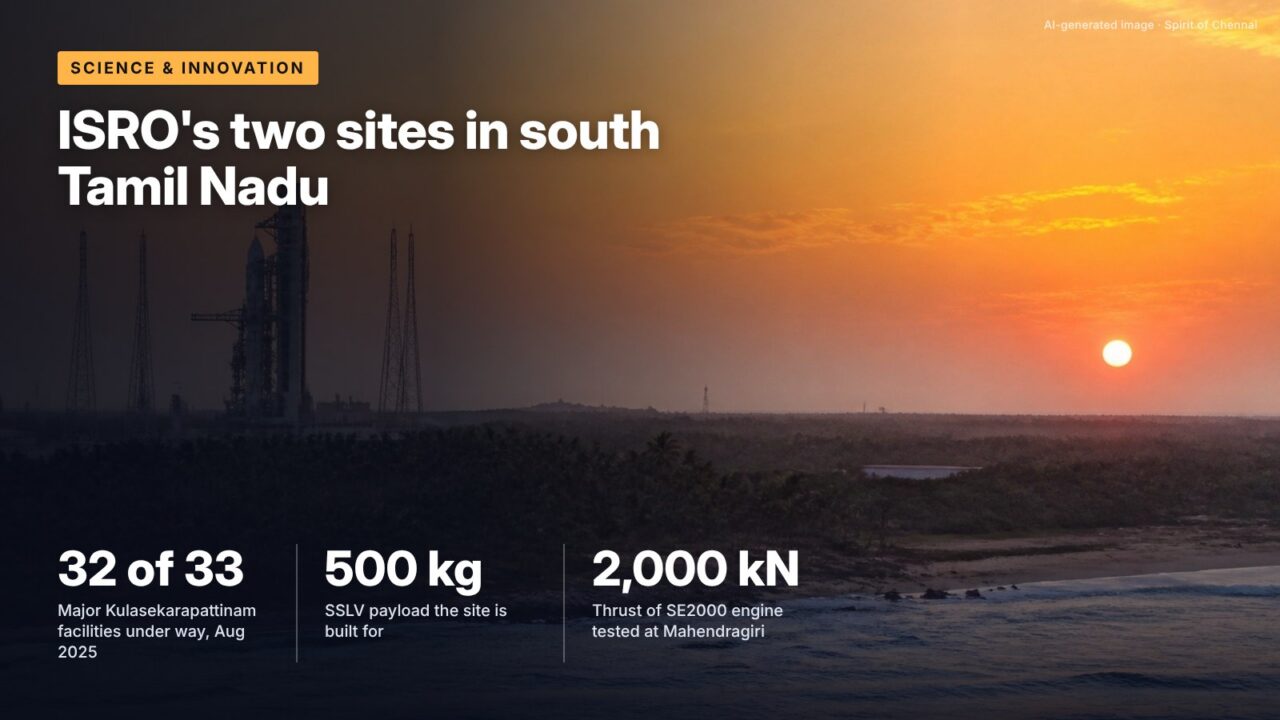
Two of India’s space programme’s most important sites outside Sriharikota are in southern Tamil Nadu. Mahendragiri tests the engines; Kulasekarapattinam, under construction, is being built to launch small rockets south over open sea.
The numbers
Construction had begun on 32 of the 33 major facilities at the SSLV Launch Complex in Kulasekarapattinam, Thoothukudi district, when ISRO Chairman V. Narayanan laid the foundation for its launch pad on 27 August 2025, the Indian Space Research Organisation said. ISRO targets completion by the end of 2026.
In neighbouring Tirunelveli district, the ISRO Propulsion Complex at Mahendragiri has spent 2025 firing the engines that will lift India’s heavier rockets, including a new 2,000 kilonewton semi-cryogenic engine. Together the two sites make southern Tamil Nadu the place where India’s rocket engines are proven and, once the new complex opens, where small rockets will be launched.
Why a second launch site, and why here
ISRO describes the Kulasekarapattinam complex as primarily for polar launches of the Small Satellite Launch Vehicle (SSLV), aimed at the global market for satellites of up to 500 kg, and for launches by non-governmental enterprises (ISRO, March 2025). A polar or sun-synchronous orbit requires a rocket to head roughly north or south. From Sriharikota, on the Andhra Pradesh coast, a rocket heading south passes near Sri Lanka and must bend its path in flight, which costs fuel and therefore payload. From Kulasekarapattinam, on the Gulf of Mannar coast close to the southern tip of the peninsula, the track south is over open sea.
For a large rocket that penalty can be absorbed. For a small three-stage vehicle carrying a few hundred kilograms, every kilogram of performance matters, which is why the site is being matched to the SSLV rather than to ISRO’s heavier launchers.
It’s often said Kulasekarapattinam will replace Sriharikota as India’s main spaceport.
The record shows ISRO’s own descriptions say the complex is built primarily for SSLV polar launches and for private launch companies (March 2025; August 2025). The heavier PSLV, GSLV and LVM3 rockets remain tied to Sriharikota’s existing pads.
How the site came together
Land was the first task. In September 2020 the Department of Space said, in a Press Information Bureau release, that the Tamil Nadu government had identified about 961.67 hectares in Thoothukudi district at its request, that a survey of 431.88 hectares was complete and that a preliminary notification had been issued. The release also said only one launch pad was proposed.
| Date | Milestone | Source |
|---|---|---|
| 21 Sep 2020 | TN identifies about 961.67 ha; 431.88 ha surveyed | Department of Space via PIB |
| 28 Feb 2024 | Prime Minister lays foundation stone for the complex | ISRO |
| 5 Mar 2025 | Groundbreaking for two upper-stage assembly buildings and a launch service building | ISRO |
| 27 Aug 2025 | Foundation for the launch pad; 32 of 33 facilities under construction | ISRO |
| End of 2026 | Target for completion | ISRO |
Source: ISRO releases of 7 March 2025 and 29 August 2025; Department of Space release of 21 September 2020 (PIB). Land areas converted from the release’s hectare-are-centiare format.
What the complex will contain
The upper-stage assembly facilities will prepare the SSLV’s second and third stages. The August 2025 release lists the rest: vehicle integration buildings, a launch pad with a rail track for a Mobile Launch Structure, a jet deflection duct to carry exhaust away from the pad, vibration isolation systems, tracking radars, telemetry and telecommand stations, and safety and firefighting facilities. Sounding rockets, small research rockets for upper-atmosphere studies, were targeted to begin flying from the site in December 2025; ISRO’s releases read for this article do not confirm whether that happened.
Mahendragiri: where engines are proven
The Mahendragiri centre began as part of the Liquid Propulsion Systems Centre and became the ISRO Propulsion Complex on 1 February 2014. It assembles, integrates and tests liquid and cryogenic engines and stages, runs high-altitude tests on upper-stage engines and satellite thrusters, and produces and supplies the cryogenic propellants for India’s launch vehicles, ISRO says.
Every cryogenic engine is hot-tested before it flies. On 14 March 2025 IPRC ran the CE20 engine for the sixth operational LVM3 mission for 100 seconds, the longest hot test of that engine to date, using a nozzle protection system that allowed it to fire at sea-level pressure. Earlier tests in the high-altitude facility had been capped at 25 seconds (ISRO, March 2025).
Planned rise in LVM3’s payload to geosynchronous transfer orbit once the SE2000 semi-cryogenic stage replaces the current liquid core stage (ISRO, March 2025).
The semi-cryogenic engine
The bigger story at Mahendragiri is the SE2000, a 2,000 kN engine burning liquid oxygen and kerosene, both of which ISRO describes as non-toxic. It will power a new stage, SC120, replacing the L110 core stage on LVM3. A semi-cryogenic engine is so called because only one of its propellants, the oxygen, is super-cold. The engine is tested in the Semicryogenic Integrated Engine Test facility, dedicated on 27 February 2024 and able to handle engines of up to 2,600 kN.
Three short tests of the engine’s power head, which includes everything except the thrust chamber, followed in quick succession: 2.5 seconds on 28 March 2025, 3.5 seconds at up to 60% of rated power on 24 April and 3 seconds at 60% on 28 May. Each refined the ignition and start-up sequence, the most delicate phase of any liquid engine. ISRO gives the design chamber pressure as 180 bar and the specific impulse, a measure of fuel efficiency, as 335 seconds.
What this means for you
- Kulasekarapattinam is not open to visitors as a launch-viewing site; any viewing arrangements would be announced by ISRO closer to operations.
- Private launch companies are among the intended users, which could bring supplier work to Thoothukudi and Tirunelveli districts.
- Mahendragiri’s tests decide when LVM3 can carry heavier satellites; dates of LVM3 missions depend on these engines clearing acceptance.
- Treat target dates as targets. ISRO’s own releases have moved the first sounding-rocket flights and completion timelines before.
What to watch
End of 2026
ISRO’s target for completing the Kulasekarapattinam launch complex.
Pending: integrated SE2000 tests
After the power-head tests of 2025, ISRO’s next step is full-engine firing ahead of an SC120 stage test; no date has been set out in the releases read.
Checked against official sources on 23 October 2026. Figures and rules change; confirm on the linked official pages before relying on them.
Sources
- Foundation Stone Laid for Launch Pad at SSLV Launch Complex, Kulasekarapattinam, ISRO, August 2025
- Commencement of the construction of SSLV Launch Complex at Kulasekarapattinam, ISRO, March 2025
- ISRO Propulsion Complex (IPRC), Mahendragiri, ISRO
- Flight acceptance hot test of CE20 cryogenic engine for LVM3-M6, ISRO, March 2025
- ISRO achieves major breakthrough in semicryogenic engine development, ISRO, March 2025
- Short duration hot test of semicryogenic engine, ISRO, April 2025
- Successful third hot test of semi-cryogenic engine power head test article, ISRO, May 2025
- Department of Space release on the second launch port at Kulasekarapattinam, PIB, 21 September 2020 (archived copy)