DPIIT’s 2022 States’ Startup Ranking graded Tamil Nadu’s startup policy on 25 actions across seven areas. The state’s report card shows top marks for building the ecosystem and weaker scores on money and market access, with specific fixes recommended.
The numbers
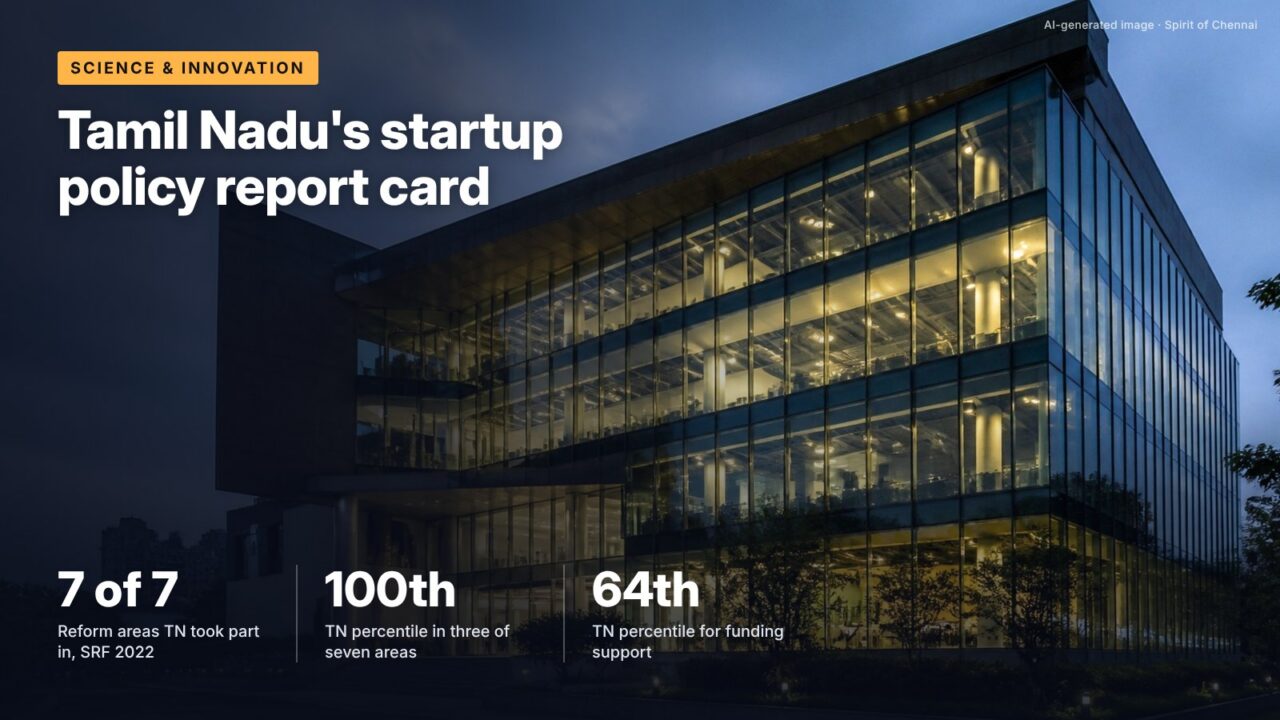
In the fourth edition of the Department for Promotion of Industry and Internal Trade’s States’ Startup Ranking, Tamil Nadu took part in all seven reform areas and all 25 action points, and reached the 100th percentile in three of them: fostering innovation and entrepreneurship, capacity building of enablers, and its roadmap to a sustainable future. Its weakest score was the 64th percentile in funding support, according to the state report published with the results.
The results were announced on 16 January 2024 by Commerce Minister Piyush Goyal at Bharat Mandapam in New Delhi. Thirty-three states and Union Territories took part, the highest in any edition, the results page says. Tamil Nadu competed in Category A, for states and UTs with more than one crore people, alongside 18 others.
How the ranking works
The exercise does not count startups. It scores what a state government has done to support them. Each state submits evidence against action points such as having a startup policy and a single-window portal, running incubators, giving seed grants, buying from startups and training officials. States are then placed in performance bands, and each gets a report with percentile scores by reform area: a percentile of 100 means no participating state did better in that area.
| Reform area | TN percentile |
|---|---|
| Fostering innovation and entrepreneurship | 100th |
| Capacity building of enablers | 100th |
| Roadmap to a sustainable future | 100th |
| Incubation and mentorship support | 94th |
| Access to market | 79th |
| Institutional support | 75th |
| Funding support | 64th |
Source: DPIIT, States’ Startup Ranking 2022, Tamil Nadu state report. The extracted report does not label scores against areas unambiguously; this is the order in which they appear. Confirm against the original PDF.
Who Tamil Nadu was measured against
Category A in 2022 contained 19 states and UTs: Gujarat, Karnataka, Kerala, Tamil Nadu, Maharashtra, Odisha, Punjab, Rajasthan, Telangana, Andhra Pradesh, Assam, Madhya Pradesh, Uttar Pradesh, Uttarakhand, Bihar, Haryana, Chhattisgarh, Delhi, and Jammu and Kashmir. Category B held 14 smaller states and UTs, from Himachal Pradesh and Goa to Puducherry and Sikkim (DPIIT results page). Percentiles in the state report are calculated against the other participants, so a 100th percentile means Tamil Nadu matched or beat every one of them in that area, including Karnataka and Maharashtra, which have far more startups. A lower percentile in funding support does not mean the state spent little in absolute terms; it means other states scored better on the action points assessed, such as how funds are disbursed and tracked.
What Tamil Nadu reported
The state’s evidence, summarised in the report, included more than 2,250 startups registered with the state during the assessment period and more than 7,000 overall; about 2,000 startups supported by state-backed incubators; more than 80 incubators supported through EDII-TN, STPI and the state’s TANSIM mission; and over 250 programmes in schools and colleges. It described its policy as the Tamil Nadu Startup and Innovation Policy 2018, which aims to make the state one of the top 20 global startup destinations by 2032, and counted more than 15 active startup schemes.
TANSEED, the state’s seed scheme, had been revamped as an equity-linked grant: up to ₹15 lakh for early-stage startups in rural impact, climate action and women-led ventures, and up to ₹10 lakh for others. Four editions had been held by August 2022. The report also names a Tamil Nadu Emerging Sector Seed Fund investing ₹3 crore to ₹10 crore per round, an SC/ST Startup Fund and an Innovation Voucher Programme.
The report gives three different funding numbers: more than ₹20 crore disbursed to 240-plus startups, more than ₹23 crore sanctioned to 240-plus, and more than ₹30 crore supporting 150-plus. The gap between sanctioned and disbursed is itself a finding.
Why funding scored lowest
The assessors’ main recommendation on funding was an online disbursement system that tracks every transaction and lets startups apply for funds through the portal. That fits the inconsistency in the state’s own figures. Union data point the same way: seed money approved by incubators for Tamil Nadu startups under the Startup India Seed Fund Scheme was only ₹3.4 crore in 2021 and ₹8.3 crore in 2022, the years the ranking assessed (Lok Sabha, February 2026).
It’s often said The ranking shows which state has the most startups.
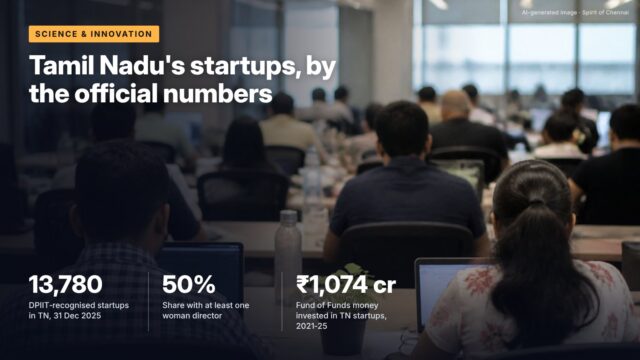
The record shows It grades state policy and support, not numbers. Tamil Nadu reached the 100th percentile in three reform areas while ranking sixth by count of DPIIT-recognised startups at the end of 2025, with 13,780 against Maharashtra’s 35,992 (Lok Sabha, February 2026).
The fixes DPIIT recommended
The report’s recommendations are specific enough to check against what the state does next:
- Access to market: a mandatory minimum share of departmental and public sector purchases from startups, and more demo days and hackathons for government buyers.
- Incubation: performance targets for incubators, including how full they are, a hub-and-spoke model, and virtual acceleration programmes.
- Institutional support: more departments involved and startup-specific incentives from them, plus a chatbot for routine grievances.
- Capacity building: quarterly workshops for officials and investor outreach in every district.
- Sustainability: rural incubation centres and a separate social impact measure.
The report also suggested studying startups registered for five years or more, to see which survive. That matters because recognised-startup counts have been rising quickly: Tamil Nadu went from 10,577 at the end of 2024 (Lok Sabha, February 2025) to 13,780 a year later.
What this means for you
- If you are an early-stage founder, TANSEED’s higher ₹15 lakh tier targets rural impact, climate and women-led ventures; check current terms with StartupTN.
- The assessors flagged state procurement as a weak spot. Founders selling to government should watch for any minimum-purchase rule.
- Incubator quality varies. The recommendation for incubator performance targets is a reason to ask an incubator for its occupancy and outcomes before joining.
- Rankings grade governments. They are not a guide to which city or sector will fund your company.
What to watch
Pending: next States’ Startup Ranking edition
DPIIT’s next results will show whether Tamil Nadu’s funding and market-access scores improved.
Pending: successor to the 2018 policy
The state’s startup policy dates from 2018; any revision would be the vehicle for the procurement and incubator reforms suggested.
Checked against official sources on 23 October 2026. Figures and rules change; confirm on the linked official pages before relying on them.
Sources
- States’ Startup Ranking 2022, Tamil Nadu state report, DPIIT / Startup India
- States’ Startup Ranking 2022 results, DPIIT / Startup India, January 2024
- Lok Sabha Unstarred Question 588, Start-ups in India, Ministry of Commerce and Industry, 3 February 2026
- Lok Sabha Unstarred Question 1161, Employment through Start-ups, Ministry of Commerce and Industry, 11 February 2025
- StartupTN, Tamil Nadu Startup and Innovation Mission