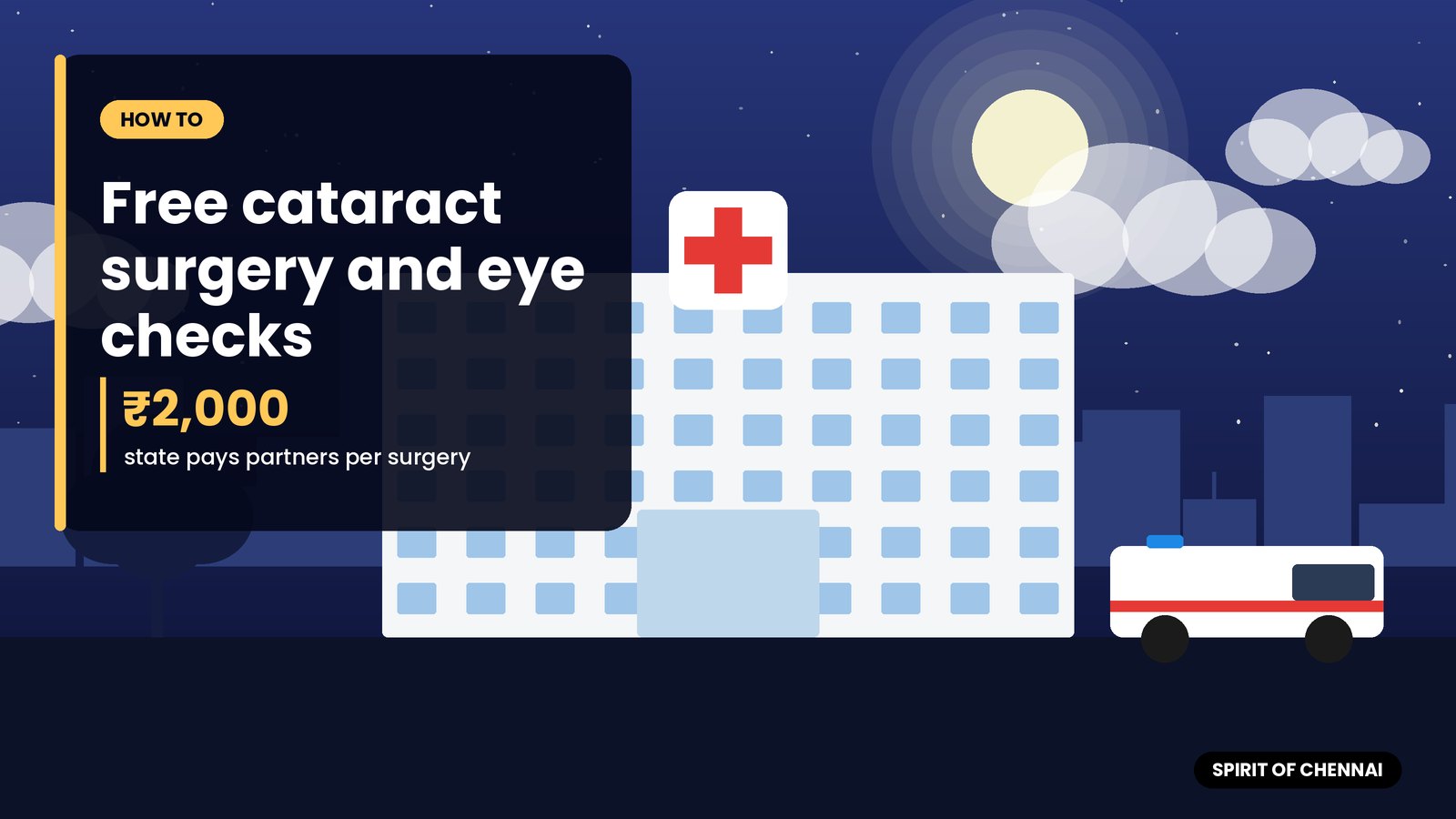
Cataract surgery is free under the National Programme for Control of Blindness in Tamil Nadu, at government hospitals and at NGO and private hospitals that partner with the district blindness control society. You can get your eyes checked at the ophthalmology OP of any government hospital, or at a screening camp, and be booked for surgery with a lens implant without paying. The state pays partner hospitals ₹2,000 per surgery, cashless, according to the Tamil Nadu State Blindness Control Society.
Cataract causes 62% of blindness in the state, the society says, which is why the programme also screens school children and gives free spectacles, gives near-vision glasses to the elderly poor, and screens people with diabetes once a year for retinal damage. In Chennai, the programme’s state office is at the Regional Institute of Ophthalmology (RIO) in Egmore.
Before you start
| Document | Who needs it | Notes |
|---|---|---|
| Photo ID | Everyone | For registration at the OP or camp |
| Old OP card and eye reports | Returning patients | Saves repeat tests |
| Current spectacles | Spectacle wearers | The doctor checks your present power |
| List of medicines, sugar and BP reports | People with diabetes or heart conditions | Surgery is planned around these |
| CMCHIS card, if you have one | Families in the state scheme | The programme also funds eye surgery in government hospitals under CMCHIS |
Source: Tamil Nadu State Blindness Control Society
How to get a free eye check and cataract surgery
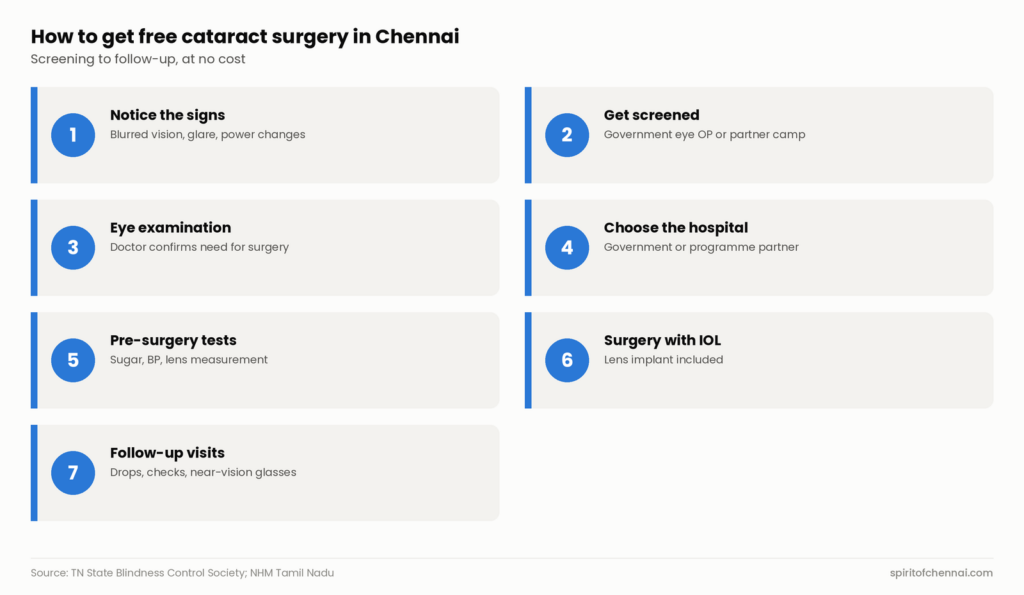
- Notice the signs. Blurred or dim vision, glare from headlights, or frequent changes in spectacle power are common reasons to get checked. Do not wait for vision to be lost.
- Get screened. Visit the eye OP at a government hospital in the morning OP hours, 7.30 am to noon, per the health department charter, or attend a screening camp run with the district society’s NGO partners.
- Have the eye examined. The ophthalmologist confirms the cataract and checks if surgery is needed now.
- Choose the hospital for surgery. Surgery is free at government hospitals and at NGO and private partners of the programme, the National Health Mission page says. Partners are paid by the state, so you should not be charged.
- Complete pre-surgery tests. Blood sugar, BP and lens measurement. Bring your medicine list.
- Undergo surgery with lens implant. Cataract surgery under the programme includes an intraocular lens (IOL), according to the state society.
- Go back for follow-up. Use the eye drops as told and return for checks. Ask about near-vision spectacles if you need them.
What the programme offers free
| Service | Who it is for | Where |
|---|---|---|
| Cataract surgery with IOL | Anyone with cataract | Government hospitals, NGO and private partners |
| Free spectacles after screening | School children | School screening |
| Near-vision spectacles | Elderly poor | Through the programme |
| Diabetic retinopathy screening, yearly | People with diabetes | Block PHCs and government hospitals |
| Retinopathy of prematurity screening | Pre-term babies | Newborn care units |
Source: TN State Blindness Control Society; NHM Tamil Nadu
In 2019-20, the latest year published by NHM Tamil Nadu, the programme recorded 2,62,903 cataract surgeries through 68 NGOs and 89 government hospitals in 38 districts, and gave 1,90,817 free spectacles to school children.
The state pays partner hospitals ₹2,000 per cataract surgery, cashless, so a patient sent through the programme should not pay, says the Tamil Nadu State Blindness Control Society.
Common mistakes
It’s often said you have to wait until a cataract is ‘ripe’ before surgery.
In fact The ophthalmologist decides when surgery is needed based on how much the cataract affects your sight and daily life.
- Skipping follow-up visits. Most complications are caught at the checks after surgery.
- Paying for a ‘premium’ lens at a camp without asking what the programme covers. Ask what is free first.
- People with diabetes missing the yearly retinal screening, which is separate from cataract surgery.
If it goes wrong
If a partner hospital asks you to pay for surgery done under the programme, ask in writing what the charge is for, and contact the District Blindness Control Society, chaired by the District Collector, or the state society at RIO Egmore (044-28520799, teleophthal.tnsbcs@gmail.com), listed on the society website. For general health information, call the 24-hour 104 helpline. If vision suddenly worsens or the eye becomes red and painful after surgery, go back to the hospital the same day.
This is general information. Your ophthalmologist will advise on the timing and type of surgery for your eyes.
Quick answers
Is cataract surgery free in Tamil Nadu government hospitals?
Yes. It is free under the National Programme for Control of Blindness, including at partner NGO and private hospitals.
Where is the programme’s office in Chennai?
The Tamil Nadu State Blindness Control Society is at the Regional Institute of Ophthalmology, Egmore. Phone 044-28520799.
Do senior citizens get free spectacles?
The programme gives near-vision spectacles to the elderly poor.
How often should diabetics get eyes checked?
Once a year; the programme runs yearly tele-screening for diabetic retinopathy.
Information checked against official sources on 19 October 2026. Fees, dates and rules can change; confirm on the linked official pages before acting.
Sources
- Tamil Nadu State Blindness Control Society (NHM Tamil Nadu)
- National Programme for Control of Blindness in Tamil Nadu (National Health Mission, Tamil Nadu)
- Citizen’s Charter 2019-20, Health and Family Welfare Department (Government of Tamil Nadu)
- Press Release No. 646 on the 104 helpline, 6 May 2024 (DIPR, Government of Tamil Nadu)