
You are entitled to copies of your hospital records in Tamil Nadu, and a doctor or hospital must issue them within 72 hours of your written request. That rule comes from the Medical Council’s 2002 professional conduct regulations, which also require inpatient records to be kept for three years from the start of treatment. Ask in writing at the hospital’s medical records section, show ID, and pay the copying charges.
For government hospitals, the Right to Information Act is a backup if a request stalls: the application fee in Tamil Nadu is ₹10 and copies cost ₹2 a page, under the state RTI fee rules. And at hospitals that have gone digital, such as Rajiv Gandhi Government General Hospital and Kilpauk Medical College Hospital, outpatient prescriptions and lab results have been recorded online since June 2026 and can be viewed through your digital health ID.
Before you start
| Document | Who needs it | Notes |
|---|---|---|
| Patient’s photo ID | Everyone | Matches the name on the case sheet |
| Inpatient (IP) or OP number, dates of admission | Everyone | From the discharge summary or bill |
| Authorisation letter from the patient | Relatives or attendants | The regulations allow authorised attendants to request |
| Death certificate and proof of relationship | Family of a patient who died | Relatives are entitled to a death summary |
| Written application with date | Everyone | Keep a copy with the hospital’s acknowledgement |
Source: Medical Council Regulations 2002, clause 1.3; Charter of Patients’ Rights (draft)
How to get your records
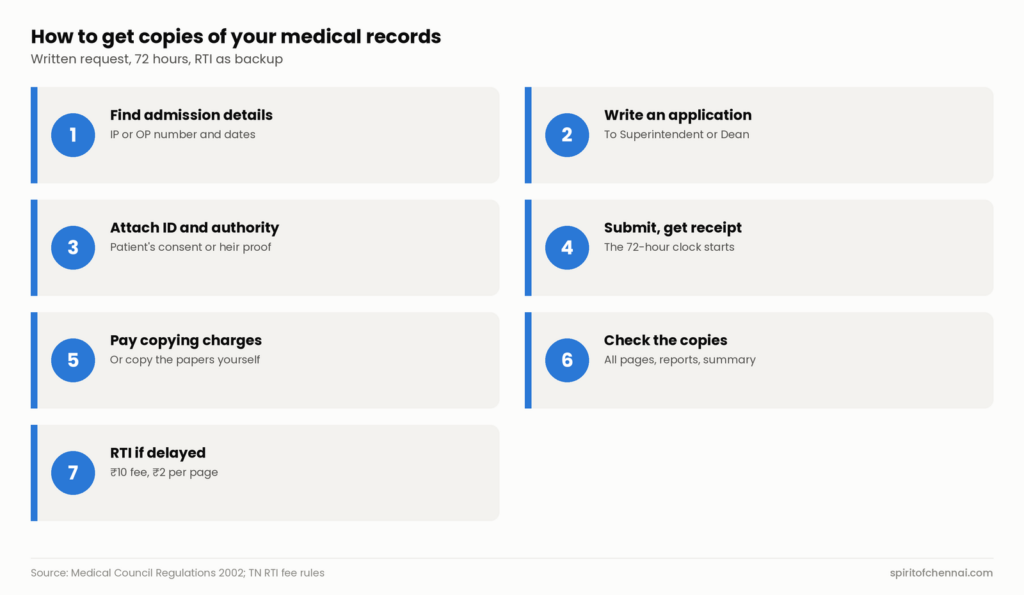
- Find your admission details. Note the IP or OP number, ward and dates from the discharge summary or bill.
- Write a short application. Address it to the Medical Superintendent or Dean, list what you need (case sheet, investigation reports, scans, discharge summary) and give your phone number.
- Attach ID and authority. A relative should attach the patient’s authorisation, or a death certificate and proof of relationship if the patient has died.
- Submit and get an acknowledgement. Hand it to the medical records section and ask for a dated receipt. The 72-hour clock starts here.
- Pay the copying charges. Hospitals may charge a reasonable photocopying fee, or let you copy the papers yourself, according to the draft patients’ charter.
- Collect and check the copies. Check every page is legible and that test reports and the discharge summary are included.
- Use RTI if a government hospital delays. File with the hospital’s Public Information Officer with ₹10 by cash, court fee stamp or demand draft. Copies cost ₹2 a page.
- Check your digital record. For OP visits at ABDM-linked hospitals, view prescriptions and reports in your ABHA app with consent.
Fees and timelines
| Item | Fee or time | Applies to |
|---|---|---|
| Issue of records after request | 72 hours | All registered doctors and hospitals |
| Records during admission | Preferably within 24 hours | Draft patients’ charter |
| RTI application | ₹10 | Government hospitals |
| RTI copies | ₹2 per A4 or A3 page | Government hospitals |
| RTI inspection of files | First hour free, then ₹5 an hour | Government hospitals |
Source: Regulations 2002, clause 1.3.2; Charter of Patients’ Rights (draft); TN RTI fee rules
Requests for medical records must be acknowledged and the documents issued within 72 hours, under clause 1.3.2 of the 2002 regulations.
Common mistakes
- Asking verbally at the ward. Without a written, dated request, there is no 72-hour clock.
- Waiting years. Inpatient records need be kept for only three years from the start of treatment.
- Collecting copies without checking them. Missing pages are easier to fix on the spot.
- Handing over the only original discharge summary to an insurer or lawyer. Give copies.
If it goes wrong
Scans and X-ray films are records too. If you need the actual images rather than the radiologist’s report, say so in your application, so the hospital knows to include them.
If a private hospital or doctor refuses or delays beyond 72 hours, send a written reminder citing clause 1.3.2, then complain to the Tamil Nadu Medical Council (914 Poonamallee High Road; tnmedicalcouncil@gmail.com), which enforces the regulations. For a government hospital, file an RTI application; if there is no reply, the RTI Act’s appeal route applies. If you need the records for a legal claim, a lawyer can advise on what else to request.
Quick answers
How long does a hospital have to give me my records?
72 hours from a written request, under the 2002 Medical Council regulations.
Can a relative collect records?
Yes, an authorised attendant can request them; carry the patient’s authorisation or, after a death, proof of relationship.
How long are hospital records kept?
Inpatient records must be kept for at least three years from the start of treatment.
What does RTI cost in Tamil Nadu?
₹10 to apply and ₹2 per page for copies.
Information checked against official sources on 19 October 2026. Fees, dates and rules can change; confirm on the linked official pages before acting.
Sources
- Indian Medical Council (Professional Conduct, Etiquette and Ethics) Regulations, 2002 (copy published by the Delhi Medical Council)
- Charter of Patients’ Rights, NHRC draft circulated for comments (Ministry of Health and Family Welfare)
- Tamil Nadu Right to Information fee rules (Tamil Nadu State Information Commission)
- Tamil Nadu Medical Council