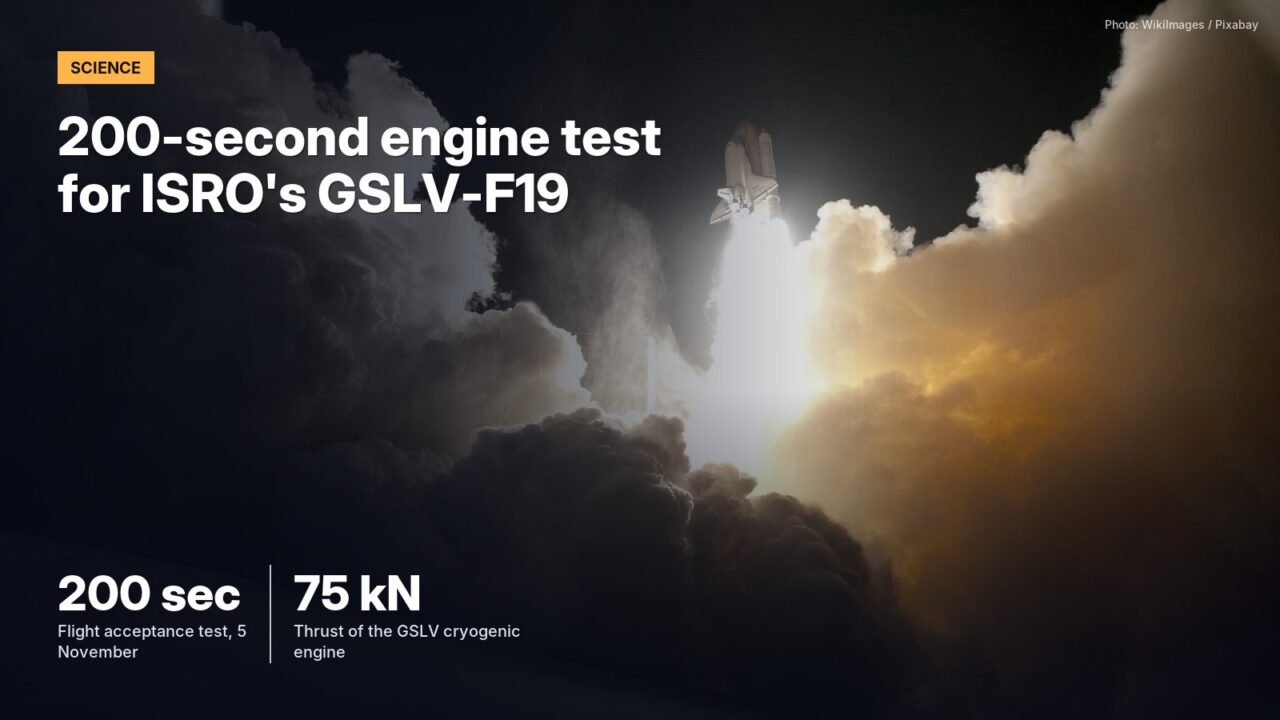
The engine that will push NavIC satellite NVS-04 towards orbit ran for 200 seconds on a test stand in the Mahendragiri hills, ISRO said.
Two hundred seconds. That is how long ISRO kept the cryogenic engine for its next GSLV flight burning on 5 November at the ISRO Propulsion Complex (IPRC) in Mahendragiri, in the hills above Kanniyakumari, according to the space agency’s release of 10 November.
It was a flight acceptance test, the last full firing an engine gets before it is fitted to a rocket.
The main engine and the gas generator both lit as expected, ISRO said, and the engine’s steady-state performance was normal and matched the predictions made before the test. This particular engine will now be integrated into the cryogenic stage of GSLV-F19, the rocket that is to carry the navigation satellite NVS-04. ISRO has not announced a launch date.
Why a single engine gets fired before it flies
A cryogenic engine burns liquid hydrogen with liquid oxygen, both kept hundreds of degrees below zero, and on the GSLV it powers the upper stage that does the last part of the climb to a transfer orbit. Every engine built for a flight is fired on the ground first. The test checks that this unit, rather than the design alone, starts cleanly and holds its thrust and pressures for the duration, and the numbers recorded are compared with what engineers expected. If the readings match, as ISRO says they did here, the engine is cleared to be bolted into its stage and shipped to Sriharikota. A failed or off-nominal run would mean pulling the engine, finding the fault and testing again, which is why these firings tend to come weeks before a launch rather than days.
The GSLV’s cryogenic engine produces 75 kN of thrust, according to IPRC. The larger LVM3 rocket uses a 200 kN cryogenic engine, and both are tested at the same complex.
Tamil Nadu’s propulsion test site
IPRC sits in the Mahendragiri hills, மகேந்திரகிரி, in Tirunelveli district, close to Kanniyakumari. It was earlier called the Liquid Propulsion Systems Centre, Mahendragiri. The complex assembles and tests the second and fourth stages of the PSLV and the cryogenic engines and stages of the GSLV and LVM3, and it runs vacuum tests on upper-stage engines, thrusters and the liquid apogee motors that satellites use to reach their final orbits.
The next engine family is being proved here too, a 2000 kN semi-cryogenic engine that burns liquid oxygen and kerosene.
What NVS-04 joins
NVS-04 belongs to ISRO’s second-generation navigation series, built to keep India’s regional navigation system, NavIC, running as the older IRNSS satellites age. NavIC gives position, velocity and timing services over India and a region about 1,500 km beyond its land mass. Its standard service is specified at better than 20 m for position and better than 40 nanoseconds for timing.
The previous satellite in the series, NVS-03, went up on GSLV-F18, the 20th flight of the GSLV, from the Second Launch Pad at Sriharikota. ISRO said that mission placed the satellite in its intended geosynchronous transfer orbit. NVS-03 carries an indigenous atomic clock alongside procured ones and adds an L1 signal to NavIC’s existing L5 and S-band signals.
GSLV-F19 will be the next in line, carrying the engine that ran at Mahendragiri on 5 November.
For Context
The series has had one setback. NVS-02 was launched on GSLV-F15 on 29 January 2025, the 100th launch from Sriharikota, and ISRO said the rocket’s stages, including its indigenous cryogenic stage, performed flawlessly and put the satellite into the planned transfer orbit with high precision.
The problem came afterwards, on the satellite itself. The valves that admit oxidiser to the thrusters meant to raise NVS-02 to its working orbit did not open, and the satellite was left in an elliptical orbit. ISRO said it was working on alternate strategies to use the satellite for navigation from that orbit.
Checked against official sources on 15 November 2026.
Sources
- ISRO conducts flight acceptance test of cryogenic engine for next GSLV mission, Indian Space Research Organisation, 10 November 2026
- About IPRC, ISRO Propulsion Complex, Mahendragiri
- GSLV-F18/NVS-03 mission, Indian Space Research Organisation
- GSLV-F15/NVS-02 mission, Indian Space Research Organisation
- ISRO Propulsion Complex, Mahendragiri, home page