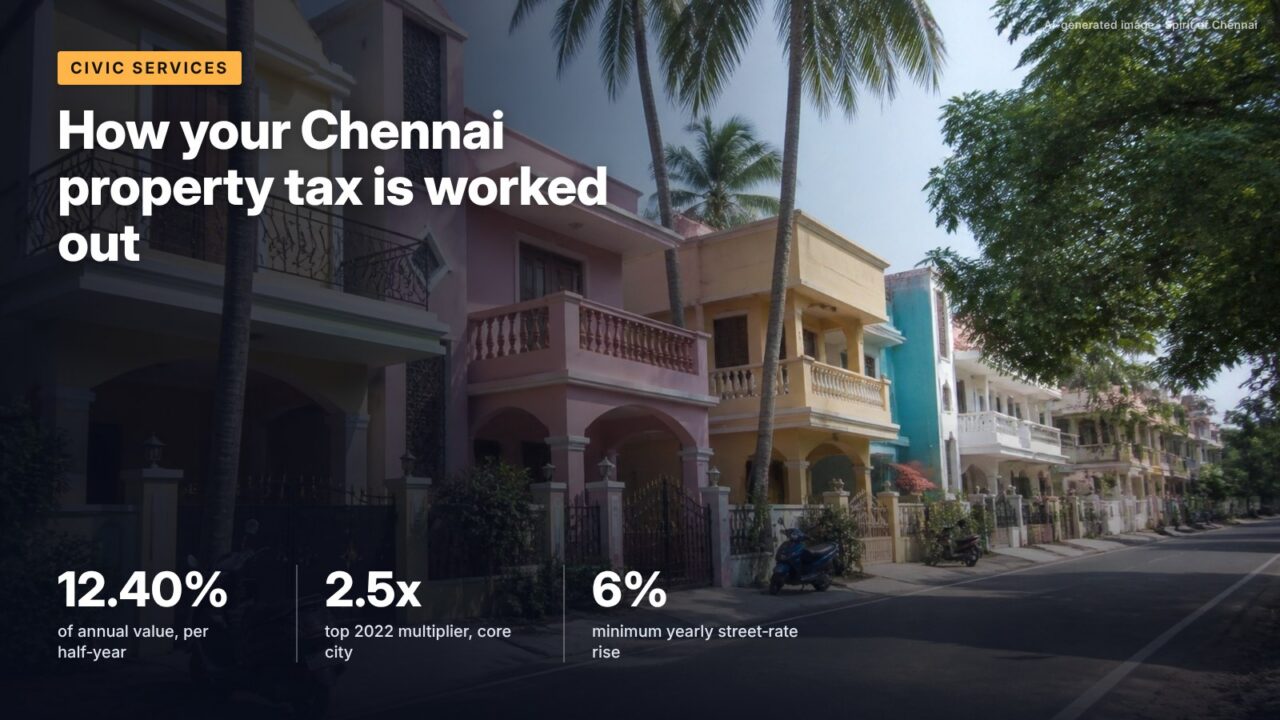
Every Chennai property tax bill comes out of one short formula built on a street rate, your floor area and a fixed tax rate. The 2022 revision changed the multipliers and added an automatic 6% yearly rise, so the bill now keeps growing without any fresh council decision.
The numbers
The Greater Chennai Corporation does not value your house. It values your street. Each street carries a Basic Street Rate (BSR), a notional monthly rent per square foot, and your tax follows from that rate, your built-up area and how the building is used. The Corporation’s revenue department sums it up in one line: the half-yearly tax equals plinth area times BSR times 1.35408.
That multiplier hides five steps, and the 2022 revision (Gazette notification of 11 April 2022) changed the street rates beneath it for the first time in years. It also wrote in an automatic yearly rise of at least 6%. Knowing the steps is the only way to check whether a bill is right, and the only basis for an objection that will hold up.
The formula, step by step
The Corporation’s own worked example uses 100 sq ft on a street with a BSR of ₹1. Monthly rental value is area times BSR, so ₹100. Multiply by 12 for the annual rental value: ₹1,200. Ten per cent of that is treated as land value (₹120) and the rest as building value (₹1,080). The building value gets a 10% deduction for maintenance (₹108), leaving ₹972. Add the land value back and the annual value is ₹1,092. The half-yearly tax is 12.40% of that annual value, or ₹135.40.
The 12.40% is three levies stacked together: general tax at 9%, education tax at 2.5% and library cess at 0.9%. The 2022 notification made the existing 12.40% the floor rate for the city, which means it cannot be cut below that level.
| Step | What it means | Example (100 sq ft, BSR ₹1) |
|---|---|---|
| Monthly rental value | Area × BSR | ₹100 |
| Annual rental value | × 12 | ₹1,200 |
| Land share | 10% of annual rent | ₹120 |
| Building share less 10% maintenance | ₹1,080 − ₹108 | ₹972 |
| Annual value | Building share + land share | ₹1,092 |
| Half-yearly tax | 12.40% of annual value | ₹135.40 |
Source: Greater Chennai Corporation, Revenue Department page (worked example and tax-rate split), accessed October 2026
So a 1,000 sq ft flat on a street with a BSR of ₹2 would pay about 1,000 × 2 × 1.35408, or ₹2,708 a half-year, before any rebate. The BSR here is only an illustration; the real one for your street is in the Corporation’s online calculator, which asks for zone, ward, street, area and usage.
What the 2022 revision changed
The notification, issued under Section 98-A of the Chennai City Municipal Corporation Act, 1919, followed Council Resolution 39/2022 and G.O. (Ms) No. 53 of 30 March 2022. It did not change the formula. It multiplied every existing street rate by an “increase factor” that depends on floor area, usage and whether the property is in the old core city or the areas added to the Corporation in 2011.
| Category | Core city factor | Added areas factor |
|---|---|---|
| Residential, up to 600 sq ft | 1.5 | 1.25 |
| Residential, 601 to 1,200 sq ft | 1.75 | 1.5 |
| Residential, 1,201 to 1,800 sq ft | 2 | 1.75 |
| Residential, above 1,800 sq ft | 2.5 | 2 |
| Industrial | 2 | 1.75 |
| Commercial | 2.5 | 2 |
| Private schools and colleges | 2 | 1.75 |
Source: Tamil Nadu Government Gazette Extraordinary No. 218, Part III-2, GCC notification SRO C-11(a)/2022, 11 April 2022
The government’s case for the size of the rise is set out in the notification’s own recitals. The wholesale price index stood at 48.1 in 1998-99 and 142.9 in January 2022, a 2.97-fold rise, while Tamil Nadu’s economy grew about 5.2 times between 2008-09 and 2021-22. Hotels, marriage halls, hospitals and cinemas, which were earlier taxed on rentals or ticket rates, were moved to area-based assessment at the non-residential rate. Vacant land tax went from ₹0.50 to ₹1 per sq ft for most assessments.
From each 1 April the street rate rises by 6% or by the average GSDP growth of the past five years, whichever is higher, under the 2022 notification.
Who sets the rates, and how
The revision ran through three layers, and the order matters for anyone who wants to contest it. The state government issued G.O. (Ms) No. 53 on 30 March 2022. The Corporation Council adopted Resolution 39/2022 on 9 April. The Commissioner then published the notification on 11 April under Section 98-A of the 1919 Act, inviting objections to the Principal Secretary and Commissioner at Ripon Buildings within 30 days, after which the Council was to decide and finalise the provisions. The new rates applied from the first half-year of 2022-23.
Special-category properties such as hotels and hospitals moved to the new area-based method only once they had cleared all arrears up to the second half of 2021-22, which tied the reform to arrears recovery. After 2022, the automatic yearly rise means rates change without this full chain being repeated.
Rebates, penalties and the age discount
The notification set an age rebate tied to when a property was last assessed: 10% for assessments up to March 1997, 6% for April 1997 to March 2007, 3% for April 2007 to March 2017 and nothing after that. Semi-permanent roofs get a 20% concession on monthly rental value. Paying within the first 30 days of a half-year (1 to 30 April and 1 to 30 October) earns a 5% incentive up to ₹5,000, but only for full payment. Late payment costs 1% simple interest a month, according to the revenue department.
It’s often said the Corporation reassesses each house’s market value when it raises tax.
The record shows Individual values are not reworked. The 2022 notification multiplied existing street rates by fixed factors and then set an automatic yearly rise, so two identical flats on the same street pay the same whatever their sale price.
Why this tax matters to the Corporation
Property tax is the single largest own-revenue line in the Corporation’s budget. The Budget at a Glance for 2026-27 records ₹2,070.85 crore of property tax actually collected in 2024-25, out of total revenue receipts of ₹4,679.38 crore, or about 44% (₹2,070.85 crore divided by ₹4,679.38 crore). The revised estimate for 2025-26 is ₹2,300 crore and the budget estimate for 2026-27 is ₹2,450 crore. Profession tax, the next largest, is budgeted at ₹600 crore.
| Year | Property tax (₹ crore) | Total revenue receipts (₹ crore) |
|---|---|---|
| 2024-25 (actuals) | 2,070.85 | 4,679.38 |
| 2025-26 (revised estimate) | 2,300.00 | 5,511.77 |
| 2026-27 (budget estimate) | 2,450.00 | 6,040.97 |
Source: Greater Chennai Corporation, Budget at a Glance 2026-27
The same annual value feeds a second bill. Chennai Metro Water levies water tax at 1.5% and sewerage tax at 5.5% a year on the annual value fixed by the Corporation, according to its tariff page. A higher assessment therefore raises two bills, not one. Wrong classification has been a long-running issue: a CAG review of Metro Water billing for 2004-05 found properties billed as domestic that the Corporation had classed as commercial, and quantified ₹6.27 crore of short collection in two sample areas.
What this means for you
- Check three things on your bill: the street’s BSR, the area recorded and the usage class. Most disputes come from one of these.
- If your flat crossed a slab line (600, 1,200 or 1,800 sq ft), the factor changes sharply. Make sure the recorded area matches your sanctioned plan.
- Pay the full half-year amount in April or October to get the 5% incentive, capped at ₹5,000.
- Expect the bill to rise every April by at least 6% under the 2022 rule, even without a new government order.
- A change in your assessment also changes your Metro Water tax, which is charged on the same annual value.
What to watch
1 April 2027
The next automatic street-rate rise of 6% or the five-year average GSDP growth, whichever is higher, falls due for all properties.
Pending
Revised estimates for 2026-27 will show whether collections reach the ₹2,450 crore budgeted, when the 2027-28 budget is presented.
Checked against official sources on 23 October 2026. Figures and rules change; confirm on the linked official pages before relying on them.
Sources
- GCC notification SRO C-11(a)/2022 on property tax revision, TN Government Gazette Extraordinary No. 218, 2022
- Revenue Department: property tax calculation, Greater Chennai Corporation, 2026
- Budget at a Glance 2026-27, Greater Chennai Corporation, 2026
- Water and sewerage tariff, Chennai Metropolitan Water Supply and Sewerage Board, 2025
- Computerised Billing and Collection in CMWSSB, CAG Audit Report (Civil) for 2004-05