Koyambedu is not run by the Corporation or by an agricultural market board. It answers to a committee created by a 1996 state law that made wholesale trade in perishables outside the market a licensing offence. Here is how that law works, who sits on the committee and where its money comes from.
The numbers
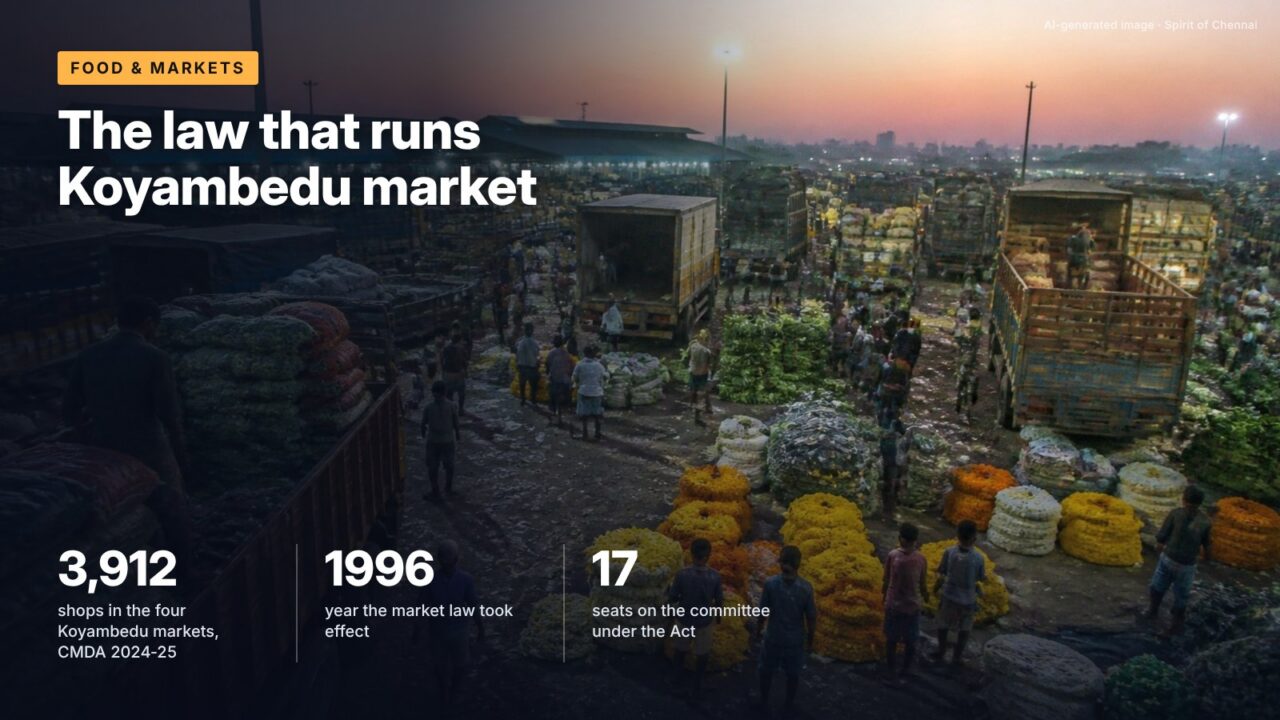
The Koyambedu Wholesale Market Complex has four markets with 3,912 shops between them: 1,956 for vegetables, 992 for fruit, 472 for flowers and 492 for food grains, according to the CMDA policy note for 2024-25. CMDA sold the shops outright to wholesale traders. What it kept was control of the ground in between: the roads, gates, drains, toilets, lights and security that make 3,900 shops work as one market.
That control sits with the Market Management Committee, a body created under the Tamil Nadu Specified Commodities Markets (Regulation of Location) Act, 1996 (Act 24 of 1996). The committee has run the complex since December 1996, according to its page on the CMDA website. Understanding the Act explains most of what traders and buyers experience at Koyambedu, from the entry fee at the gate to the licence on the shop wall.
A law written to move a market
The 1996 Act is a location law. It lets a local authority propose a “market area” for a commodity, invites objections, and then lets the government declare that area by notification. From a “notified date”, nobody may carry on wholesale trade in that commodity in the market area except under a licence issued under the Act (section 21). Wholesale here means buying or selling for anything other than the buyer’s own consumption; sales by primary producers and retail traders are excluded.
The Schedule names the commodities the law can be applied to: vegetables, fruits, flowers and other perishables; textiles; iron and steel; food grains; and iron scrap. That is why the same framework sits behind CMDA’s iron and steel market at Sathangadu, which the 2024-25 policy note says is being modernised at a cost of ₹33.35 crore. The Act applied to the Madras Metropolitan Planning Area at once and can be extended to other areas by notification.
Who sits on the committee
Section 8 of the Act fixes the committee’s make-up and section 9 adds a Chairman and Vice-Chairman nominated by the government. Counted from the Act, that is 17 seats. CMDA’s own page describes an 18-member committee headed by the Member Secretary of CMDA, and cites G.O.(Ms) No.136 of the Housing and Urban Development Department, dated 12 April 2007, as the order that last constituted it.
| Seat | Number | How filled |
|---|---|---|
| Chairman and Vice-Chairman | 2 | Nominated by government (s.9) |
| Licensed wholesale traders | 3 | Nominated by government |
| Recognised trade associations | 3 | Representatives |
| Non-officials | 2 | Nominated |
| Corporation Commissioner, CMDA Chief Planner, CMDA Chief Executive Officer | 3 | Ex officio (Chennai area) |
| Director of Agricultural Marketing or nominee | 1 | Ex officio |
| Officials | 2 | Nominated in consultation with the local authority |
| Chief Administrative Officer | 1 | Ex officio, appointed by government |
Source: Tamil Nadu Specified Commodities Markets (Regulation of Location) Act, 1996, sections 8 and 9; CMDA, Market Management Committee page
Members serve three-year terms and can be renominated (section 12). The first committee under the Act was to be formed without the trader and association seats. Seats set aside for traders and their associations number six of the 17; officials and government nominees hold the rest.
It’s often said Koyambedu market is run by the Greater Chennai Corporation.
The record shows The market is administered by its own statutory committee, chaired under CMDA. The Corporation Commissioner is one ex officio member. Under section 38 the “local authority” can inspect the committee and issue directions, and appeals against the committee’s own orders go to it, but day-to-day running is the committee’s job, as CMDA describes it.
Where the committee’s money comes from
Section 24 lets the committee levy fees through bylaws for stalls, shops, offices, godowns, licences, common services and vehicle entry. Everything it receives goes into a Market Committee Fund (section 32), which can be spent on maintaining markets, safety, standard weights and measures, collecting market information and repaying government loans (section 33). Staff are government servants; their salaries are paid first from the state’s Consolidated Fund and then repaid by the committee.
CMDA’s page lists the committee’s main service contracts, which show what the money buys. The entry-gate fee collection contract for 2013-14 was worth ₹6.73 crore. Solid waste was handled by a contractor at ₹871.50 a tonne under a contract running from February 2010 to February 2022. Security for 2013-14 cost ₹86.22 lakh, toilets ₹5.84 lakh a month, and electrical and street-light upkeep ₹24.61 lakh a year. These are the latest figures the page shows; it has not been updated with current contracts.
Perishable waste the market’s bio-methanation plant can take a day, producing about 5,000 units of electricity for the grid; it cost ₹5.5 crore, of which the Union renewable energy ministry paid ₹3.75 crore (CMDA).
Licences, appeals and the government’s reserve powers
A trader’s licence under section 21 lasts three years and is renewable. It can be refused to someone whose licence was cancelled in the previous three years, who has a conviction connected with the business, or who is a front (benamidar) for another person. Cancellation or suspension needs a hearing. Traders who were in business before the area was notified had to be registered first (section 20), and the committee had to provide them with alternative premises (section 22).
Appeals climb a ladder set out in section 45: an officer’s order goes to the committee, the committee’s order to the local authority, and the local authority’s to the government, which also has a general power of revision. If the committee is judged incompetent, persistently in default or financially at risk, the government can supersede it after a hearing and appoint a Special Officer for up to one year, extendable to a total of three (sections 41 and 42).
Two different counts of the same market
Official figures for the complex do not line up. The CMDA page on the complex says the Koyambedu Wholesale Market Complex spreads over 295 acres and that Phase I built 3,194 shops for perishables, of which 2,948 were allotted. The 2024-25 policy note gives the market an area of 86 acres and 3,912 shops including the food grain market. The larger acreage appears to describe the wider CMDA site, which also planned bus and truck terminals; the smaller one the market itself. Readers should treat both as CMDA’s own figures for different boundaries rather than as a contradiction resolved by either.
Koyambedu also sits outside the farm-marketing system most people assume it belongs to. Tamil Nadu’s regulated markets are governed by a separate 1987 Act and run by 27 market committees, and the Agricultural Marketing Department handbook lists no market committee or regulated market in Chennai district at all. The city’s biggest produce market is a planning and location measure, not an agricultural produce market committee.
What is being added now
The 2024-25 policy note lists finished works at the complex (boom barriers at vehicle entry, traffic signals, high-mast lights, modern urinals and a fountain in the flower market) and works in progress: 216 kW of solar plants, a control room watching 218 CCTV feeds with 200 more cameras planned for shopping areas, a dedicated committee website, a park on the open space reserve beside the flower market and a renovated clinic. The note gives no costs for these items.
What this means for you
- A licence from the Market Management Committee, not a Corporation trade licence alone, is what lets a wholesaler trade in the notified Koyambedu area.
- Disputes over registration or licences go first to the committee, then to the local authority and then to the government, in that order.
- The committee’s contact for administrative matters is its Chief Administrative Officer, listed on CMDA’s committee page.
- If you see an official figure for the market’s size, check whether it refers to the 86-acre market or the 295-acre complex before comparing.
What to watch
Pending
Commissioning of the 216 kW solar plants, the 218-camera control room and the committee’s own website, all listed as in progress in CMDA’s 2024-25 policy note.
Pending
A fresh constitution of the committee: members serve three-year terms, while CMDA’s page still cites the 2007 order as the last one.
Checked against official sources on 23 October 2026. Figures and rules change; confirm on the linked official pages before relying on them.
Sources
- Policy Note 2024-25, CMDA, Housing and Urban Development Department, Government of Tamil Nadu
- Market Management Committee, Koyambedu Wholesale Market Complex, CMDA
- Koyambedu Wholesale Market Complex, CMDA
- Tamil Nadu Specified Commodities Markets (Regulation of Location) Act, 1996 (Act 24 of 1996), copy hosted by PRS Legislative Research
- Handbook, Department of Agricultural Marketing and Agri Business, Government of Tamil Nadu