Tamil Nadu’s free and cheap electricity is not free to make. The bill is split three ways, between the state budget, the consumers who pay above cost, and the distribution company’s balance sheet, and the regulator’s paperwork shows how.
The numbers
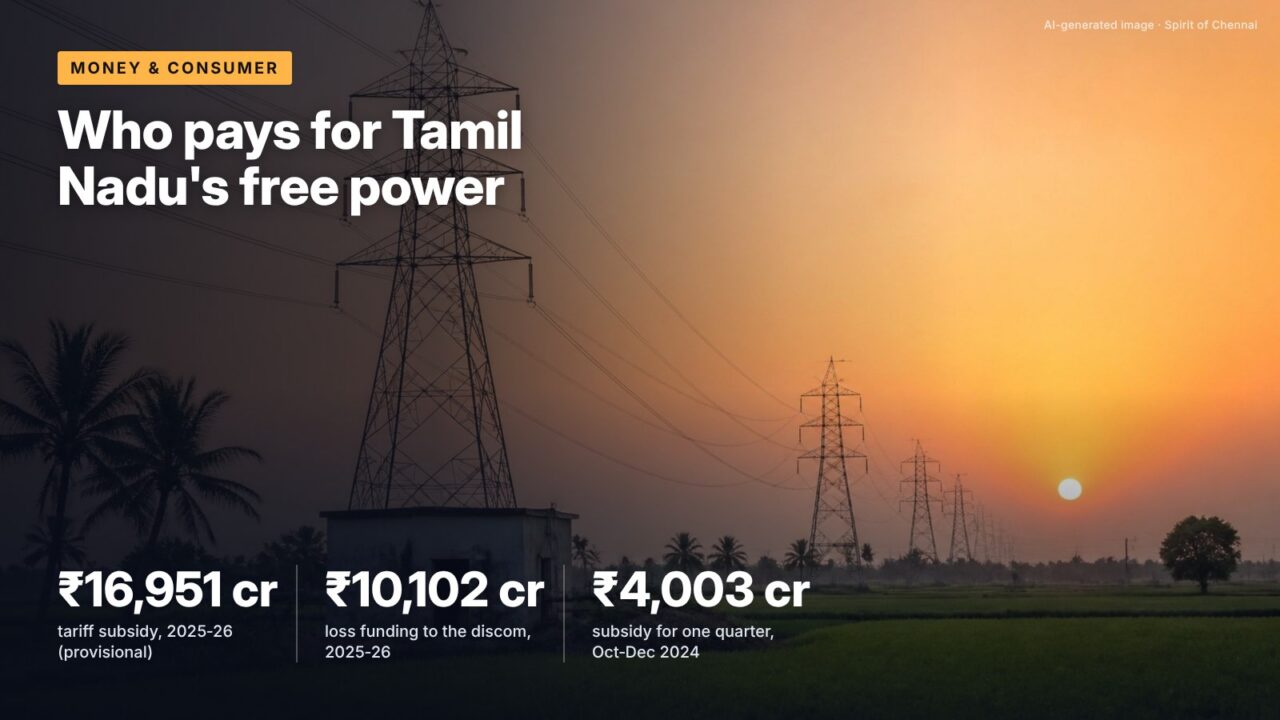
In 2025-26 the Tamil Nadu government budgeted ₹16,951 crore to pay the electricity distribution company for supply it had told the company to give away or sell below the regulated tariff, and a further ₹10,102 crore to fund the company’s losses, according to PRS Legislative Research’s analysis of the 2026-27 state budget. Both figures are provisional. Together they come to about ₹27,000 crore, larger than many entire departments.
That is only one of the ways the cost of supply is covered. Some consumers pay more than it costs to serve them, which keeps others’ bills down. What is left over shows up as accumulated loss and borrowing in the books of the state-owned utilities. This piece follows each of those channels using the regulator’s own orders and letters.
How the tariff is set
Retail electricity prices in Tamil Nadu are fixed by the Tamil Nadu Electricity Regulatory Commission (TNERC), not by the government or the utility. The current framework is a multi-year order: Tariff Order No. 7 of 2022, dated 9 September 2022, which determined generation and distribution tariffs for five years, FY 2022-23 to FY 2026-27. The utility files its expected costs, the Commission tests them in public hearings, and it approves what it considers a fair revenue requirement. Tariffs for each category are then set to recover that requirement.
The tariff the Commission approves is the full price. If the government wants a group to pay less, or nothing, it must make up the difference. The Electricity Act, 2003 (Section 65) lets a state subsidise any consumer category, but only if it pays the amount to the distribution company in advance; otherwise the Commission’s full tariff applies. That rule is why every subsidy announcement is followed by a TNERC order or letter fixing the amount.
What the state pays, category by category
The clearest public window into the subsidy is the Commission’s quarterly reconciliation. Its letter of 12 March 2025 to the Tamil Nadu Power Distribution Corporation (TNPDCL) compares the subsidy the government paid provisionally for October-December 2024 with what actual consumption justified.
| Category | Actual subsidy, Q3 2024-25 (₹ cr) | Adjustment |
|---|---|---|
| Domestic | 1,903.24 | ₹21.01 cr more payable |
| Agriculture (normal) | 1,473.26 | ₹25.38 cr excess |
| Agriculture (self-financing scheme) | 274.19 | ₹3.95 cr excess |
| Power looms | 136.67 | ₹7.68 cr excess |
| Huts | 90.30 | ₹0.49 cr excess |
| Time-of-day charges | 85.28 | ₹1.36 cr more payable |
| Lift irrigation | 15.11 | ₹1.73 cr excess |
| Common supply | 13.19 | ₹12.28 cr more payable |
| Places of worship, handloom, network charges | 11.43 | ₹1.01 cr more payable |
| Total | 4,002.67 | Net ₹3.57 cr excess |
Source: Tamil Nadu Electricity Regulatory Commission, subsidy reconciliation letter D.No.333/2025, 12 March 2025. Total and last-row sum calculated for this article from the letter’s category figures
Two readings follow. Domestic consumers took 47.5% of that quarter’s subsidy (₹1,903.24 crore of ₹4,002.67 crore), and farm pump sets, normal and self-financed together, took 43.7%. Free power is often discussed as a farm subsidy, but households are now the larger claimant. Second, the reconciliation is tight: the government overpaid by just ₹3.57 crore over the quarter, to be adjusted at year end. The same letter asks TNPDCL to fit meters to all hut services and time-of-day meters for one commercial category, a reminder that some subsidised supply is still estimated rather than measured.
Power subsidy for domestic consumers in the 2026-27 budget estimate, with ₹7,338 crore separately for farmers’ pump sets and ₹5,000 crore of loss funding for TNPDCL (PRS, Tamil Nadu Budget Analysis 2026-27).
Where the cross-subsidy comes in
The second channel never appears in the budget. Higher-tariff categories, typically commercial and industrial consumers, are charged above the average cost of supply, and the surplus offsets cheaper tariffs elsewhere. National policy tolerates this within limits: the Union power ministry told the Lok Sabha in March 2018 that the Tariff Policy asks commissions to bring tariffs within plus or minus 20% of the average cost of supply, through a gradual roadmap. It added that a state wishing to help a category may do so through direct benefit transfer, with the subsidy paid to the distribution company as the Act provides.
In practice this means a Guindy workshop or an OMR office pays part of the cost of a residential flat’s lower slabs. Cross-subsidy is cheaper for the treasury than a cash subsidy, but it makes industrial power dearer, which matters in a state that competes for manufacturing investment.
It’s often said free electricity is a cost the electricity board quietly absorbs.
The record shows The state is required to pay the subsidy in advance, and TNERC reconciles it every quarter against metered or assessed consumption, as its March 2025 letter shows. What the utility does absorb is the gap between total costs and total revenue, which is then funded by loss-funding grants and borrowing.
The losses that remain
The third channel is the balance sheet. PRS records the debt of the state’s power sector public sector undertakings at ₹2,47,130 crore as of 31 March 2026, or 7% of gross state domestic product, separate from the state’s own liabilities. The budget’s ₹10,102 crore of loss funding in 2025-26 and ₹5,000 crore in 2026-27 are the state paying down part of that gap.
The scale matters for the wider budget. The Comptroller and Auditor General’s State Finances Audit Report for 2024-25 found that interest and subsidies together took about 34.23% of the state’s revenue expenditure that year. PRS’s State of State Finances 2025 put Tamil Nadu’s total subsidies at 14% of revenue receipts in 2023-24, level with Rajasthan and Karnataka and below Punjab’s 21%.
Why the 2026-27 numbers look smaller
PRS notes that the energy sector allocation in the 2026-27 budget, ₹15,176 crore, is 49% lower than the 2025-26 revised estimate. Much of the difference is the shrinking loss-funding line rather than the tariff subsidy itself. A smaller grant does not by itself mean a smaller gap; if costs outrun tariffs and subsidy, the shortfall reappears as borrowing by TNPDCL, which the state guarantees. PRS puts outstanding state guarantees at ₹1,79,782 crore at the end of March 2026.
TNERC’s order list for 2025 also shows Order No. 3 of 2025, dated 26 March 2025, fixing the provisional tariff subsidy for FY 2025-26. Each year’s subsidy is set this way first, then trued up quarter by quarter.
What this means for you
- Your bill shows the tariff after subsidy. The difference between that and the full TNERC tariff is paid from the state budget in advance.
- Any change in free units or slab rates for homes has to be matched by a TNERC subsidy order; watch for one after any announcement.
- Shops and small businesses pay above cost partly to keep household tariffs low; that is the cross-subsidy, and it is regulated, not hidden.
- Utility losses are ultimately public debt. The ₹2.47 lakh crore power PSU debt is serviced through tariffs, subsidies or the budget.
What to watch
FY 2026-27
Final year of the five-year control period under Tariff Order No. 7 of 2022. A fresh tariff petition for the years from 2027-28 is due to come before TNERC; no hearing date has been published.
Quarterly, pending
TNERC’s reconciliation letters for 2025-26 and 2026-27, which will show how domestic subsidy has moved after the 2026 changes to household supply.
Checked against official sources on 23 October 2026. Figures and rules change; confirm on the linked official pages before relying on them.
Sources
- Tamil Nadu Budget Analysis 2026-27 (PRS Legislative Research, August 2026)
- Subsidy reconciliation for FY 2024-25, 3rd quarter, letter D.No.333/2025 dated 12.03.2025 (Tamil Nadu Electricity Regulatory Commission)
- Corrigendum No. 2 to Tariff Order No. 7 of 2022, FY 2022-23 to FY 2026-27 (Tamil Nadu Electricity Regulatory Commission, 2022)
- Tariff orders and subsidy orders list, 2025 (Tamil Nadu Electricity Regulatory Commission)
- Lok Sabha Unstarred Question No. 2208, Cross Subsidy of Tariffs, 08.03.2018 (Ministry of Power)
- State Finances Audit Report, Tamil Nadu, 2024-25: Executive Summary (Comptroller and Auditor General of India, 2026)
- State of State Finances 2025 (PRS Legislative Research, 2025)