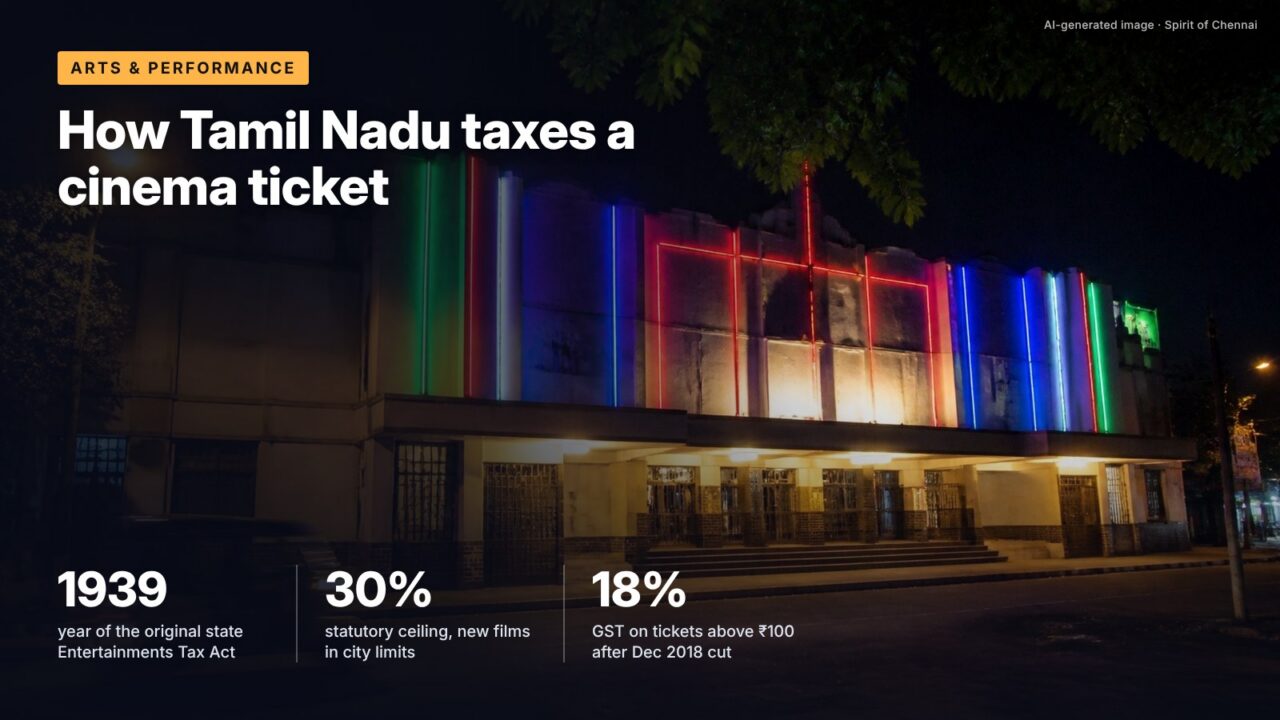
A Chennai cinema ticket carries GST and a separate local entertainments tax. How the 1939 Act gave way to GST and a 2017 local levy, and why the rate keeps being renegotiated.
The numbers
A cinema ticket in Chennai carries two separate taxes, set by two different governments. GST goes to the Centre and the state jointly. A local entertainments tax, charged under a 2017 state Act, goes to the corporation or municipality where the theatre stands. The second exists only because the Constitution (One Hundred and First Amendment) Act, 2016 kept a narrow slot for it: entertainment taxes “to the extent levied and collected by a Panchayat or a Municipality”.
Before July 2017 the state collected entertainments tax itself, under the Tamil Nadu Entertainments Tax Act of 1939. The way that older system worked, film by film, explains a lot about how Tamil cinema and the state still bargain over tax today.
The 1939 Act and the exemption system
Under the 1939 Act the Commercial Taxes Department collected the levy, and exemptions were granted one film at a time. The department’s archive of government orders still lists the pattern: seven orders between 20 and 31 December 2013, for films including Vallinam, Vizha and Madha Yaanai Koottam, each granting exemption “as per the recommendations of the Committee”. An exemption mattered because it let a producer price tickets competitively or keep the margin.
The 1939 Act was amended repeatedly around the edges. A 2010 amendment Bill shows one such fix: from 6 January 1993 theatre owners had been allowed to collect maintenance charges that were not to be taxed, but the 1995 amendment meant to give legal effect to this was never brought into force. The 2010 Bill made it retrospective to 1993.
GST and the 2017 local Act
When GST began on 1 July 2017 it absorbed state entertainment taxes. Tamil Nadu responded with the Tamil Nadu Local Authorities Entertainments Tax Act, 2017 (Act 20 of 2017, dated 28 June 2017), which hands the levy to local bodies. Section 3 says the tax is “levied and paid to the local authority concerned”. Proprietors file returns and pay; unpaid tax can be recovered as arrears of land revenue.
The cinema rates were rewritten within months. An ordinance of 26 September 2017, replaced by Act 5 of 2018, followed a high-level committee of secretaries and film industry representatives. It made the tax payable on the admission price excluding the tax itself, and barred inspectors from entering a theatre without prior permission from an authorised officer.
| Entertainment | Statutory rate under the 2017 Act |
|---|---|
| Cinema, new film (up to 10 years old), in corporations, special-grade municipalities and within 5 km | 30% of admission, excl. tax |
| Cinema, old film, same areas | 20% |
| Cinema, all films, other areas | 20% |
| Direct-to-home services | 30% of gross charges |
| IPL and similar tournaments | 25% of gross payment |
| Amusements / recreation parlours | 10% / 20% |
Source: Tamil Nadu Local Authorities Entertainments Tax Act, 2017, section 3, as amended by Act 5 of 2018 (India Code)
These are ceilings written into the Act. Section 11 lets the government exempt any entertainment or class of entertainments, or remit the tax wholly or partly, and the rate actually charged on cinema tickets has been set below the statutory figures by such orders. Those orders are not collected in a public online archive, so this article does not quote a current cinema rate; theatre-level rates are best confirmed with the local body.
Length of the entertainments tax exemption granted to a new amusement park project near Chennai by G.O. Ms. No. 133 of 21 October 2019, running to 31 October 2024.
Section 11 is used for investment too. The 2019 order exempted a new amusement park investment for five years, a sign that the levy is treated as an industrial-policy tool as well as a revenue line.
The GST side
GST on cinema admission was cut by the GST Council at its 31st meeting. A PIB release of 22 December 2018 recorded that tickets above ₹100 would move from 28 to 18 per cent and tickets up to ₹100 from 18 to 12 per cent. On a ₹150 ticket that is a difference of ₹15 in GST alone. The Council’s 2025 rate rationalisation revised many service rates again, and the current cinema slab should be checked against the latest CBIC rate notification. Live performances are treated differently: the Council’s services rate schedule exempts admission to classical and folk dance, theatre, concerts and similar shows where the charge is not more than ₹500 a person.
It’s often said GST abolished entertainment tax.
The record shows GST replaced the state’s own entertainment tax, but the 2016 constitutional amendment explicitly preserved entertainment taxes levied and collected by panchayats and municipalities. Tamil Nadu’s 2017 Act uses exactly that power.
Concerts and the December season
The local levy may now reach the auditorium. L.A. Bill No. 36 of 2024, introduced on 9 December 2024 by the Municipal Administration Minister, says the 2017 Act had no provision for concerts, dramas and shows held by institutions, including educational institutions, where admission is charged. It proposed a 10 per cent tax on each payment for admission to such events, and widened the definition of an institution to cover companies, societies and clubs. For Chennai, where sabhas sell tickets and season passes for the Margazhi music season, that is a significant change if it is in force; organisers should confirm its status and any notified rules with the Greater Chennai Corporation.
Why the rate keeps being renegotiated
The record shows a recurring pattern: a statutory rate set in law, then reduced or exempted by executive order after talks with the industry. The 1939 system did it film by film through a committee; the 2017 system set new ceilings within three months and still relies on section 11. That gives the state flexibility but makes the effective tax hard for the public to trace. Because the money goes to local bodies, it also means a concession granted in Chennai is revenue foregone by the corporation, not by the state treasury.
What this means for you
- The local entertainments tax on your ticket is revenue for Greater Chennai Corporation, not the state.
- Ticket prices shown online usually include both taxes; ask the theatre for a break-up if it is not printed.
- Sabha and event organisers should check whether the 2024 amendment on concerts has been notified before pricing season tickets.
- GST on dance, drama and concert tickets has been exempt where admission is ₹500 or less per person; check the current CBIC schedule.
What to watch
Pending
Whether the 2024 amendment taxing concerts and institutional shows is notified, and at what rate local bodies apply it.
Pending
Any fresh remission order under section 11 for cinema, which would change the effective local rate.
Checked against official sources on 23 October 2026. Figures and rules change; confirm on the linked official pages before relying on them.
Sources
- Tamil Nadu Local Authorities Entertainments Tax Act, 2017 (India Code)
- Tamil Nadu Local Authorities Entertainments Tax (Amendment) Bill, 2018 (PRS Legislative Research)
- L.A. Bill No. 36 of 2024 amending the 2017 Act (PRS Legislative Research)
- L.A. Bill No. 6 of 2010 amending the Tamil Nadu Entertainments Tax Act, 1939 (PRS Legislative Research)
- G.O.s and notifications archive, entertainment tax exemptions 2013 (Commercial Taxes Department, Tamil Nadu)
- G.O. Ms. No. 133, MAWS, 21 Oct 2019, Gazette Extraordinary No. 401 (Govt of Tamil Nadu)
- Decisions of the 31st GST Council meeting on GST rates for services, 22 Dec 2018 (PIB)
- Constitution (One Hundred and First Amendment) Act, 2016 (GST Council)
- GST rates for services schedule (GST Council)