Ten years of Tamil Nadu’s handloom policy notes trace two different stories. Handloom weaving is shrinking, in members, societies and households drawing free power. Powerloom weaving is holding steady and its cooperatives are growing.
The numbers
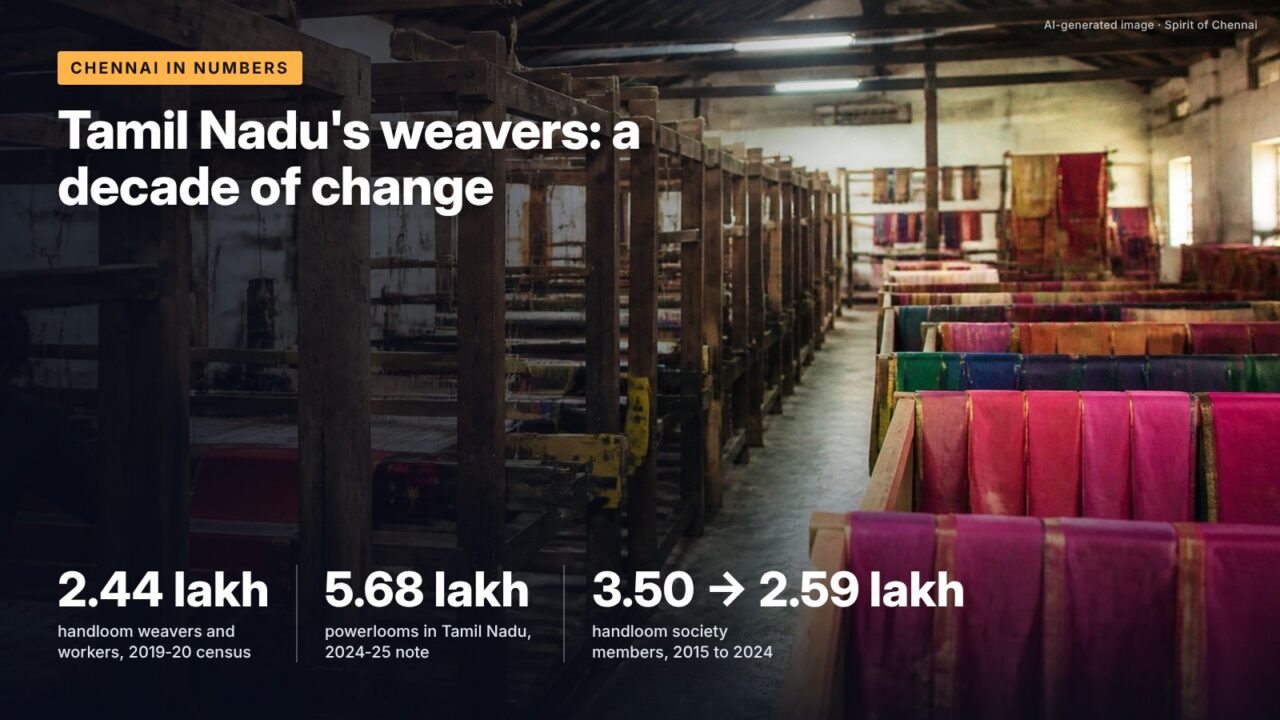
Tamil Nadu had 2.44 lakh handloom weavers and allied workers and 1.91 lakh handlooms in the 4th All India Handloom Census of 2019-20, according to the Handlooms department policy note for 2024-25. That is about 7% of India’s 35.22 lakh handloom workers and 8% of its 27.01 lakh looms. About 60% of the workforce are women.
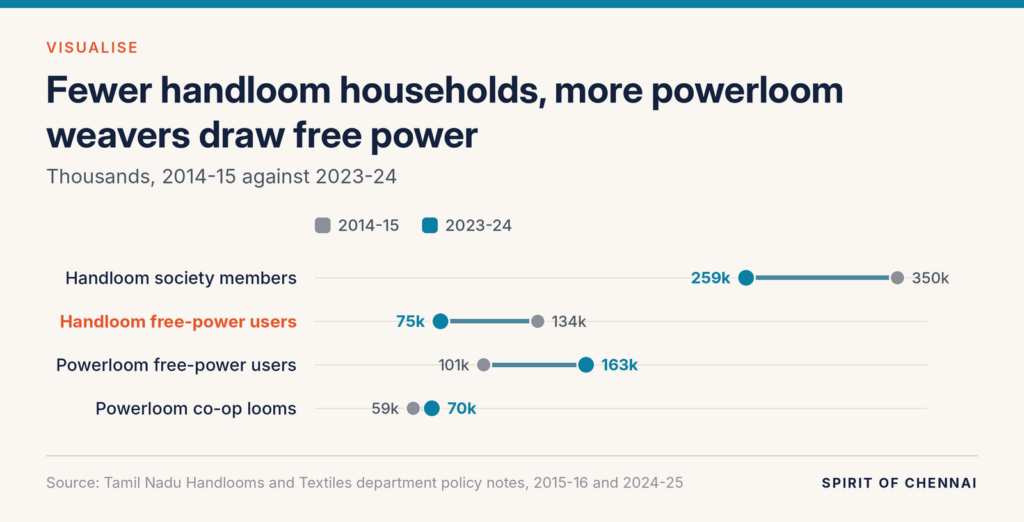
The trend is clearer in the cooperative records, which the department reports every year. Membership of handloom weavers’ cooperative societies fell from 3.50 lakh in the 2015-16 policy note to 2.59 lakh in 2024-25, and the number of societies from 1,163 to 1,114. Over the same years, powerloom weavers’ cooperatives grew from 188 societies running 59,058 looms to 237 societies with 70,288 looms.
The total number of powerlooms in the state barely moved, from 5.63 lakh to 5.68 lakh, with employment steady at about 10.2 lakh people. Powerlooms are now the backbone of state-sponsored cloth production, including the Pongal sarees and school uniforms.
A decade in the cooperative records
| Indicator | 2014-15 (note 2015-16) | 2020-21 (note 2021-22) | 2022-23 (note 2023-24) | 2023-24 (note 2024-25) |
|---|---|---|---|---|
| Handloom cooperative societies | 1,163 | 1,134 | 1,112 | 1,114 |
| Handloom society members | 3.50 lakh | Not given | Not given | 2.59 lakh |
| Handloom society sales, ₹ crore | 1,088.05 | 1,027.01 | 1,414.22 | 1,241.99 |
| Powerloom cooperative societies | 188 | 209 | 226 | 237 |
| Looms in powerloom cooperatives | 59,058 | 61,221 | 69,640 | 70,288 |
| Powerlooms in Tamil Nadu | 5.63 lakh | 5.63 lakh | 5.63 lakh | 5.68 lakh |
| Handloom free-power beneficiaries | 1,33,764 | 77,550 | 73,334 | 75,364 |
| Powerloom free-power beneficiaries | 1,01,410 | 1,42,227 | 1,65,028 | 1,62,799 |
Source: Tamil Nadu Handlooms and Textiles policy notes 2015-16, 2021-22, 2023-24 and 2024-25. Society counts in 2021-22 are as on 31 March 2021.
The free-power columns are the sharpest signal. Households drawing the handloom electricity allowance fell by 44% over the decade, from 1,33,764 to 75,364, even though the allowance itself rose from 100 to 300 units every two months. Powerloom beneficiaries rose 61%, from 1,01,410 to 1,62,799, as their allowance went from 500 to 1,000 units.
Fall in handloom households drawing free electricity between 2014-15 (1,33,764) and 2023-24 (75,364), from the Handlooms department policy notes of 2015-16 and 2024-25.
Two counts of handloom weavers
The headline number of handloom weavers depends on the source. The 2015-16 note gave 3.19 lakh weavers in 1.89 lakh households without citing a census. Since 2021 the notes use the 2019-20 handloom census figure of 2.44 lakh weavers and allied workers. The 2023-24 note counts 1.26 lakh of them inside the cooperative fold and the 2024-25 note 1.18 lakh. The two figures are not strictly comparable, but every series points the same way.
Welfare board rolls
Welfare board rolls show a similar fall. The 2015-16 note recorded 2,68,282 registered handloom weavers with the welfare board and 1,42,893 powerloom workers. The 2023-24 note gave 1,11,935 enrolled with the Handloom and Handloom Silk Weaving Workers’ Welfare Board as on 31 March 2022, and 89,000 with the Powerloom Weaving Workers’ Welfare Board as on 28 February 2023. Enrolment drives and renewals affect these rolls, so they measure registration as much as work.
What the cooperatives produce
Sales by handloom cooperatives went from ₹1,088.05 crore in 2014-15 to ₹1,241.99 crore in 2023-24, a nominal rise of about 14% over nine years. Production in 2023-24 was worth ₹1,091.93 crore. Powerloom cooperatives produced 1,931 lakh metres in 2023-24, worth ₹789.15 crore, most of it for state schemes. The 2023-24 note shows 1,228.05 lakh metres for the sarees and dhotis scheme and 413.07 lakh metres for uniforms in 2022-23, against 145.47 lakh metres for the open market.
Co-optex, the state’s handloom marketing society, sold ₹215 crore through 150 showrooms in 2023-24, up from ₹200.92 crore in 2022-23 and ₹171.90 crore in 2021-22. Old age pensions now reach 28,108 handloom weavers at ₹1,200 a month, up from 26,434 at ₹1,000 in 2022-23.
The work the state guarantees
State orders are what keep many looms running. The 2015-16 note said the sarees and dhotis scheme gave work to 11,000 handloom and 54,000 powerloom weavers, and the uniform scheme to about 10,000 handloom weavers and 53,000 powerloom workers. The 2021-22 note put the saree scheme at 14,000 handloom and 54,000 powerloom weavers. The 2024-25 note gives 2,664 handloom, 11,124 pedal loom and 41,983 powerloom weavers on the saree scheme, a different split that now separates pedal looms.
The department is also building infrastructure for the weavers who remain: the 2024-25 note lists 10 mini handloom parks at a total cost of ₹20 crore, a ₹74 crore silk park at Arani on 20.53 acres and a 75-acre handloom silk park at Kancheepuram costed at ₹82.56 crore. Weaver Mudra loans numbered 10,445, worth ₹59.27 crore, in 2023-24.
It’s often said Tamil Nadu’s handloom sector is growing on the back of state support.
The record shows Handloom society membership fell from 3.50 lakh to 2.59 lakh between the 2015-16 and 2024-25 policy notes, and households drawing handloom free power fell from 1,33,764 to 75,364. Powerloom cooperatives grew.
Chennai itself has few looms on these lists; its link to the sector is mainly as a market. The 2024-25 note budgets ₹227 crore for a Unity Mall in Chennai with 4.64 lakh sq ft of space, and the city’s Co-optex showrooms are part of the society’s network of 150.
The spinning side, overseen since 2021 by a separate Department of Textiles, has its own long decline in the cooperative sector: six cooperative spinning mills remain with 1,18,368 spindles, according to its performance budget.
What this means for you
- Handloom weavers outside a cooperative can still register with the welfare board through the Assistant Director of Handlooms for their area to access pensions and insurance.
- Buying from Co-optex or society outlets supports cooperative weavers directly; the state rebate scheme lowers prices in festival periods.
- When you see a weaver count, check whether it is the 2019-20 census figure or a department estimate; they differ.
- The annual policy note, tabled with the budget, is the best single source for these numbers.
What to watch
Pending
The 5th All India Handloom Census, which would update the 2019-20 count of 2.44 lakh weavers in Tamil Nadu.
Pending
The next Handlooms department policy note, which will show whether cooperative membership has kept falling.
Checked against official sources on 23 October 2026. Figures and rules change; confirm on the linked official pages before relying on them.
Sources
- Handlooms and Textiles Department Policy Note 2015-16 (Government of Tamil Nadu)
- Handlooms, Handicrafts, Textiles and Khadi Department Policy Note 2021-22 (Government of Tamil Nadu)
- Handlooms, Handicrafts, Textiles and Khadi Department Policy Note 2023-24 (Government of Tamil Nadu)
- Handlooms, Handicrafts, Textiles and Khadi Department Policy Note 2024-25 (Government of Tamil Nadu)
- Department of Textiles Performance Budget, Demand No. 17 (Government of Tamil Nadu, 2024)